
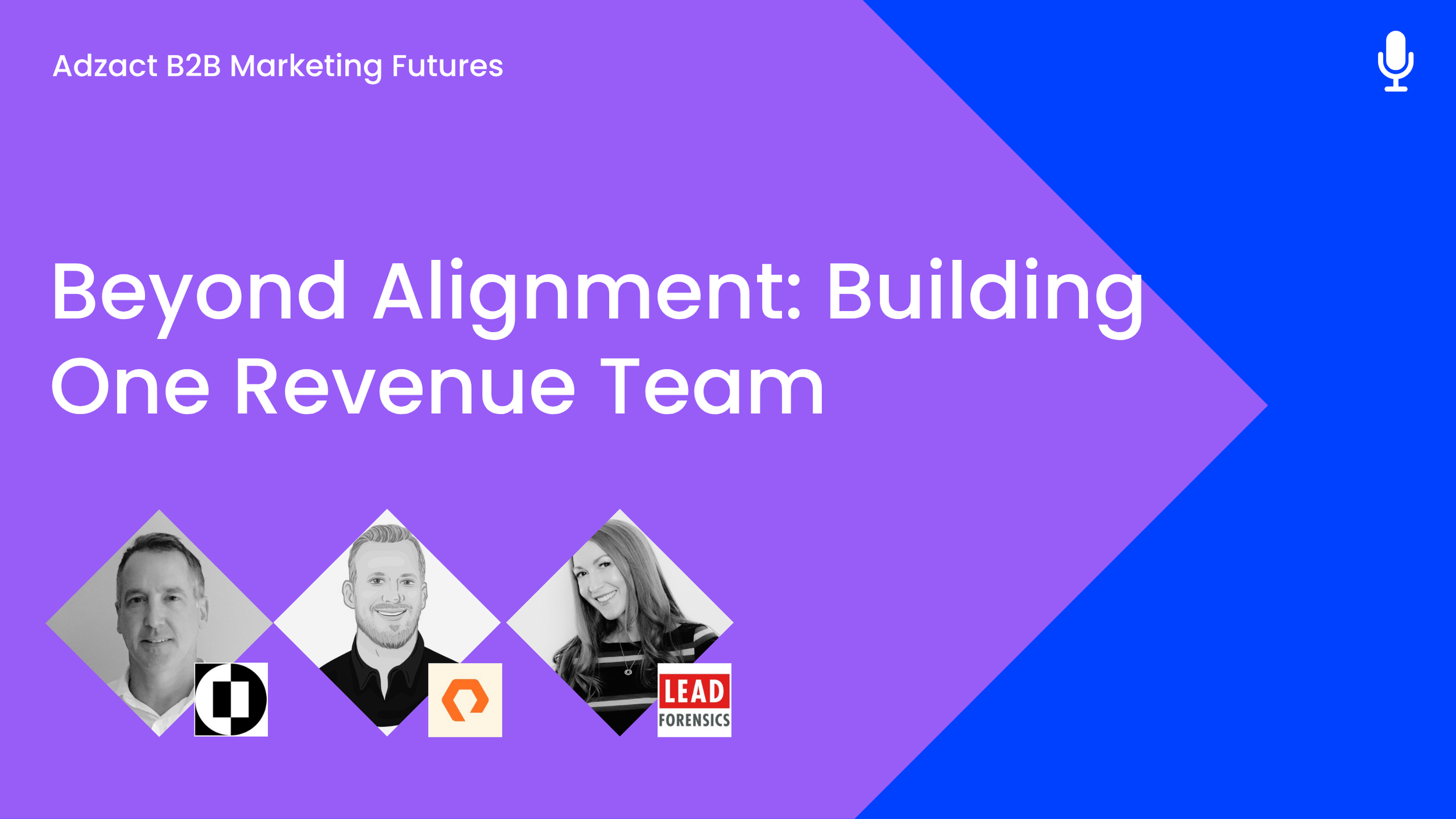
Beyond Alignment: Building One Revenue Team
Questions we will cover:
Where do you see the biggest breakdowns in sales and marketing alignment today?
We’ll open by examining the core pain points, ranging from misaligned definitions of leads, gaps in data hygiene, inconsistent routing, lack of visibility, and unclear expectations around follow-up and attribution.What frameworks, rituals, or processes have helped you build alignment in your teams?
Whether it’s your “white-glove” ABM rituals, pipeline reviews, monthly planning cycles, content co-creation, or data governance processes, this is an opportunity to share repeatable practices that have reshaped collaboration.How do you ensure that messaging, campaigns, and data strategies actually support sales outcomes?
Here we’ll explore the systems and methods you use: qualification models, CRM workflows, content loops, planning cadences, or cross-functional stakeholder engagement to keep programmes tied to commercial impact.If you could fix one thing about the sales and marketing relationship in your current or past roles, what would it be?
A chance to zoom out. What fundamental shift (structural, cultural, or operational) would unlock meaningful progress?
Guests
• Dick Dunkel, VP Revenue Enablement at Altana
• Greg Dziwulski, Sr. Integrated Marketing Manager at Everpure (formerly Pure Storage)
• Kirsty Dawe, CMO at Lead Forensics
Transcript
Joaquin Dominguez (00:00)
Welcome to another episode of B2B Marketing Futures, the podcast for B2B marketers sponsored by AdSac, the B2B demand automation platform. Today we are exploring a challenge that almost every organization talks about, but very few fully solve sales and marketing alignment. When these teams operate in sync, companies can create a powerful engine for growth.
But when they are misaligned, the result is often confusion around lead quality, friction around pipeline ownership, and campaigns that fail to translate into revenue. In this episode, we'll explore where the biggest breakdowns tend to happen between sales and marketing, the frameworks and processes that help teams collaborate more effectively, and what practically advice leaders can apply to improve alignment across their organizations.
But before we begin, I'd love for each of you to briefly introduce yourselves, share a bit about your background and yeah, so Greg, maybe would you like to start?
Greg Dziwulski (01:03)
Sure, thanks Joaquin. Pleasure to be here. My name is Greg Jowulski. I'm a Senior Integrated Marketing Manager at a leading storage and data management innovator at Everpure, we just rebranded. And I've spent the last 11 years in B2B tech marketing, bridging the gap between global strategy and field execution. So I've been in roles like I am now in integrated marketing fashion and then also been in field marketing and ABM roles as well. So pleasure to be here.
Joaquin Dominguez (01:29)
And every peer was formerly peer-stored, right? To the ones listening. Great. Great.
Greg Dziwulski (01:33)
That's right. right. Yes, thank you.
Joaquin Dominguez (01:35)
Yeah. Awesome. Thank you so much. Kirsty, welcome.
Kirsty Dawe (01:39)
Thank you, Joaquin. Yeah, I am Kirsty. I am CMO at Lead Forensics. We are a technology that empowers B2B organizations to get more value from their website visitor traffic by identifying those websites as to who don't convert. So obviously a subject that's close to a lot of our hearts from a marketing perspective and
I have been in B2B SaaS for a long time. I've worked and run agencies. And my primary goal now is really focused around, want to say driving, it's demand creation for our solution. I think we're moved away from driving demand. It's demand creation. And ultimately we wouldn't exist without sales. will say that. So supporting the sales teams with their goals.
Joaquin Dominguez (02:24)
awesome welcome thank you so much Kyrszy and Dick welcome
Dick Dunkel (02:28)
Thank you, Joaquin. Great to be with you all. My name is Dick Dunkle and I'm the Vice President of Revenue Enablement at Altana. Altana is a very exciting revolutionary technology platform that's importers, exporters, government agencies and logistics companies to really optimize global trade. So with all the challenges of tariffs and trade security,
we're helping companies to really manage that. So very exciting. And my background is really in mostly in sales. So I was an account executive and sales leader for many years and for the past 10 years have been in sales enablement. And so I tend to sort of represent the seller side of the equation in this, which is great to sort of counterbalance, I guess, with Kirsty and Greg. So very focused on sales execution.
and the collaboration that exists across the different teams from marketing to business development to sales, all the way through to customer success. And really think about that as a life cycle as successful customers generate success stories that ultimately feed back to marketing.
Joaquin Dominguez (03:34)
Awesome. Thank you so much for those great introductions. Let's start by grounding the conversation in the reality that many organizations face today. Despite the shared goal of revenue growth, sales and marketing teams often operate with different incentives, definitions of success and ways of working. From your experience, where do you see the biggest breakdowns between sales and marketing alignment today?
Kirsty Dawe (03:57)
I'll go on that one. I think for me, it's if they're not honestly, often they're not aligned on revenue together. They should have a shared revenue goal that they are working as a team to deliver. And if that is in place, then they have to work together to operate and deliver that most effectively. And if revenue
is at the heart of everything, not MQLs, not demos, not engagements, but how are we driving revenue together? Ultimately, as a team, they're going to get towards the right goal. And I think that's where the problem initiates is marketing don't have that revenue focus. It's less common today, but even talking back from being agency side, it's, I just need to deliver.
this many MQLs, this many SQLs, and my job is done. It's it's revenue. When you're aligned on revenue, everything becomes a lot easier.
Greg Dziwulski (04:54)
Yeah, I think curses spot on. think there's, obviously in marketing, a lot of times you're looking at the pipeline because the pipeline is what marketing can really influence the most. the revenue is a little obviously more downstream and those close one deals there. And so, you know, I think it becomes a factor of, okay, how do you, how do you make sure you're aligning your marketing success goals to the revenue?
right? And making sure that all those key metrics that we're looking at as measures for our success in marketing are ultimately like Kirsty's saying, helping achieve the bottom line with the revenue levels. Cause ultimately that's what matters for the company. Right? I think the other thing too, for me is a breakdown can be sometimes when we don't have the right content for the right audience in the right place. Right? And sometimes, you know, you know, sales is looking for things.
to be able to deliver to customers, customer facing the content in different parts of their buying journey. And when marketing isn't aware of that or doesn't have those gaps in the content for certain buying stages, really kind of, it slows down the sales cycle a little bit, right? And it's something that, we as marketers have to be a little bit more aware of and making sure we don't create that friction in the buyer's journey.
Kirsty Dawe (06:07)
Yeah, because it goes all the way. I think marketing's role goes all the way through, you know, right from, okay, there's MQL, there's SQL generation. But even when somebody is in pipeline, marketing have a responsibility to support sales, to nurture that prospect through to ultimately closed one. And I think if we're staying with them on the journey,
we will be aware of the things that are missing, like you said Greg.
Dick Dunkel (06:35)
You know, I think about it, maybe I'll think about it for a second from kind of like at the executive level, having a very, very strong and clear strategy, you know, a go to market strategy and, sort of ideal customer profile and really a targeted growth plan that I think
is a result of the insights that are generated from marketing and from sales that obviously feed into the executive strategy. But I think when you have that, then you can really get everybody rowing in the same direction in terms of like, what are we doing at corporate marketing? What are we doing in field marketing? What are we doing in business development? And then how are those translating into high quality? You guys mentioned marketing generated leads and sales qualified leads. We really try to pay attention to the quality.
of those leads because the higher quality leads, we see much better velocity on those opportunities and better conversion rates. So to me, I think the only thing I would add to what Greg and Kirsty said is kind of executive level strategy that's informed by the insights from the field and from marketing that ultimately help us to be really focused and coordinated.
Kirsty Dawe (07:38)
Yeah, I mean, you're almost you're working it backwards, aren't you? Because like the way I think about how we build our plan, obviously, we have a revenue goal, and we know what our ICP is. our ICP like we only generate opportunities with businesses, not just that are going to be able to buy, but also going to have like good lifetime value with us. So that goes right the way through to like customer success as well. But to your point,
Every single channel that we use has what we call a different RPD, like a return per demo. And that makes up the revenue goal. So if we say, yeah, yeah, we're going to deliver it, one channel could mean we have to deliver a thousand demos to get that result. Another channel could mean a hundred. So we're like, where can we get more of those ones that we only need a hundred to get the demo? Like, let's focus our energies on that because that maximizes everyone's time.
And because we have all of that detail, that then adds up to, right, this is the end number that we're going to get to. So yeah, all of that detail is incredibly important.
Greg Dziwulski (08:42)
Yeah, Kirsty and Dick, you guys are both speaking to a challenge that I have in my current job, right? It's an integrated marketing manager. You're like in that quarterback position, right? Where you're looking across all channels, all marketing channels, right? And how do we pull the different levers to get what we need ultimately for the business? And, you know, my other stakeholder is my sales team, my business, the solution that I support, right? Like they have a certain target that they're looking to get after.
And sometimes those goals that we have in the marketing campaign don't exactly align to the sales goals. So it's like, how do I make sure that, you know, we're achieving what we're, we set out to with the agreed upon goals with the CMO and our marketing leadership, but also make sure that we're supporting that business and trying to figure out where those connection points are. And also getting the feedback from both the marketing sides and the sales sides to make decisions on how we start investing in our.
time, effort, money, right?
Dick Dunkel (09:36)
I totally relate to that because, you know, and I think it's important for people to know that, well, at least in my case, like I'm speaking from the perspective of really a small company. Like we're a fairly early stage company. You know, we have about 30 salespeople, know, small marketing team, but, you know, small sales operations team.
but we really are putting a very, very concerted effort into, think, Greg, what you described, which is really sort of trying to understand as we look at our pipeline and we look at the health of that pipeline, what is the origin? What is the journey that those prospects or those customers went on to get to where they are? And where should we be investing more in terms of marketing dollars and business development and pipeline generation activities?
So that's something we're working on right now. guessing that there are larger companies that are probably doing a really good job of that. But it's a critical function to make sure that you're maximizing the return on your marketing dollars.
Kirsty Dawe (10:29)
Thank
Greg Dziwulski (10:30)
Yeah,
and I won't rat hole us on this topic, you know, there's the whole, there's so many different attribution models, right? To pipeline and revenue. And so from a marketing perspective that you've had last touch, there's multi-touch people use chain base models. There's just, there's so many ways of things. There's like, pre opportunity marketing and influence. There's post opportunity marketing influence. So it's like just trying to figure out what the agree. And I think we're heading back to what we're originally talking about, which is those.
agreeing on some metrics that both the marketing and sales side can say this is how we're going to measure success together.
Kirsty Dawe (11:03)
Yeah. I think attribution is a really important point though, because like a lot of organizations will say it's either it's a demo that's come from marketing or it's come from sales. The reality is it probably hasn't come from either. It's just that the last touch was in some cases marketing and in some cases sales. And we are working towards
and what we're calling an all-bounds model. So away from this was inbound or this was outbound to actually it was created by both of us and what are all the touch points along the way? Like we are not there. Like that is one of my major goals for this year to have probably a linear attribution model in place where all the timestamp maybe where we put the first touch gets more waiting and the last touch gets more waiting but there's all these other things in between and
The reason why that's important is because we have so many activities going on and a lot of them just drive prospects straight to the website. And then it's like, okay, well, that just came from the website marketing did that. It's not true. Sales probably did something. They sent them a piece of content or a LinkedIn campaign.
like
got them there because they engaged with that or they received an email from us. So we're trying to get that huge, huge chunk of opportunities that are created into the correct baskets to know, where can we, where should we be spending more to get more of those? So I think attribution is absolutely key, but it becomes a joint sales and marketing.
Greg Dziwulski (12:35)
Absolutely.
Joaquin Dominguez (12:35)
Yeah, let's talk about the structures or the frameworks that help bring sales and marketing on the same page Attribution could be one, but Dig, you've had a huge impact on the sales world through the Medic framework Could you briefly tell us its history and explain how it helps create a shared language among teams when
Dick Dunkel (12:58)
Sure.
Joaquin Dominguez (12:58)
qualifying opportunities?
Dick Dunkel (13:00)
Sure, yeah. So just some quick background. Actually, it's interesting. Here we are. It's the spring of 2026, and the original acronym MEDIC turns 30 years old this spring. So 30 years ago, I was living in a small rented house in Needham, Massachusetts, working for a company called Parametric Technology Corporation. And at the time, I was responsible for developing an intermediate sales training class.
PTC, it's important to note that PTC, even in 1996, was a very, very innovative and revolutionary technology company. so the things that, in order for us to be able to successfully sell pro-engineer, our innovative design through manufacturing technology, you know, was actually a very complex and a very competitive and a very political sale.
And so, some basic, people maybe have heard some basic sales qualification frameworks like Bant. Bant is great if you're selling a commodity, but if you're selling a very complex product into a political environment, you need a little bit more, you need some more data points. And so, we learned that the things that we had to have in order for us to be successful in that selling environment is, we had to have a champion.
We had to have somebody that was selling for us internally. We had to clearly identify pain and that pain had to be aligned with the senior executive that was going to be sponsoring and had access to discretionary spending. We had to influence the decision criteria and negotiate a process. And through that process, we had to capture metrics that we would use to justify the investment. So there you go. Those are basically the six elements of the original acronym MEDIC.
And people have sort of fiddled with it a little bit since then. And a lot of people use MedPic today. But I've used it since 1996. I returned to the field and sales and sales management positions. But Joaquin, to answer your question, we really think of it as a common framework that ultimately provides a framework of customer value. What does the customer need?
What value can we provide? Who are the people that can drive that change inside of the organization? And ultimately, the idea is that if you use this as a common language from marketing, marketing can really think about, OK, well, what are the kinds of metrics that we can generate for this target audience? And who do we think could be the potential champions of this kind of solution? And ultimately, who are the executives?
that have ultimate authority over that. Those are important questions that I think marketing needs to understand. And then that ultimately feeds into our sales process. And then that leads then into a transition into how we deliver and implementation and customer success. So one of the things that we're really trying to adopt at Altana is really that MedPic is a common language that we can use.
across all of these teams, you because that's one of the issues I think, I think maybe Kirsten, you said in the very beginning is that, you know, things break when you have sort of teams that aren't effectively communicating,
Kirsty Dawe (15:49)
Yeah.
Dick Dunkel (15:50)
right? And one of the challenges of communication is, one of the most basic elements of communication is like common language. are we using the same terms? when I say champion, do know what that means? when I say decision
Joaquin Dominguez (16:02)
then.
Dick Dunkel (16:02)
criteria, do you know what that means? so having a, having a universal common understanding of what do these things mean
And what do they mean for our company? And what do they mean for our prospects and our customers? So now we are sort of building that framework that extends us from customer awareness, you know, and our strategy on the marketing end to how we initially qualify, to how we execute the sales process, to ultimately how we deliver and hand over to implementation and customer success. You know, I almost think of it as one of the things that we do during the sales cycle is we're actually building
customer success story before we actually get to delivery, right? So it's like, you know, with the customer saying, okay, you know, what does success look like for
Joaquin Dominguez (16:39)
Yeah.
Dick Dunkel (16:42)
you? And what are the goals and what's the return on investment that you would hope to achieve? And if we do a really good job of sort of building that story during the sales cycle, then we're really setting our implementation and success teams up for success. And then we get into the good post-sale motion of QBRs and continued executive alignment. And it really creates an environment
where we can ultimately agree, we're winning, we're succeeding together. And that creates a great environment for growth and expansion.
Joaquin Dominguez (17:08)
It's all about customer centricity and understanding your customers' challenges and having that common language around their pain points. That's really interesting. Thank you so much,
for sharing that. I think Greg, you mentioned before that...
your team maps marketing campaigns to a structure by your journey. And I think that connects very well with what Dick was explaining. If you understand your customers by your journey, you can put your campaigns that hopefully will talk to the pain points at the buyer journey that they are.
Greg Dziwulski (17:44)
Absolutely. and you know, there's everyone's familiar with the funnel model, right? You got your top of funnel, that'll funnel bottom funnel. But I think nowadays there's just so much more complexity to a lot of these sales cycles, especially in B2B tech. you know, I think one, one thing our, our organization is doing at Everperiod, we're adopting a seven stage Gartner model that really like, identifies the, the jobs to be done, the questions that are being answered, you're being asked.
that need to be answered and, ultimately like what they're feeling in that stage and what content we need to then either deliver or create, you know, to help serve that, the needs within each of those seven buying stages. I think, as I've been developing that for my current campaign, it's really important, to figure out where we have those gaps to really understand, where the pain points are, for the buyer in each of those stages and make sure that.
We're speaking to those. Like, so every time we're developing a piece of content, we're saying, okay, are we answering these questions that we put in this buyer's journey framework? we, are we satisfying the concerns or the feelings that they're having during that? You know, are we writing in a tone that kind of, you know, speaks to that for them? And then also what type of content are we, are we delivering? Right? Like it's.
Different stage of content might require something a little bit more brief like an infographic or some one-page executive brief or something Whereas a little bit further down. Maybe you're looking for some more technical white paper type materials, right? So it's just really trying to figure out how do we answer the question the best? How do we get the? help them do the jobs that they need to do within each of those buying stages and I just anecdotally have to go back to
Dick talking about a medic because I, you my, my, my previous company in a fortune 500 company and they were instituting medic, towards the end of my, my tenure there. And, it's, it's really awesome to be, you know, and I saw a Dick is, uh, joining this podcast as the biological father of medic. was like, this is really cool because I mean, it's really interesting to see how
something that has been around that long is still seen as extremely important in the sales organization. And I think there is a point of, man, we could be leveraging this a lot better in marketing that I don't see us using today. Like if we have the right, if sales and marketing are using the right tools, which I think is extremely important, right? if we're using the right, the same CRM and we're able to access the same information.
we can see what sales is inputting from a medic standpoint and make sure if we're account-based marketing or we're doing stuff in the field that we can deliver a more personalized experience based on what those accounts need or what they're going through. Right now, I don't see the marketing leveraging medic.
as much as we could be, And I think that's a really interesting thing to consider going forward is how do we take those elements that sales has given us, those great nuggets of information and turn them into great experiences that marketing is delivering for our prospects and customers.
Dick Dunkel (20:53)
Yeah, it's a great perspective. If you don't mind, I could share maybe a little anecdote just from some things that we're doing today. One of the things that we've done is we have developed kind of a scoring a scoring framework with MedPic. And so the idea is that, it's a simple framework on a scale of zero to three. Zero is you don't know. One is the thing has been identified. Two is that it's been aligned. And three is that it's been validated, through a POV or
And then you can actually extend that even to post-sale. Four, it's being implemented. Five, value has been realized. But we use that scoring framework and we've actually mapped the MedPix scores to the sale stages. And what that's doing is it's providing us with insights into where we're executing well and where we're not executing as well. And one example of this is through this process, we actually learned that we were not really securing executive alignment.
at the level that we needed to at the midpoint of our sales cycle that would basically be where we would gain sponsorship for moving forward with like a POV or POC. And we sort of worked backwards and we realized that one of the issues that we had was that we were not really executing as well as we should during our scoping process, discovery and scoping.
And so that's actually an area where we're focusing right now is how do we execute better in this area? And so we're really partnering with marketing, product marketing to really develop kind of, and our pre-sales team. So it's really a cross-functional team that's really come together to say, okay, if we execute better during our initial qualification and discovery and scoping, then that's going to result in stronger champions, which is going to lead to better executive alignment, which is going to result in better conversion rates.
all the way through to closed. so to me, that's just an example of how, and we're using AI to actually automate the creation of these MedPick scores. Ultimately, the account executive owns the score, but they're getting help in terms of some automation there. So to me, think that's, I think as a way to sort of encapsulate, Greg, I think what you described, I think you described it beautifully. To me, that's just a kind of a real world example of how we're putting some of those ideas into action.
Kirsty Dawe (22:58)
I think I was going to ask about the
Greg Dziwulski (22:59)
That's great. Thanks.
Kirsty Dawe (23:00)
question that the SD or the role that the SDR plays in terms of bridging the gap between marketing and sales, because obviously our sales resources are best resource. We don't really want them in front of opportunities or customers that haven't reached the right criteria. like the SDR obviously is probably a key part of finding all of those criteria out. Do we have?
a champion, what is the key problem statement that organization has so that then when sales go in, they're prepped and also they're confident, I can sell this because they've got all of that insight. And I think previously that might have, and in some organizations still doesn't exist. It's like from marketing straight into sales. And I think that causes a problem. need that middle function. And whether it's an SDR or some level of qualification, like we have.
accepted job titles and criteria and all the things that we have to meet before an SQL is accepted. There's always things we can do better. But I know that anything that goes through an SDR is much more likely to convert than if it's straight through to sales.
Dick Dunkel (24:10)
Yeah, I think I would agree with that. we went through a process where we were really trying to simplify and productize our offering because we have a very sophisticated product. We're trying to make it simpler to understand for customers. And so we broke it down into nine very, very clear use cases that customers can use for trade compliance and resilience. And that was really developed in partnership with sales insights from customers, as well as marketing research really came up.
work together to develop that. And now that's being fed into the BDR program. So the BDRs now have clear insight into that. And they can really ask great initial questions about those nine core use cases to really do an initial assessment as to how well we line up with what the customer is looking for. So yeah, I fully agree, that that's a very valuable function.
Greg Dziwulski (25:00)
I think, Kirtzy, you're hitting something that's really near and dear to marketers' hearts is like, you do all this effort, right? And to drive leads and to drive engagement with existing leads and contacts. it's like, then where does it go? And most of the time, the answer is the SDR, right? And so, or BDR, use BDM. I've heard tons of different acronyms used across different companies, but that function is extremely crucial.
You know, I think it's a really an important glue to this whole marketing sales alignment. I, I've seen these, I've seen this type of role sit both in marketing and in sales organizations. not to say there's one right or wrong answer to that, but I think the most important is that they're getting enabled by marketing on what's coming in bound. Right. And also they're being provided some great resources from marketing about to do some outbound.
efforts as well. But then on the backside, it's how do we hand these off to sales? When do we hand these off to sales? we making sure that we're asking the right questions so we don't get shut down too early? And we open that door to have the meeting because ultimately a lot of these SDRs, their goal is to just get a meeting set with the sales rep, right? So get just enough information and interest to get that meeting set.
a great point. It's a huge important, you know, glue to the sales and marketing.
Kirsty Dawe (26:24)
I was just going to add while you were talking earlier, Greg, I was thinking you were talking about all the content and collateral that needs to be created along the whole journey. And we've looked at that, but also by segment now, because our ICP has broken down into, for us, its thermographic segments. But we cannot get that information and that good quality insight for our messaging without sales.
like sales are the ones that gave it to us, cause they're talking to the customers every day. And I think that marketing has to be aware of that. Like we cannot create the best possible messaging for our prospects without sitting down with sales and asking them what are they saying? What are the challenges? What are the issues? What's important at this point of the journey versus and by segment.
that's where we got much better traction because we did sit down with sales. We didn't think we knew it. We don't know it. They know way better than us because they're talking to them all the time. that's a really great way to get aligned.
Greg Dziwulski (27:19)
100 %
Joaquin Dominguez (27:20)
Yeah, many times we've seen that it is very basic, like sales and marketing teams, they are working from very different definitions of what a good account actually is. Marketing might be targeting based on industry, company size, engagement, intent, and sales could be judging opportunities based on much deeper, more qualitative criteria.
What we try to do at Atzact is to bridge that gap by redefining how companies are evaluated in the first place. So instead of relying purely on firmographics or intent data, we analyze how companies actually behave. For example, we can identify companies that invest heavily in their people by looking at how they describe employee benefits in job postings or companies that
can take brand and storytelling seriously because they use very like hyperdactions on their videos, on their careers page, or even companies that generally prioritize sustainability and not just target and do greenwashing. So these are all things that today you can measure and you can see with AI, you can detect them at scale by analyzing how companies present
themselves publicly. And when you combine those hundreds of signals, you start to get a much more clear picture of which companies are truly a good fit. And from there, everything starts and everything becomes much simpler, right? Because marketing focuses their effort on the right accounts from the start and sales spends time with companies that already look like their best customers. So
At that time alignment becomes much less about processes and much more a natural outcome of both teams working on the same understanding of the market. with that in mind, I love to bring it back to all for a final thought. And I would love to hear like one final piece of advice that you would like to give to our audience.
really struggling to get sales and marketing alignment correctly.
Greg Dziwulski (29:34)
I think, just taking up to maybe, I guess, a meta layer of everything we're discussing. It's like you have to have a good flow of information. this is a cycle of information that needs to flow from, from how we target to who we're bringing in. to your point, Joaquin, are we
using the right qualification questions, And then when sales either closes one or closes even lost the deal, flowing that information back to marketing and redefining the targeting and honing that targeting so we can continue to get better and get that. So when that flow of information between marketing to the SDR team or whoever's following up on inbound leads and to through the sales cycle and then back to marketing and you're using the same tools and you're using the same
same language and how you speak about things. Again, whether you're using, a prop, whether using a framework like medic or whether you're using, it's just important that we're speaking the same language that we have similar metrics and that that information is flowing across all the different stages. And then it doesn't end when the customer either buys or doesn't buy that we're flowing that back into how we're doing marketing at the beginning and how we're doing outreach.
and who we're targeting and what to target them.
Dick Dunkel (30:51)
I'll jump in. I've got a thought here, which is sort of something that's top of mind with something that we're really focused on right now at Altana. And so the idea is like beginning at the end. And when we really look at the end, we really are really trying to understand like who are our most successful customers? Why are they successful? Why do they love us?
And by the way, who loves us? It's interesting, when you sell a complex solution, sometimes the people who are your champions during the sales cycle, sometimes those people change in delivery, that there's different people. And so ultimately understanding who are the people that are really winning with us and understanding and really profiling.
the success of those customers and maybe, Joaquin, back to your earlier point of sort of what are the characteristics and qualities of that organization that we want to try to replicate. And so to me, think making sure that you don't miss out on really tapping into that valuable source of information that can really inform your business strategy, your marketing strategy and how you win.
Kirsty Dawe (31:55)
Yeah, I'm going to I'm just going to reinforce exactly what you said, because it's for us, what made the big difference was just nailing our ICP. But it did start it was definitely like an entire revenue optimization focus, because we started at we're a SaaS business, where are we getting our best retention? What are the characteristics of the customers that love us? And the ones that are most value to us long term? And then
it just flowed from, okay, so how do I identify more of those markets more of those win demos with more of those and even to the point now where we're building our product for more of those. And that helps us with our marketing because the messaging that we're creating is designed specifically for that audience. But we know we get better conversions, higher order values, longer attention, but it's a very strict ICP. Like we have so many
leads that come into marketing every day that we never pass through to sales because they just don't meet the criteria. But that's going to help us with our long term revenue goals. So if there's a team, you're all bought into it. And it's great for marketing to be able to go, well, of course, I want to give you more of those because that drives more revenue overall to the business. If everyone's bought in, then it becomes much easier. And it becomes much easier to I think, initially, it's like it's hard to say no, they want to buy it. But
they're never going to stay with us, they're going to chat. And then it becomes easier, much easier to say no and yes to the right opportunities.
Joaquin Dominguez (33:29)
Well, thank you all for those great insights, honestly. Thank you. Thank you so much. We know that sales and marketing alignment is like super strategic. It is a priority, but as we heard today, achieving it requires a lot of effort, frameworks, shared definitions, strong collaboration across teams. And to our listeners, thank you so much for joining us.
today. If you enjoyed this episode, please be sure to subscribe and share the episode with colleagues who are working to bridge the gap between sales and marketing. Thank you. Thank you so much and until next time.
Kirsty Dawe (34:07)
Thank you.
Dick Dunkel (34:08)
Thank you.
Greg Dziwulski (34:09)
Thanks,
it was a pleasure.