
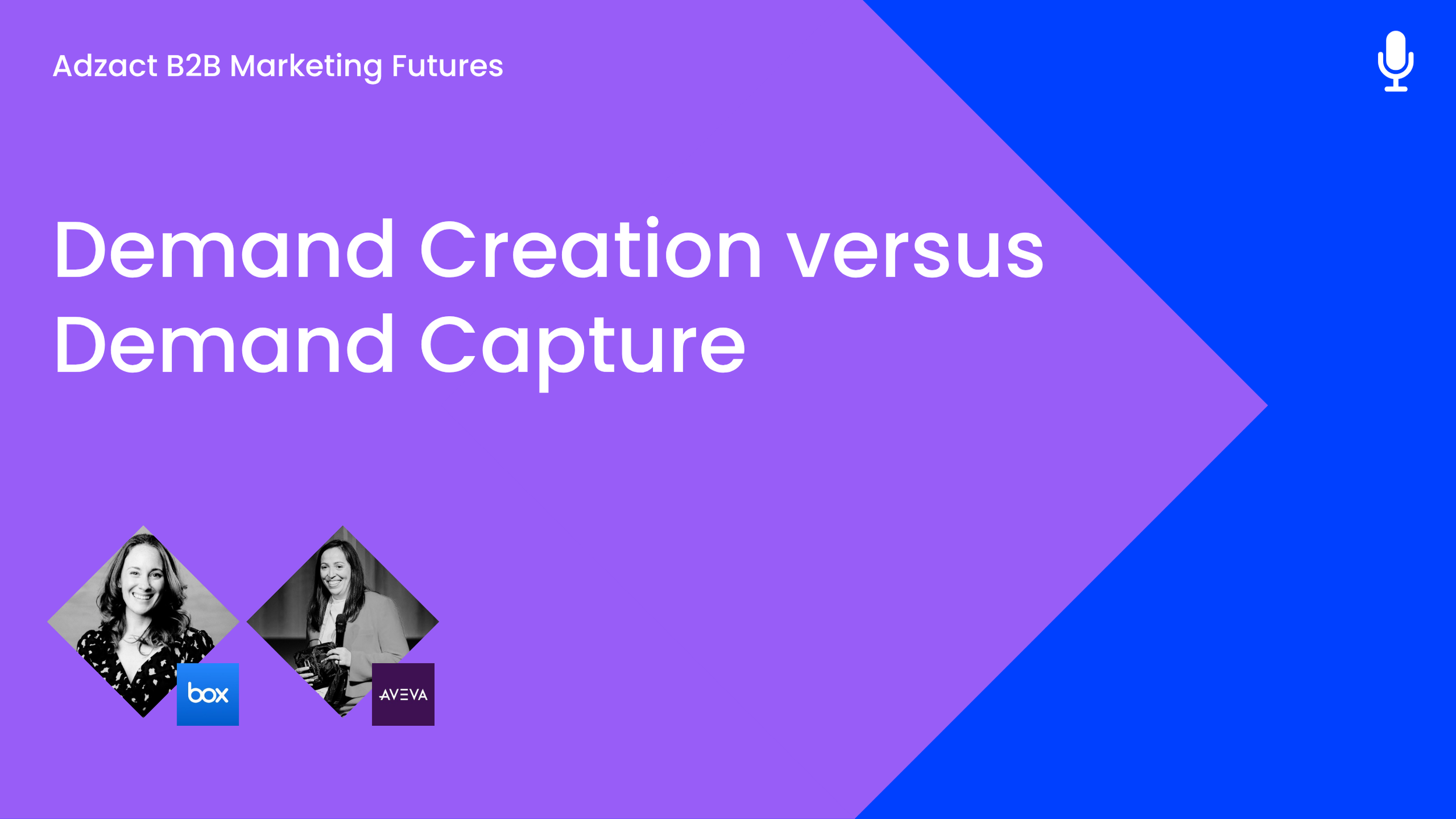
Demand Creation versus Demand Capture
Questions we will cover:
1) Where do you focus your marketing efforts today, on creating demand or capturing it?
We will open with a quick pulse check. Do you lean toward a 50/50 split, 60/40, or do you reject the split altogether?
2) What strategies have worked best for you in building long-term brand awareness and engagement?
This is a chance to share top-of-funnel tactics, brand-led initiatives, and creative bets that helped shape awareness or differentiation.
3) What strategies have worked best for you in capturing demand?
From paid search to content, sales enablement or retargeting, what has helped you turn interest into pipeline?
4) What does the right balance between demand creation and demand capture look like for your organisation?
Has that balance changed as you have scaled? Does it vary by region, segment, deal size, or maturity?
5) How do you connect long-term brand initiatives with pipeline and revenue goals?
We will close by discussing how you link brand-led work to performance metrics and business outcomes.
Guests
• Kathryn Thomas, Director EMEA Marketing at Box
• Laura Troncoso, Senior Manager Events Demand Generation at AVEVA
Transcript
Joaquin Dominguez (00:00)
Welcome to another episode of B2B Marketing Futures, the podcast for B2B marketers sponsored by ATSAC, the B2B demand automation platform. Today we are diving into demand creation versus demand capture and why getting that balance right is critical for building pipeline today while shaping demand for tomorrow. As marketing teams face increasing pressure to deliver pipeline while also building long-term brand equity,
And as AI and machine learning begin to automate more of how campaigns are targeted, optimized, and distributed across channels like Instagram, Reddit, and Connected TV, the balance between these two approaches has never been more critical. In this episode, we'll explore how our panelists think about that balance, what's actually working in practice, and how teams can connect long-term demand creation with measurable
pipeline outcomes. But before we jump in, I'd love for our guests to introduce themselves and share a bit about their background and their current focus. So Catherine, maybe would you like to start?
Kathryn Thomas (01:05)
Sure, happy to. So I am Catherine Thomas from Box. And at Box, I lead the marketing team. Box itself is the intelligent content management company for secure collaboration and automated workflows. And our job really is to connect our content to your enterprise content to AI. That is our mission in life and our purpose.
And yeah, it's a pleasure to be here today.
Joaquin Dominguez (01:31)
Thank you so much.
Laura (01:32)
Okay, thank you so much, Faki. Super happy to be here. And Laura Troncoso, I lead our demand generation intelligence team within our global events at Aviva. If you haven't heard of Aviva, it's not the insurance company, it's leader in industrial intelligence software company. So we basically create and capture data
AI-infused applications controls and advisors to drive real-world action. That's what we do. It's quite interesting because we get to see how companies are shaping their industrial intelligence with the software and how they are pioneering. We're looking at really interesting stories. We have our Aviva Award coming up in Milano from the 19th to the 21st.
in May. So if you're interested of how industries are using technology and data and how they're pioneering, we're going to have more than 13 industries there. So I hope to see you there if you wanted to see how they're doing it.
Joaquin Dominguez (02:38)
And that's a small event, right? Like 20 people in the event?
Laura (02:43)
Now we have more than 4,000 attendees at this event. More than 13 industries coming. It is a global audience. So we're bringing people from all across the world. It is happening in Milan also. This year audience is going to be quite strongly European based on MIA as well. But yeah, super excited about it. We have really good customer stories coming there as well.
For example, the life science industry is looking at some regulations that are changing. So we can see how these companies like Roche or Bosch are looking at their data and their utilizing software to then be able to make sure that they prepare for these regulation data ahead of others. And then that's
Joaquin Dominguez (03:28)
course.
Laura (03:28)
just an example. We also have Petrobras.
And then Saudi or Anco that they're using AI and data in their day-to-day basis and how they're using this in their processes and how they making sure that they use resources in a better way. There's a lot of sustainability stories there. It is quite interesting thing to go to, like an interesting thing to go to, even if you're not the like the target audience there, because I personally enjoy
Joaquin Dominguez (03:56)
ours.
Laura (03:56)
just looking at how
industries are using technology to use resources in a better way and become more sustainable.
Joaquin Dominguez (04:05)
That's really interesting. And please share your demand generation and demand capture techniques in the context of that event. And just to get started with the first question, will, well, first of all, thank you so much for those great introductions. And I would love to hear from you. Where do you focus your marketing efforts today? Creating demand, capturing it, for example, Laura, that event, is it?
to create demand or to capture demand or I don't know, it would be great to hear what do you think about that. And also if you could split demand creation and demand capture, like is it like 50-50, 60-40 or does it depend entirely on your market and growth stage? Please tell me.
Kathryn Thomas (04:54)
I think there has to be a baseline percentage unless you're in a very, very unique place where you are so well known and the value of your product is so understood that you are putting funding and effort into that establishing demand for your market and not just converting it. So I think
Our personal model is we have to have at least 30 % of our overall budgets for our EMEA markets into building that demand from the start, which again, still feels a little bit low, especially where you're in markets where you might not be as well known, but it is that balance between the goals and requirements of the business to actually convert that demand and getting that balance correct. So I think it kind of depends on
how much presence you already have established in a given market, of course, where your, how your audience perceives you. So some companies certainly have a great presence, but actually they're not known for the thing that they do today. is a great example of that, where, you know, if you get past Dropbox Association and you get people to understand what Box is, it's still, know, you're the cloud storage company.
or something like that. And box is value proposition has moved on so far from that. So I think there's always that legacy of maybe where a company comes from as well. So you have to have both. You have to be both known well and also known for what you do today and the value that your
Joaquin Dominguez (06:21)
Thank
Kathryn Thomas (06:21)
company brings today. So even Bohemian like Microsoft get into a problem like that where the thing that you want to be known for might not be the thing that you actually do or that people know you for from the past.
Joaquin Dominguez (06:33)
cars. What about you, Laura?
Laura (06:35)
Well, I actually had to look at the definitions of both of them before checking on this, but for us, what's not more important is even creating demand or maintaining demand. The most important thing is what's the connection between the two. So for example, yes, we do have events, we do have our regional teams, we do have our brand.
initiatives that are quite strong and growing at the moment. But we need to have a purple thread between all of this into how does this connect? Because if you invest a lot in creating demand and do a lot of branding activities, but then there's no continuity into what happens next. Then you're like two arms and they're not talking to each other, right?
So for us even like within me sitting down in tier one global events, we have to make sure that the story that we're saying to our customers makes sense and that we have that connection between the two. as big as a company grows, this silos becomes more evident. So I think
Kathryn Thomas (07:44)
Mm-hmm.
Laura (07:44)
it's very important.
for corporations right now to then either have this integration into the storytelling and then how can we sit down in the change, making sure that we have a so what. So yes, we reached this place that we have created this demand because we have that problem for a while, to be honest. We have those two arms not talking to each other very nicely.
And then we were creating a lot of demand, but then so what happens then after and why you're not moving it on. And then we saw like, we need that to be fixed before we then talk about what's more important. And for us, the industrial intelligence is the story that we found as that connection. We can clearly connect with an industry from beginning to end.
So then every content that we do at every level is industrial based. So if we're talking to a marine audience, then we making sure that that goes within that. And then our emails as well, like everything is done by industry. Because obviously when you're talking to me and I'm sitting down as a consumer product engineer.
Then I see an email that is made out for me that resonates much better. And then I see something of customer story that is thought leadership and how they're shaping that space. So that's what really makes the difference, I think. And that's what we're
Joaquin Dominguez (09:13)
that connection.
Laura (09:14)
trying to work on lately. And then, yeah, the bigger the company, we went down from a company that was like a software
It was always a medium size, but now we're like growing quite a bit. We were purchased by Snyder and then we become quite big quite quickly. So then within that is making sure how we break down silos and then how we work together as an engine. And it has to be something simple, something
Joaquin Dominguez (09:42)
Mm-hmm.
Laura (09:43)
that connects that because when it is complex,
People will have their own interpretation of it.
Joaquin Dominguez (09:50)
Of course. the focus
by industry, think that's really interesting. And also it's really interesting to the balance that both of you mentioned. And let's go deeper into demand creation. What strategies have actually worked when it comes to building long-term awareness and generating demand? Is it brand campaigns, thought leaderships, events, account initiatives? What have you seen generally moving the needle in?
creating demand.
Kathryn Thomas (10:19)
So I've got a fairly strong perspective on this. I think that most of our buyers are pretty intelligent. so if you, I'll give them good credit. I think it's true. if you're an intelligent buyer, are you really gonna get swayed by a big ad campaign somewhere if you don't already think that there's credibility built up with that organization? So I think you have to kind of come back to.
what would make you buy something? You're not gonna buy something just because you saw a big banner. It might give you awareness of the fact that that company exists, maybe in association with what they do, but it's certainly not gonna make you feel like that's the company that you're gonna advise to your board member or your boss that you should go in and procure through. So I think thought leadership plays a hugely significant role in all of this. And the other pillars that go along with thought leadership are third party validation.
you know, working with your analyst groups, working with your customer audiences, doing everything that they can help you to amplify that voice when it's not coming from you, it's going to feel even more credible. So I think that's your first pillar in any new market and any place that you're working within is getting that credibility really established. I'll give a couple examples there. have, know, AI is relatively new, but it's huge.
so we have our CEO who is very much at the forefront telling the AI conversation and he's really focusing his approach on not just the box story, but actually having a wider perspective on the market so that you're actually seen and understood to be a thought leader who can advise beyond what's your content solution for powering AI to where is AI going? How is it going to work with agents? How is it going to redefine my workflow?
everything else so that you are seen in that trusted light. Then on another hand, you absolutely want to get influencers who have established credibility in the market talking about that as well. Now, your thought leadership might help empower that conversation because it gives you a perspective and something to talk about, but you need that pillar as well as your other third party, your customers telling that story and creating a channel where your customers can really broadcast their voice quite strongly.
as well as your analysts. think when you have those pillars established well from a thought leadership perspective, then your ad campaigns make sense. amplifying and creating that presence makes a lot of sense. But if you do one without the other, I think you're just wasting money trying to get your brand name known. And maybe if you're a consumer brand, that makes sense. But I think when you're in a B2B space that has a much more complex deal cycle and complex buyer, you need to understand that you can't just fake it till you make it. You have to actually prove it.
Joaquin Dominguez (12:52)
Of course. And the case of influencers, are you sponsoring, I don't know, podcasts? What kind of things are you doing with influencers?
Kathryn Thomas (12:59)
Yeah, a bit of everything. I I think we all understand that the media landscape has dramatically changed over the last few years. And we have, you know, journalists who have created their own substats. It's not, your comms team isn't as simple as, you know, let's go and pitch to the big tier one media publishers. Those voices have presence in other spaces and they're significantly more amplified with their own following. So, yes, a combination of, you know, some of those respected journalists building up.
understanding and reputation with them, as well as podcasts where people receive informative information. And I think there's an interesting thing there where that's quite distributed. Some people, some of your buyers are gonna go to a podcast completely unrelated from your discipline and you might wanna be present there as well as being in, from our perspective, the leading AI tech publications and podcasts and things like that. So.
You do have to think about the diversification as well, but I think a good presence across all of those different media sources, as well as traditional media still plays a huge role in ensuring that you are getting that tier one coverage is important too.
Joaquin Dominguez (13:58)
What about you, Laura?
Laura (13:59)
I echo with Katrina, like you need to make sure that you have that credibility in the market to be heard and it's not coming from you. You need to have that from a third party that is very reliable. And then yes, I agree with the ads campaign. It's very hard for us to prove in the B2B market when you implement so much money into a big ad campaign into is that
really doing return of investment for you. So I think it is like, yeah, if we do that, you're like just shooting on the air and hoping that it gets something back, but it's not really tangible. And I think, I don't know, in other scenarios, but B2B for us, definitely we need to prove ROI to then keep doing what we did and make sure that
it is working and then try again. And I think that's the beautiful thing about marketing as a whole. We can put it out there, see how it performs, and then come back and start driving again. As demand generation, obviously, I sit down with events. I would say events keep being strongly a demand engine. Yes, COVID changed the market when it happened because there was people
not going to events, then it changed completely, then you had to do it with the same budget that you've been doing it for the last seven years. But in reality, when someone comes to an event, it's usually the best way you can do for cross-sell, upsells and trade shows are really important for that, for your brand and for everything. But also,
It depends a lot about your audience, like who you're targeting with. And I do think our audience is smart. They're not going to buy a software just because it is cool, right? They have to see, it doesn't work for me, what is happening, what is trending. And then is this a good brand? Is this reliable? And that's why we use third parties like, we want to make sure that we are competitive and that
those third party like Garner are talking about us in a good way. And that's where you need to like build that credibility from within other sources.
Joaquin Dominguez (16:13)
Yeah. And also the other example that
you were mentioning earlier about doing the Aviva world event, but you mentioned it is an industrial software event where Aviva is organizing the event, but it's not beating all the time that Aviva is the only solution. And then you have your clients speaking at the event. And of course they will speak positively about Aviva because they are happy.
But it's not all the time about Aviva. So putting that message out there in a subtle manner, think is really important. And doing it with events, I think it's a very clever way.
Laura (16:52)
Yeah, we position ourselves as industrial intelligence software. And within that, we've been growing this event from the last five years to what it is today. And yes, it is an event to network because you have a lot of opportunity there. It is an event to see what the industry is saying, whatever you're seeing in marine, life science.
energy is doing quite a lot of different things out there. And it's also very interesting. You can learn from like, aeolian energy and then see how they're implementing that in chemicals. So it is not only like getting one industry together, it's making sure that we have really all of these people, smart engineers in the room and they're all talking to each other and they're like, wait, they're doing that in
marine or maybe I can do that in energy or maybe I can do that in life science because it is the same software so I can then do that. So it is quite interesting as an attendee for that reason.
Joaquin Dominguez (17:59)
course.
Laura (18:00)
Yeah, if we were doing like let's just come to Aviva and we will sell our software to you that would be very interesting, right?
Joaquin Dominguez (18:08)
No.
Laura (18:09)
That would be very boring.
Joaquin Dominguez (18:11)
Of course.
Laura (18:12)
Yeah, so we want to see how they're using it. Yes, you're using our software, but you're using it in a way that is allowing you to grow within your area and your pioneering. And it's quite interesting.
Joaquin Dominguez (18:23)
That's really interesting. And let's shift to the other side of the equation. Once that demand already exists, what are the most effective ways you've found to capturing it and converting it into pipeline?
Kathryn Thomas (18:37)
Hmm.
So I think the first thing is knowing that the demand exists, right? Like that's probably the biggest challenge and knowing before that becomes something that you're answering to in either an MQL format or an RFP, which is worse. If you didn't know the RFP was coming, your chances of winning the RFP isn't very strong. So I think that the first challenge is getting ahead of that.
conversation and understanding that there is demand and you need to be doing something about it. Well, that requires a certain level of analytics to understand what your market is doing. There's lots of tooling obviously out there that can help you with that. But I think you do need that as a first base, whether it's Bumpera or at Sixth Sense, you need a platform where you can start understanding what your buyer's intent actually is. And then you need to start thinking
what do I do about it? So there's the whole architecture of what do we do once we understand that. But today's model is still in most companies oriented on they've filled out a form on the website and they have scored high enough to be an MQL and those MQLs will get passed over to our Legion team and we as marketers are going to focus as much as possible on
optimizing that conversion moment by leveraging the campaigns, the joint message, everything they saw on market at top of funnel should marry to the middle of funnel. That's all great. And that helps us optimize that flow as it comes in today. But our buyers are self educating more and more. The LLMs and Google search through LLMs is allowing them to access a lot of the intent that they might have gone to your website for in the past. Again, that should
technically mean that when they do raise their hand, hand raises are more qualified and they know what they're doing, but you want to influence that so much earlier on. So I think that's one of the biggest areas is you have to see that intent. have to have a way within your business to operate in response to that intent earlier on in that cycle. I think I was at a conference earlier this week where I can't remember the exact stat, but it was a shocking amount of people.
think it's 60 % of the actual customer buying decision-making process. Not just the customer, buying decision-making process is made before the point that they would actually register as intent, either come to your website or raise their hand through a contact me form. You're so far down that conversation. So I think if you're not.
re not only thinking about how you're getting earlier on in that intent cycle, but you're actually changing your business processes and way that you think you're responding to that signal. that's really challenging. think a lot of marketing organizations are bringing in these, platforms that allow us to have that intelligence, but I don't think we're necessarily to the point where we've, come to a confidence in how we re architect, re architect that expectation of the business to how we actually work with, with intent tooling and
at an account level as a account level and intent and persona level as opposed to that feed me an MQL when it's ready.
Joaquin Dominguez (21:32)
interesting what about you Laura
Laura (21:35)
Well, one of the things that is very important is measurement and tracking. are a data company. We have our data science team in-house.
Joaquin Dominguez (21:46)
Mm-hmm.
Laura (21:47)
So is there intelligence? So we want to make sure how we check that and how we're going to make sure that what are we passing on to our sales team is actually good, right? For that to be.
continue within the pipeline. So within that, we're being quite smart into, we're implementing things like ABM in our website. We're implementing things like custom personalization and things like that. And it's all thanks to the data that we can get into how people are consuming these and how they're doing it. think one thing that is very important
I think when we have this conversion is that yes, you are a lead and we continue to talk about leads is still in my day to day. But I believe the future of marketing will be account based marketing, which is a bit because if you want to convert that pilot and if you want to continue that conversation, you're talking to a company, you're selling to a company mostly within B2B and it's identified that
a buying center and making sure I have this account with this many leads and then making sure that we have in a package for later on. We're not there yet, but I believe that's the future of B2B marketing. Like we won't have leads, we will have account-based marketing as a whole. And it's
Kathryn Thomas (23:12)
Mm-hmm.
Laura (23:12)
just going to be smarter in the way we do it because that's how we look at it because our buying centers are growing.
And we need to cater for all of those audiences. Because before maybe it was two people. Now we're looking at buying centers that are more than seven or 10. And then you have to make sure that you have content for all of them to make sure no one objects when you're driving down towards the finish line, which is more like a never-ending finish line because it's like you have to make sure that that's a cycle,
But yeah, I think two things that can help with this is looking at that intent that you're mentioning, but looking at it in that smart way and seeing what's happening and then making sure that they consume it in the way that is very personalized. So yes, we do have our classic ABM, but we do have that industrial ABM. So everything's by industry, which is quite good because it tells that story beginning to end.
and it helps with that progression. And then also I think an important role that we play in converting this pipeline is we have this idea of marketing and sales and then we pass the baton, right? And then you have hard conversations into your leads are not good enough or we're not progressing this and all of that. One thing that can change that conversation in which you have that
LDR team, those representative people that are like in the middle between that area that is between sales and marketing and you are all part of the same team. And that can really help because they can curate that and make sure that is quality for our sales team too. So that is an important part. think that has changed the game for us. And I think if I had a
magic book for my marketing and I will do marketing account base and I will make sure that we have like our sales guys in-house decorating that before we then give progression into our sales team but obviously I don't have a magic book but yeah.
That I think that that's the kind of future that I see for marketing. We're getting smarter in the way we do it and we should be thinking of accounts, big marketing much more. And
Joaquin Dominguez (25:34)
Hmm.
Laura (25:35)
that area should grow. Because that's the way forward because our consumers are getting smarter and bigger. So we need to think about a company as a whole.
Kathryn Thomas (25:44)
Laura, can I ask you a couple of follow ups on that?
Laura (25:46)
Go ahead.
Kathryn Thomas (25:47)
So my first question is, are you moving to account based today? Or are you still working on the traditional lead flow of MQL?
Laura (25:54)
We're still
working on lead, but I think there's some blimps there that we will get there. But yeah, we're not there yet. that's good.
Kathryn Thomas (26:03)
We're on the journey. I'm just curious because we're on the journey as well.
think also it's where we all have to move. I completely agree with you.
Laura (26:10)
Yes.
Kathryn Thomas (26:11)
I think, and it'll be interesting because I think most organizations are in the funnel model. But I think it's going to be an interesting thing that we have to prepare stakeholders for as well. Because it's a very different momentum to become proactive from being in a reactive model where you get fed to you need to now go and
and how we enable them to do that. It's going to be, I think, the core piece of success here is that it'll be a big organizational change requirement, not just the content and the tooling to go and allow us to do that. You mentioned another piece around personas, and it's so cool to hear that you're doing ABM across so many different industries. That's really exciting. How are it?
Are you or would you use AI to help you in that journey?
Laura (26:53)
definitely we use AI for it. Yes, because when you're trying to personalize for so many people, it's really hard to do it if you have a small team, right? So then AI plays a major role within. So then it's using dynamic content as an example. And then AI changes according to who's seeing this content, but you set it up as a dynamic.
content in the back end. So it takes a lot of time to set up from the beginning, you know? But then once it's there, it just flows because, and it's much like a better customer experience for whoever is engaging with it. So yes, definitely AI has to play a pivot role in this. And it is within personalization for so many, that's where you need to be smart, but obviously it has to be set up.
from your team because otherwise then you do the opposite. Then it becomes a robotic experience and it's not nice.
Kathryn Thomas (27:54)
Yeah, and
it's probably also the connected experience because I imagine you can do that at a campaign level, but is it connected up through your website experience? Again, from this conference, I thought it was really interesting. They mentioned the number of personas. We know that there's 10 plus more personas in a buying decision in a complex B2B sale. But what I thought was really interesting is they were like, so how many does your website speak to? Probably one.
Laura (28:15)
Yes, Kerr.
Kathryn Thomas (28:17)
Or maybe two. how much, when you're actually creating like a pitch deck or your sales enablement, how many does that speak to? Again, it's probably one like it's, when we have that one decision maker, how do we enable them to go and sell to those other lines of businesses and support across their organization? I thought that was such an interesting point. Not one that I have an answer for yet, but I'm sure AI plays a critical role in getting us there.
Joaquin Dominguez (28:38)
Yeah, and you need content not only for your website but for every asset that you put in the funnel, whatever, if it's an ad, a playbook, whatever, needs to be talking to the persona. And of course, the website needs to be aligned with that and having several landing pages and everything. of course, AI helps a lot with that personalization that you were mentioning, Laura.
thank you so much. We covered a lot of...
today, from how you think about demand creation versus demand capture to the strategies that are working on the ongoing challenge of measurement. Before we wrap up, I'd love to hear any final thoughts or advice you'd give to marketers who are struggling to find the right balance between demand creation and demand capture.
Kathryn Thomas (29:28)
So I loved what Laura said in her presentation. I think it is a lot about connecting those pieces together. I think that was a very, very good point. It doesn't really matter how good you do on either side if they aren't actually a connect in motion. So that was a great takeaway. And then I think my other piece of feedback would just be you have to assess the market that you're in, where you're at in your maturity and probably align your distribution accordingly to that.
Laura (29:50)
Yeah, my advice would be don't focus on creating that balance. Focus on having a story. Like marketing is all about creating that story and making sure that people engage. We all love a story. If you look at the neuroscience of engagement, one of the things that pulls up more from people is a story, right? So what is our line story and how can we continue that throughout the whole?
the whole journey. And not only it doesn't stop, not only in the NQL level, it goes farther than that. So then it's like, as an example with the ABM staff, yes, it must be really hard to talk to all the 11 buyers that you will have in a buying center, but maybe you can talk to the company and then tailor your content to that company and they will feel identified with that content because they're working that company,
I think it's maybe finding that way of engagement with people and trying to tell that story from beginning to end and then find that personalization balance between them to create that engagement that is so important. Because at the end of the day, what you want is that people engage with your content to that more further. But yeah, and if you have that, like you said, I think
That was a really important thing that Catherine said about making sure that if we think about accounts and companies and we're in that journey, it's going to change the way we do business. It's going to change the way ourselves see us because they're going to have to be more involved within. then we had to make sure that because then that progression just happens. It's not forced. just happens within.
whatever the leads are, the buy-ins are to the company, whatever that is, because you have that story from beginning to end. And then if you have your sales team with you on that storytelling too, it's just like a better journey, a better customer experience for your future customer.
Joaquin Dominguez (31:53)
I think the power of stories is such a powerful thing. All right, Thank you so much for this thoughtful conversation and thanks to everyone listening. If you enjoyed the episode of B2B Marketing Futures, don't forget to subscribe and share it with your network. We'll see you in the next one.