
Al Can Automate, But Can It Build Brand?
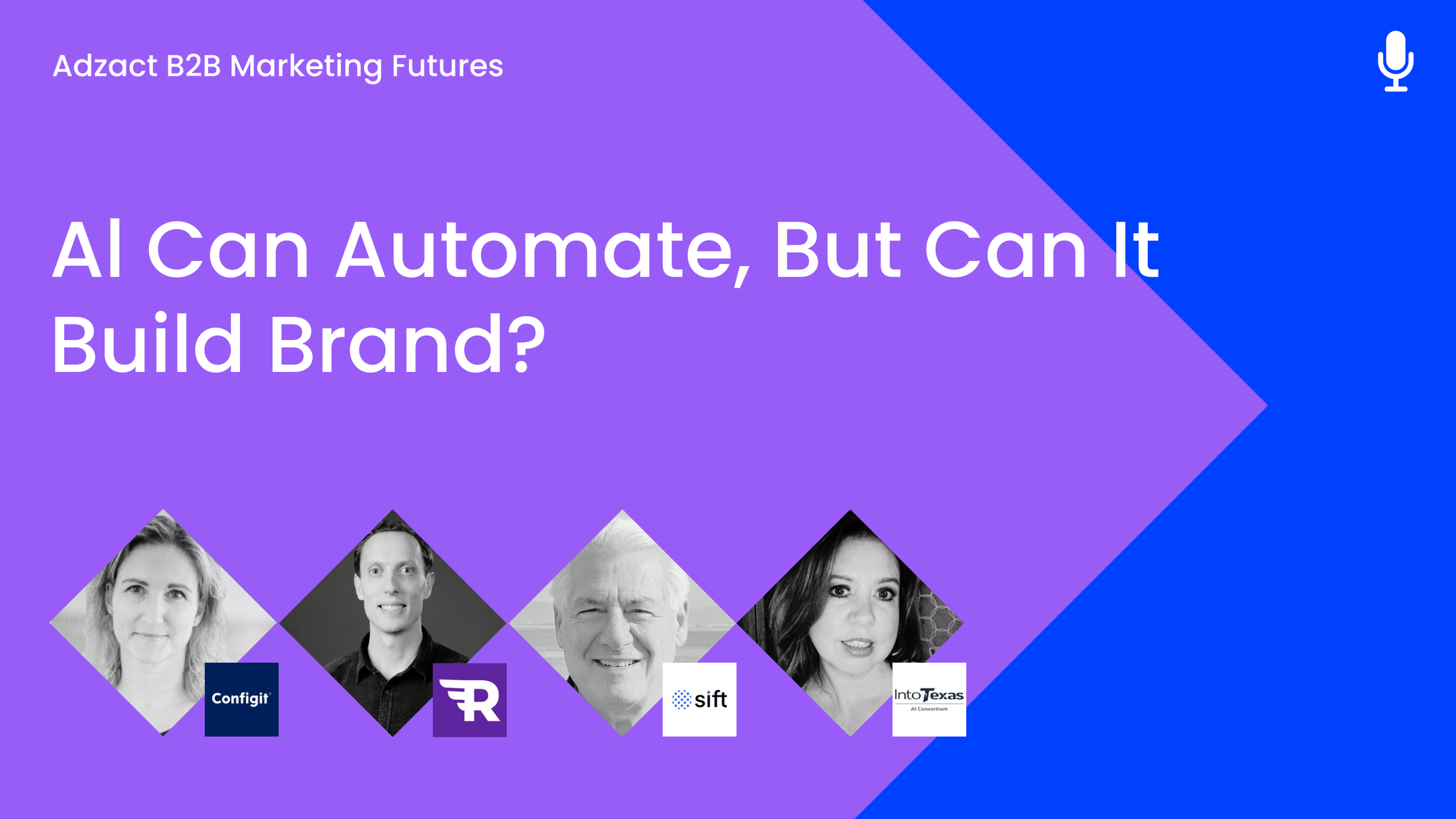
In an AI-first world where targeting, sequencing, campaign optimisation, and even content creation can increasingly be automated, many marketing leaders are beginning to ask a fundamental question: what actually remains distinctive about marketing?
In this episode of B2B Marketing Futures, senior marketing and go-to-market leaders come together for a roundtable conversation on whether brand may ultimately become the last durable advantage in the AI era.
From the future of digital marketing strategy and the role of creativity in an age of AI-generated content, to the power and limits of hyper-personalisation and the need to rethink modern go-to-market models, the panel explores how marketing teams can remain strategic as automation accelerates.
Guests
• Anne Dorthe Gyldenkærne, Chief Marketing Officer at Configit
• Alex Olley, Co-Founder & Chief Revenue Officer at Reachdesk
• Johannes Hoech, Chief Marketing Officer at Sift
• Shannon Belew, Global GTM Strategist and Co-founder of IntoTexas (an AI-focused consortium)
Transcript
Joaquin Dominguez (00:00)
Welcome to another episode of B2B Marketing Futures Podcast. Today we are exploring a question that many marketing leaders are beginning to ask as AI reshapes the way we work. Is brand the last thing left? Across B2B Marketing, more and more of the mechanics of execution are becoming automated. Targeting, sequencing, campaign optimization, and even content production.
are increasingly driven by AI tools that promise efficiency at scale. But if execution becomes commoditized, what actually differentiates companies? Does digital marketing become infrastructure rather than strategy? And if everyone has access to similar tools, does brand trust and narrative become the real competitive advantage?
To explore these questions, I'm joined by a great panel of marketing experts working at the forefront of modern go-to marketing strategy. And before we dive in, I'd love for each of you to briefly introduce yourselves and share a little bit about your role and your experience.
Johannes Hoech (01:05)
Thank you for having me. I'm Johannes Hersch and I have two roles. I guess I have my own software business. So I'm the CEO there and I'm also the CMO at a late stage front management company in San Francisco. And so I have two hats on and depending on where the conversation goes, I'll answer with one or the other.
Joaquin Dominguez (01:26)
Welcome and welcome.
Shannon Belew (01:28)
thank you for having me. I'm Shannon Ballou. I'm a global go-to-market strategist and co-founder of IntoTexas. We're an AI focused consortium. And while we maintain a global perspective about AI and its use, we are specifically focused on the adoption and expansion of AI technology within companies across Texas in the US.
And one of the reasons for that, you're not aware, Texas is poised to become the global leader of data centers in the next five years. So very much looking forward to the conversation today.
Joaquin Dominguez (02:01)
Thank you so much, Alex, welcome.
Alex Olley (Reachdesk) (02:04)
Hello, thank you for having me. So my name's Alex. I'm based sort of between London and New York, predominantly in London. So I'm the co-founder and CRO of company called ReachDesk. So we do, we're your one-stop solution for direct mail, swag and gifting. So I run everything, both sales and marketing. So I obsess over like the alignment between those two. But yeah, I'm looking forward to this. Thanks for having me.
Anne Dorthe Gyldenkaerne (02:25)
My name is Anne-Anne Dorth-Gildenkirne, I'm the CMO at Configure. In Configure, we support and help global manufacturers to align their end-to-end information on the configuration process. And I more than 20 years of experience in working with B2B software industry and SAS.
Joaquin Dominguez (02:42)
Welcome, and thank you so much. All right, thank you all for those great introductions. Let's start with the big picture. Over the past decade, digital marketing has been defined by increasingly sophisticated tools for targeting, automation, optimization. But now AI is accelerating that trend dramatically. So the first question for the group is, are traditional digital marketing strategies still relevant in an AI-first world?
If targeting, sequencing and even messaging becomes increasingly automated, does digital marketing lose its strategic value or does it simply become the infrastructure that everyone relies on?
Johannes Hoech (03:21)
I think it's a little bit of both in the sense that what I see happening in the marketplace is just an oversaturation of messaging and there's also just a plethora of look-alike competitors that are basically copying from each other. It's the same sort of marketing and sales vernacular that they use and it's highly ineffective.
So the fundamentals part of it is, you know, and I've worked with about 150 companies, plus or minus, both as a consultant as well as an executive. And it always boils down to the same three things that are end up being an issue. They're not clear on who the ICP is. They're not clear on what the differentiation is. And they don't then translate that into compelling differentiated value props and messaging. And I think that part, you can't automate away. mean, AI can't go out and interview.
500 customers and tell you what they think and what they're feeling. But on the other side, in terms of the executional side, obviously the impact is massive and the productivity improvements are incredible. So I think it's a little bit of both.
Anne Dorthe Gyldenkaerne (04:22)
Bye.
Shannon Belew (04:22)
Yeah.
Go ahead, Dan.
Anne Dorthe Gyldenkaerne (04:23)
And to follow that, I mean, the personalization that AI also supply with and give you the ability to do is the customers in the B2B cells that we are working with, really expect us to be very ⁓ specific also to their needs. you need to be, can't just, as Johanna said, you can't just push out a lot of noise in the market. You need to cut through the noise and then you need to show that you understand.
the customers that you're trying to reach.
Shannon Belew (04:51)
Yeah, I agree with both of you. think two key words in that question is really traditional and strategy. one strategy is always critical and never goes away. And I think sometimes we lose that as we think about the adoption of AI in process, we forget that it's all still got to be strategically driven. then Johannes, I think very important what you said, especially about understanding, you know, your
IPC and knowing those customers and how to talk with them. And it's going to be critically important that we use multiple channels across digital marketing, right? It's not just an execution. It's again, it's multiple channels to reach our customers where they are and know how to customize, you know, those messages as you were also saying, So strategy, traditional.
You know, it's just changing, but it's always changing. It's marketing.
Alex Olley (Reachdesk) (05:49)
Yeah, it's funny. was, um, I was on a call this morning with, uh, founder and CEO and he's essentially head of go to market. And they were like, Oh, I don't really know what to do. We're like, we're doing, we're doing, we're doing everything right. We're serving ads, messaging people, and we're just not getting to where we want to get to. I was like, well, talk to me about your customers and who's like your best fit customers and what like slice, what slither of the pie. Cause you can't go after the whole pie.
particularly the early stage, which piece of the pie do you want? And what's the best piece of the pie for you guys? And they were like, ah, we're going after all of it, aren't we? And I was like, well, conversation is kind of over then. You just go away and do that work. And this is the thing I advise many early stage companies is just like pro bono stuff. just enjoy doing it. Even like from early stage all the way to like 100 million, like I have yet to meet like consistently many companies that should get this right. So just get signed sort of
underappreciated as the value behind it. So I think the strategic value is there and that digital marketing, digital, like we're talking about digital strategies in AI first world, that is not going to replace that. We need brains, we need thinkers that are going to be able to execute against that. I just think that a lot of the digital side of things, the targeting, secreting content, the things that we have had to have people to do, those are going to be automated. They are. So I'm looking for an R team.
people that are always thinking about how do we improve on what we've got, how do we scale this stuff without having to add headcount and how do we get better results.
Anne Dorthe Gyldenkaerne (07:17)
also think we are able to get more insight into the way that we are targeting people. it's more like look at all the different intent data, look at the different interactions and then try to make small digital ADM campaigns that are really focusing on those particular pains that we can see there in that segment. So I think we can actually enhance. ⁓
All digital campaigns and all the digital marketing strategy with very, very specific analytics and use that in an intelligent way.
Shannon Belew (07:48)
Do you think...
no, I was just going to ask you all, I mean, do you think that we've gotten just overwhelmed because of all of the tools that are available to us or we've just forgotten the basics sometimes? I I feel like it's that plays into all of this.
Johannes Hoech (08:02)
that plays into all of
this? That's an awesome question. think it's a little bit of both. Part of the problem is a lot of these tools are getting rushed to market. And so then the paint is still dripping and the actual implementation requires a lot more work than people are anticipating. And flip side, the fundamentals, the strategy side of it, then a lot of times people have this sort of pious belief that you can automate that away. And I think we all agree.
is you can't. There's one example, and I'm going to throw that out because everybody's brought up hyper personalization. And the core hypothesis is, of course, if I send you a highly targeted message that pertains to your needs and understand your profile and package this all into three lines, which by the way is not easy, that then the conversion rates will be higher. I think there is a second thing.
And this is sort of bringing it back to the branding question that I do think is just as significant a change as is the arrival of the AI technology. And that is, I think, the way people process information has changed. You know, when I grew up back in the early 1700s, you know, it was pretty much everybody had a high tolerance for 20, 30 page presentation and they would sit there and they would engage with you.
And those days are long gone. I mean, it's now all about TikTok. And if you don't get somebody excited in 30 seconds, you know, they don't really pay attention. The 30 seconds buys you the, you know, two minutes and the two minutes maybe buys you the three minutes or five minutes that you need for a demo. And that requires a very different skill set because you're basically appealing to people's limbic system, not to their frontal lobes. And so this is an area where actually the B2C
techniques I find are coming in useful. How do I create that initial impression? How do I create that emotional engagement? And I have a hard time seeing how that gets replaced with AI. mean, we use AI, for example, for videos and do in-depth analysis. I mean, you can grind through data, a massive amount of data, but that's sort of figuring out what is that five-word tagline where somebody says, oh yeah, tell me more.
And that's really difficult. And I think with people's patients going away, and really they want to be stimulated and entertained from the first five seconds. That's another area where I think you can't replace humans. You augment them, but you can't replace them.
Anne Dorthe Gyldenkaerne (10:23)
And I think that is identity and the brand is really important now also that there's trust and credibility in the brand. That's the next thing that they will, as time goes by, they will really be able the end customers to understand that this is an AI generated version of things. So they will look at other things to make sure that there's some trust and credibility in the brands they are dealing with.
Johannes Hoech (10:24)
Thank you.
Joaquin Dominguez (10:24)
and the
Shannon Belew (10:31)
Yes.
Anne Dorthe Gyldenkaerne (10:46)
So I think that's also a thing that we need to see grow a lot. They will look for, is this a trustful brand to work with and are they credible in what they're saying or is it just generated automatically?
Johannes Hoech (10:59)
What about creativity?
Joaquin Dominguez (11:00)
And what about creativity? What about creativity
in this debate? Because one of the biggest debates is whether AI enhances creativity or if it's threatening creativity. Because AI can create almost infinite variations of campaigns, ads, messaging. Does creativity become less important or does it become the only real differentiator in this context? Also,
Johannes Hoech (11:23)
real depreciator in this context, also
building trust as you mentioned. That is an awesome question. And let me ask a counter question. Let's imagine you want to build a billion dollar disruptive startup in a space that you're sort of familiar with. Are you going to go to Claude or Perplexity or Chachi PT or Gemini and say, write me a business plan?
Joaquin Dominguez (11:26)
building trust as you mentioned and
Johannes Hoech (11:46)
That's going to generate me a billion dollars in five years. And by the way, it's got to be a disruptive product, something that nobody knows. So come on, get back. I'll be back in 20 minutes. Tell me what the answer is. Until the answer to that question is yes, I think the answer to your question is pretty obvious.
Shannon Belew (12:01)
Yeah, you know, I'll add a perspective to this. So I think from a brand and creative standpoint, some of it is an equalizer. So you think about, you know, we've talked a little about B2B and B2C, but if you think about the size of different brands and companies. So I think for a small to mid-sized company or startup, right, where they are much more lean, being able to have a tool like AI to help with creativity.
It really helps advance them, gives them, you know, an equalizer where maybe they couldn't invest in that either through an agency or through more team members like a larger brand can. So I do think there's that slice of it where we have to say from a creative standpoint, it gives us some efficiencies and capabilities as a smaller company that didn't exist before. For larger companies, I think this gets back to also what Anne was referencing earlier around trust and
at the end of the day, what the true differentiator is as you're going to market and maintaining and building your customer base, right? And that's around trust and credibility of your brand. And you do have to own that. How you do that in a world that is constantly evolving and with AI and more user generated content, right? So your ownership of your brand gets out of your hands a little bit. So how do you walk that fine line of
enabling your customers, your users to be part of your brand story from that creative process, but then maintain the personality and integrity that you need to own that space with your brand. And I think that's the tough one. So to me, I see it in those two slices. It's an equalizer from a company size standpoint, but it's a bit scary as you grow as a larger enterprise.
Alex Olley (Reachdesk) (13:50)
Yeah. And I think we're quite a creative business. it's maybe a little bit biased. You we literally, we try and get the most creative things that land that are landed on people's desks. And it's funny because I speak to lots of customers, listen to a lot of our calls. I can tell you now that's what people are craving. the things that people are talking to us about now are like, the AI is like over automated things. We're seeing diminishing returns from that email and digital and stuff. But when we've tried like really creative things, high impact things, which get people to feel something.
we see better results. So we've now come to you guys to help us scale that. And so I'm seeing just like more and more companies thinking about how do I get creative? But in a way, you know, they've always hear these conversations about we tried to get AI to create videos for us. We tried to get AI to create this imagery for us, but people can still tell the difference and actually it ruined our brand. So we want to do as much as possible to be as human as possible and to create that human connection as best we can.
And I think we've sort of run these experiments internally too. Now, obviously gifting is like a big way that we use within our own. But one of the things, the puzzles I was trying to solve for so long is how do I translate all these signals into context that we can then put into messaging to Johannes's point earlier, that is relevant, that isn't perceived to be AI. That's a really hard challenge for people to overcome. And I think we're getting there. Two years ago, all these experiments.
because people were like, that looks like AI, it sounds like AI, it's AI. So no one's gonna wanna interact with that. The thing that I've learned is you have to have a human in the loop. You've got to have a human in the loop. I'll give you a practical example. So we're quite outbound heavy. So I've got lots of BDRs, my AEs as well, they generate their own pipeline. But for ages, we had all this intent data and who's visiting our website and account searches and scoring and everything. And I used to try and get them to interpret that. And then I'd ask them to like create messaging.
Anne Dorthe Gyldenkaerne (15:10)
Good.
Alex Olley (Reachdesk) (15:36)
And now we just have a system that literally goes, okay, this person used to be a customer. They've also got a person who's just been hired as an account-based marketing manager. These guys are all visiting the website. Here's the context from the closed loss deal from two years ago. We've put it into an email for you. I just need you to check it. Now hit send. All so all the hard work that was done is all about context and data that can, it's there now. We're doing it. We're seeing massive success from it. That's now working. So I think we are reaching this point where we can get creative.
but we've got to have a human in the loop that can control it. And that's what's working for us. The moment where I've been part of businesses on boards where they've tried to automate all this in an agentic flow doesn't work because people go, that's AI. I don't want any of it. And we're seeing this creeping more and more. People don't want to interact with AI. They want a human on the other end. And the companies that are mastering that and scaling it, they're the ones that are winning.
Anne Dorthe Gyldenkaerne (16:26)
So I can echo that. mean, we work, we've actually invented a new term that is not, we don't do cold calling, we do intelligent outreach. ⁓ So that's, so we train our sales people and BDRs in actually doing deep research on each of their customers. we sell very big enterprise solutions with very big buying committees. So they need to understand the strategy, need to know where do they start their talking track when they reach out to these to be as relevant as possible.
Alex Olley (Reachdesk) (16:34)
What's that?
Anne Dorthe Gyldenkaerne (16:55)
And they can use AI for a bit of it, but at least they use it as an intern to get like 60 % of the messaging. And then they amend it themselves. And then we work, I that's also a thing I really think it's going to be more paramount that sales and marketing works so closely together that we know who is engaging with all our digital campaigns, who is the top engaged companies across the different platforms. What have you done, as you said in the past, have you any engagement with them in the past? And how can we then
do some intelligent outreach to those to get a new conversation started. it's really lifted in that. And then the relation between sales and marketing is lifted, this working as one chain. and then also the BDRs, the way that they can target the conversations with the customers.
Shannon Belew (17:42)
I love that phrase, intelligent outreach. I'm totally going to steal that by the way. But you know, I think it also goes back to and you know, Alex, even what you were saying, right? It's that human in the loop and it's building real relationships. And I think, you know, people are more judgmental. They're scrutinizing, looking at things. Is this AI? I mean, you know, we all spend time on LinkedIn and you see all of these conversations about please, you know, stop.
Anne Dorthe Gyldenkaerne (17:46)
I'm sorry.
Shannon Belew (18:09)
posting things that are AI generated. We know it is. We want to hear your voice, who you are. And I think as companies, it's the same thing. And everyone that represents our companies as they're doing outreach, it should be about having their own personality and having that human touch, again, Alex, as you said, right? And doing that intelligent outreach where you can build relationships. mean, this isn't new, right? This is...
goes back to sales and marketing objectives from forever. it's just having technology that makes some of the things easier and more scalable so that we know where we can focus our time and build relationships that are going to matter versus just throwing things out there and hoping that it hits. I think that's kind of the crossover between the personalization and the creativity and that human touch under the umbrella of AI.
Joaquin Dominguez (19:04)
And what's the role of traditional advertising in this context of super humanized personalization and trying to go to market with that intelligent outreach? Do we still rely on doing top of the funnel brand awareness campaigns, then retargeting and working with that funnel approach, or do we need to rethink our go to market?
Shannon Belew (19:29)
this is what I do, right? Go to market. And I will say that we're always reinventing go to market. We're always trying to figure out how do we get smarter? How do we do it better? What's working? What's not? And, you know, one of the things that we know is that
we don't even have an opportunity sometimes to get in front of a potential customer until they're well down the path of making a decision, right? And so when you talk about top of funnel and you talk about brand awareness, I think it becomes even more critical because AI is changing the way that people buy as well as the way that we sell as a company. And so it's, think,
absolutely important that we put even more maybe into top of funnel and that brand awareness. And again, this comes to me full circle back to, you know, where I think Anne started us about credibility as a brand and building trust and building relationships. You need people to understand who you are, what you do and what you stand for as a brand because there is a lot of noise in the marketplace. So how do we cut through that noise? If I think the most recent
figure I saw was at this point, you people are, you know, 70, 80 % down the buying path, down the funnel, making a decision before they even engage with sales. So you can be as personalized as you like, but if they've already made a decision, then are you really going to impact that decision at that point? So I think brand awareness and investing in that absolutely remains critical. I don't know that it's still traditional, but
It's an investment that has to be made.
Alex Olley (Reachdesk) (21:10)
Yeah, I totally agree. We're investing way more in this. Like it's the first sort of year where I've like, I've actually gone into a board meeting like, I've never said this before, but we are investing in brand. And I know that's dangerous because I cannot tell you exactly how we're to measure it at all stages, but we are investing in that. And it's not just about investing in it and say, we will do more brand things that will generate brand is how you show up. And I'll give you like a tangible example.
Johannes Hoech (21:12)
we're investing more people in this.
Alex Olley (Reachdesk) (21:37)
Part of our brand awareness is two-fold, right? We're US company, but not everyone in the US knows us. So we do want to be more present in front of people, so that's more events. That's not new, we've always done events. It's like, how do we show up at events? So we used to kind of just have a booth, put a bit of swag on top, and kind of do what everyone else did. And I'm like, that's not really our brand. The way that we want people to have that brand recall with us is that we're the fun guys, we're loud, we're like...
We're high energy, we're essentially telling people that we're the guys that are going to help you break through the noise. So if we're not doing that, why would you want to buy from us? So when we go to events now, we do things that we get that giant purple bronco bulls with like purple hats that light up and you can win prizes and we have swag stores and we kind of go big on it. And we're like, why have we not done this before? This is who our brand actually is. So I a lot of it was how you represent yourself. I'm not saying everyone goes and hires purple bulls and gets people to time how long they're going to...
last on that at an event or anything. But a lot of it is how we show up. And when I was being to work in before, was like, I think the bar has just got higher and higher. And your brand needs to try and figure out how you can lean into that as much as possible. Things like video, the productions, it looks like Hollywood has produced some of these videos, some of these B2B companies are producing. That's their brand and they're elevating it. So I'm not just thinking about investing in brand from a perspective of let's do more things.
I'm thinking about how do we raise the bar and how do we show up in a way that people will remember us, they will identify with us, and therefore they want to buy from us.
Anne Dorthe Gyldenkaerne (23:06)
For us, it's very much we sell these enterprise-wide solutions. So we need to really work with the thought leadership and we really use articles and media. We use connecting with other big brands like big business consulting companies and do joint activities with those, join white papers. So we get support.
from we are a smaller company get support from bigger brands as well to get the credibility and the trust and de-risk our customers decision process because that's what it's about when you're selling these enterprise wide solutions. So that's how we really continuously work with our leadership because that's what built our trust and credibility in the market. that's one of the things we need to continue.
Johannes Hoech (23:49)
Yeah, I would agree with everything that's been said. would add to it the, you know, we talked about how lot of spaces are commoditized. You have the same messaging, you know, no emotional appeal and so forth. And what we found works in both of my businesses actually is really a deep understanding of the customers.
kind of emotional needs. And so we, by and large, are shifting away from the traditional, you know, talk about features and speeds and feeds and ROI and so forth. And really, in fact, the campaigns that we're going to roll out at my CMO gig is all around making you successful and, you know, what do you need in order to be successful. But do it at an emotional level. You know, what are your anxieties? What are your fears? What are you worried about?
know, most companies go out and they talk about, you we make you more profitable, we generate more revenue for you and or, you know, below your costs, what have you, the pitches. And, you know, very few people talk about what do you actually worry about and, you know, how do you manage your career and how do you progress in your career? And when you implement this new tool, you know, what's the piece of the iceberg under the surface in terms of implementation load and redirecting your resources in the company and retraining them and so
And we find, and I think it resonates with one of the earlier points around trust. We find that builds more trust because people go, they get me. Versus, let me talk to you about myself and how great my product is. I'm going to talk about you and your struggles. And it's kind of the hero's journey. We make you the hero. And it seems like that's what people are looking for as well. And again, back to branding. think in smaller companies, you don't have the budget for branding yet, but you can certainly express that in your.
artifacts and in your sales messages and LinkedIn, larger companies where they can advertise and, and, you know, do more of a brand investment, but it's more or less around that same area of make it about them, not about our sales. And we see that working. mean, I can see the difference in the converter rates and the lead volumes. And we do a lot of AB testing to try these things out. And that's another thing I would throw into the conversation.
Shannon Belew (25:56)
Yeah, I think for me that gets back to it's so much about relationship building, right? I mean, we've got technology that again helps us scale, makes it more efficient how we do it and what we do. But at the end of the day, we're still building relationships with our customers and that is the key. And it's goes back to again, all the points, the trust, the credibility, the being true to who your brand is, you know, whether you're
you know, showing up at trade shows with bulls or you're doing it through thought leadership. It's, know, you've got to know who you are, who your customers are, and then build those relationships, I think.
Anne Dorthe Gyldenkaerne (26:33)
It's so true. ⁓
Alex Olley (Reachdesk) (26:33)
Yeah, I love that point. Sorry,
sorry. Before I forget, this is one thing that our director of marketing quite rightly keeps reminding me of. He's like, dude, we can invest everything, all we want in the world and like top of fund and everything. It's like the area we must invest is our customers, more customer marketing. Because what we saw was when we did that more and more, we'd get better. We get more pipeline through word of mouth and referrals, which is way easier. It's way cheaper, happier customers, better retention.
And the thing I think I was obsessing over was just like, how do we get more? How do we get more? How do we get more of the right ones? It's like, no, no, how do we make sure our customers are really happy? How do we make sure that they're the ones driving those? And I don't think you need AI to do that. You just need to look after them and make sure that they are getting what they need, you're solving their problems. whilst, I think what's happened is we kind of have been, I certainly got drawn into this whole world of like, whoa, look at this new opportunity.
It's very easy to forget about what you've already got and everyone should lean into that.
Anne Dorthe Gyldenkaerne (27:29)
And in the end, people buy from people. People don't buy from an AI engine. So they qualify through all the data they can get. Well, we also need to make sure that we are listed all the different places, but people buy from people. They buy on trust and they buy actually what you say. I believe you help me out if something happens in the end.
Joaquin Dominguez (27:33)
Exactly.
Alex Olley (Reachdesk) (27:33)
Mmm.
That's it, and that's word of mouth. is word of mouth, by the way. Just call it what it is.
Anne Dorthe Gyldenkaerne (27:52)
Yeah.
Joaquin Dominguez (27:53)
Exactly.
Alex Olley (Reachdesk) (27:54)
That was our second biggest channel last year, word of mouth. That's it.
Joaquin Dominguez (27:58)
And is there something new you feel in the market right now? Because Johan, the thing you were saying, like understand your customer and build on those emotions and do everything around those emotions. Like we should have been doing marketing like that forever, right? And I believe that B2B marketers, we have been so focused on complicating things because of attribution and demonstrating that our work has value in our companies that we for...
Johannes Hoech (28:10)
been doing marketing like that forever, right? And I think that B2B marketers, have...
Joaquin Dominguez (28:25)
got about the most important thing, which is understand the customer and build on the emotions about them. And all the things that you're talking about are related with that. I don't know, my question is, is there something new here or is just classic marketing?
Johannes Hoech (28:40)
No, I think there's something new there. mean, yes, it is classic marketing, but with new tools. Give you concrete examples. We've done a fair amount of research into our customer base and we've done looked at the CRM data, wins and losses. We looked at the intent data and we also merged this up with live interviews, both internal interview recordings as well as external interviews.
And then you feed it into the sort of AI blender. The ability to extract insights out of that huge volume of data wasn't there before. And that's disruptive and that's very different. I mean, you really get a lot more precise certainty and it flushes up areas that sort of the human observer might ⁓ overlook. The other area, and I mean, I could do more than one monopolize the conversation, but just the...
tripling of productivity is huge, both in content generation. We do a lot of short form videos, 30 second video snippets, those kinds of things, down to the point where they're customized. You have text to video. I ⁓ record myself as an avatar. I record my voice. I just type in what I want to say and the person gets a personalized message. Those kinds of things were not there before. So the volume of data that can be analyzed and digested, as well as the productivity, and that's sort of a...
Is it radically new in the fundamental marketing sense? No, but does it enable us to be way more effective and much more efficient? Absolutely.
Joaquin Dominguez (30:04)
It's the democratization of those tools. think those tools have been there before. People could analyze transcripts and things, but probably you need to hire someone. You needed the resources and now everyone can do it. So the bar race is way higher today. And the thing is, if everyone can do good kind of analysis, if they can implement and have
and include their emotions in their campaigns, in the way that SDRs talk with prospects. The bar is quite high, right? And how do you compete there? Is it with brand again? Do we need to really rely on a brand?
Anne Dorthe Gyldenkaerne (30:37)
think
it's important that we sort of discuss in marketing here in Configure.js, like we see AI as an intern. So you send off the intern to do the tasks you wouldn't have time to do in the past and maybe sort of settle with something because that was what we had and what you had time to research. Now you can send an intern off doing the research while you do something else, go back to it and then you can work on it again. So it's literally, we all got an excellent intern.
that we can be more efficient in everything we are doing. But we need the human touch to make sure that we don't lose the trust in every matter we were working in. Yeah, so think that's at least how we work within. I think we need as marketeers to really support the organization, ⁓ also the sales department to be more curious about how they also can work using all these new capabilities without
compromising a brand because that's another thing when you democratize all this I mean, there's some very creative people in our organization again as well so we need to also have a make sure that they understand the importance of them being a part of a brand and Because they can do so much themselves and we have some very creative people in our team as well and sometimes we need to say whoa, this is
not aligned with our brain. need to step back. Here is the different way of working not to compromise.
Shannon Belew (32:01)
Yeah, you know, I think the other thing that I picked up on in this conversation too, and you talked about insights and how important that is and having AI tools to help us get that. And, know, I was just looking at a tool just this week ⁓ called Clay, which, you know, helps bring in data and helps look at unstructured data across.
you know, all the people you're trying to reach, bringing in elements from social media. So things where you had humans, interns or otherwise, you know, using Sales Navigator, doing that physical research on individual accounts to put together these little snippets of who your customers are, the people you're trying to talk to, right? The thing that's interesting to me about this though, is that as we all start to adopt and utilize these same tools and techniques,
we're all getting the same insights about many of the same people. If we think about our competitors and we're all targeting the same types of customers, right? So how do we make sure that we're differentiating our sales and our messages, even when we're using these tools to help with personalization, if we're all using the same tools and it's coming back with the same insights? I think that's kind of the next point where we have to go. And maybe, Anne, as you were saying, this is where that...
human piece continues to be so important because if everything's writing, researching, looking at the same data, structured, unstructured, right? How do we still put our brand, our individual human touch on it so that we can build those relationships?
Alex Olley (Reachdesk) (33:25)
you
Hmm.
Yeah, it's funny. I'm conveniently, I literally five minutes before this, I got sent this. It's like a cricket bat. It's really well done. Actually, it's from someone. I'm not going to read that read the note. But it's like, like teams reviewing every ball in cricket to see who won or lost the match. Our company reviews every call, blah, blah. They've sent me a cricket back. So my LinkedIn, it says I love cricket, it's got our logo on. I'm going to respond to that that quite literally happened five minutes before we started this. Someone sent something to my office.
really good research, their competitors have probably been hitting me up. I may not have even seen the messages their competitors have seen. Now I'm like, okay, they've gone to the next level. All right, fair enough. I'm going to give this person my time. And I think the companies that are endeavoring to do that aren't just trying to get the data and trying to automate the workflow. They're thinking, how do we actually like, as I said before, how are we getting the prospect to feel something? How are we actually
giving them a human connection that is above and beyond what they expect. We're shattering their expectations. We're going above and beyond there. We have since day one been always talking about that. That has been the thing that we have done to our customers that how do we completely surpass their expectations? Let's do the things that they didn't expect. That will always work. That will always work. And we are seeing a massive rise. I'm seeing this, how companies are thinking, what are those methods that we can use that's scalable?
be able to do that.
Johannes Hoech (34:47)
Yeah, I think that's a really, really good point. And, you know, we talked about the limbic tickle, you know, how do I get somebody, you know, the first 10 seconds we talked about the impact empathy, you know, how do I understand their problem, making about them and, you know, the creativity in the marketing messaging or the marketing outreach, like your little cricket piece.
That's really difficult to do. mean, I think AI is super helpful in enriching the data set on which we let that creativity do its thing. And it's also, of course, great at amplifying and or repeating and scaling up the outbound messaging. But at the core, it's that human angle, both understanding who they are, what their needs are, and then being creative at communicating that and you're of you know, cricket.
example, I think that's a great idea. That's really, really hard. And I think one of the risks actually is more on the side of people over believe in what AI can do. I think it's super powerful. I'm not trying to devalue it. it's not a crutch. It's not the thing where AI says, I need to say this, and so therefore I say it. It kind of makes you more effective, but ultimately you have to still pilot the plane and figure out what the right messaging is.
And I think I find, least in sort of both the boards that I deal with as well as the employees that I deal with, they feel like AI just pushed AI button, all the problems are solved. No, it's not. In fact, they make it harder because you have more data to digest and you really have to come up with much more nuanced messaging. then of course, as all of you know, running mass customized outbound campaigns is a Rubik's cube of its own. You can't just send out an email anymore. So it's actually raising the bar, but it's not replacing.
Alex Olley (Reachdesk) (36:00)
you
You
Johannes Hoech (36:26)
humans can do and what we can bring to the table.
Alex Olley (Reachdesk) (36:29)
Yeah,
the thing I said to my team recently is that we need to get really good at the things that require zero skill. We just need to get really good at those. And then we need to start doing the really hard things that people don't expect us to do. And I feel like what's happening is people are going, let's just do the things that everyone else can do that require zero skill and not do the other stuff. Let's not do the hard stuff. And what you said, Johannes, was like, that's really hard to do. Yeah, it is really hard. So you should do it.
We should do more of that because that's what people don't expect. That's what elevates people's experience. That's how they have better brand recall and trust us more because they are, you're doing things that go above and beyond. Not many people are doing that.
Johannes Hoech (37:04)
Yeah,
there's one headwind on let me throw that up the little startup that I built we built software, know, I I have a highly analytical background and so I when I was became a CMO for the first time 15 or 18 years ago You know, obviously I had the board and the financial side of the house come after me because after engineering or sales typically marketing is the big spender and so then they go well We don't need we can't gotta keep the engineers. We've got to keep sales
marketing, what do you have in your budget that we can toss overboard? We need to save money. And so then I obviously got into save money. So I obviously got into sort of figuring out how do you actually justify what you're doing? And that becomes financially difficult. So we built an app that actually does qualify, you know, creates a linkage between activities, know, impressions generated, email sent, LinkedIn, you know, invites sent and revenue, you know, six months later and have that really a measure, measurable trail from beginning to end. And what I find is
⁓ In the current environment, at least here in the US, financial scrutiny is huge. And if you can't walk into the board meeting or the CFO's office or the CEO's office and say, I'm going to spend this much in marketing, here's where it's going to go and here's what you're going to get out of it, you're dead. And so this is the headwind, why we all agree that marketing and branding in the sense that we talked about is absolutely still necessary.
people have very low tolerance towards the spend that's associated with it because they can't draw a direct line aside to revenue six months down the road. And so I think the additional burden, and this is why it makes it harder for folks, ⁓ is not only do you have to come up with a new message, Olympic tickle, be empathetic and all that good stuff, you also have to be able to show or demonstrate an ROI in fairly measurable ways. And that bar has also been raised. So I would say that's one of the challenges.
CMOS are phasing and not everybody to be honest is equipped to do that.
Shannon Belew (38:56)
You know, that is a fantastic
point. And I think it also speaks to proving out the ROI of AI itself. Right. I mean, because right now what we see so many, especially, you know, B2B tech companies doing is being honest, right? Especially in the U.S., they're cutting staff, cutting those humans to pay for the investment in the technology. So how are they going to measure ultimately that ROI on the technology?
and when does that bill come due? And that's not just marketing's problem, right? That's sales, that's product, it's across the organization. It's the CEO's problem ultimately, right? To prove out that that investment in the technology was worthwhile. And then we're saying, you still have to have the humans. So at what point do we start to come back and balance this mix between that investment of technology
understanding what the return on that is and what those proof points are and then bringing the humans back into the picture. I think that's gonna be the next huge challenge for B2B companies in particular.
Johannes Hoech (40:00)
Yeah, I would agree. think it's, what we did two years ago is out of date. mean, six months ago it's out of date. I mean, you're talking about clay and there's N8N and there's all these other tools that you have to master. by the way, so you're kind of repairing the airplane while it's in mid flight. It's not an easy thing. ⁓
Shannon Belew (40:17)
Always.
Joaquin Dominguez (40:20)
All right, so we've covered a lot today from automation, marketing execution, creativity, personalization. so I just want to say thank you so much for sharing all this. It's clear that while the tools and the tactics may change rapidly, fundamentals, trust, narrative, understanding the buyer remain as important as ever.
If you enjoyed this conversation, be sure to subscribe to B2B Marketing Futures podcast so you don't miss upcoming episodes where we explore the ideas that shaping the future of marketing