
Al Scale versus Brand Trust: The New Rules of B2B Go-To-Market
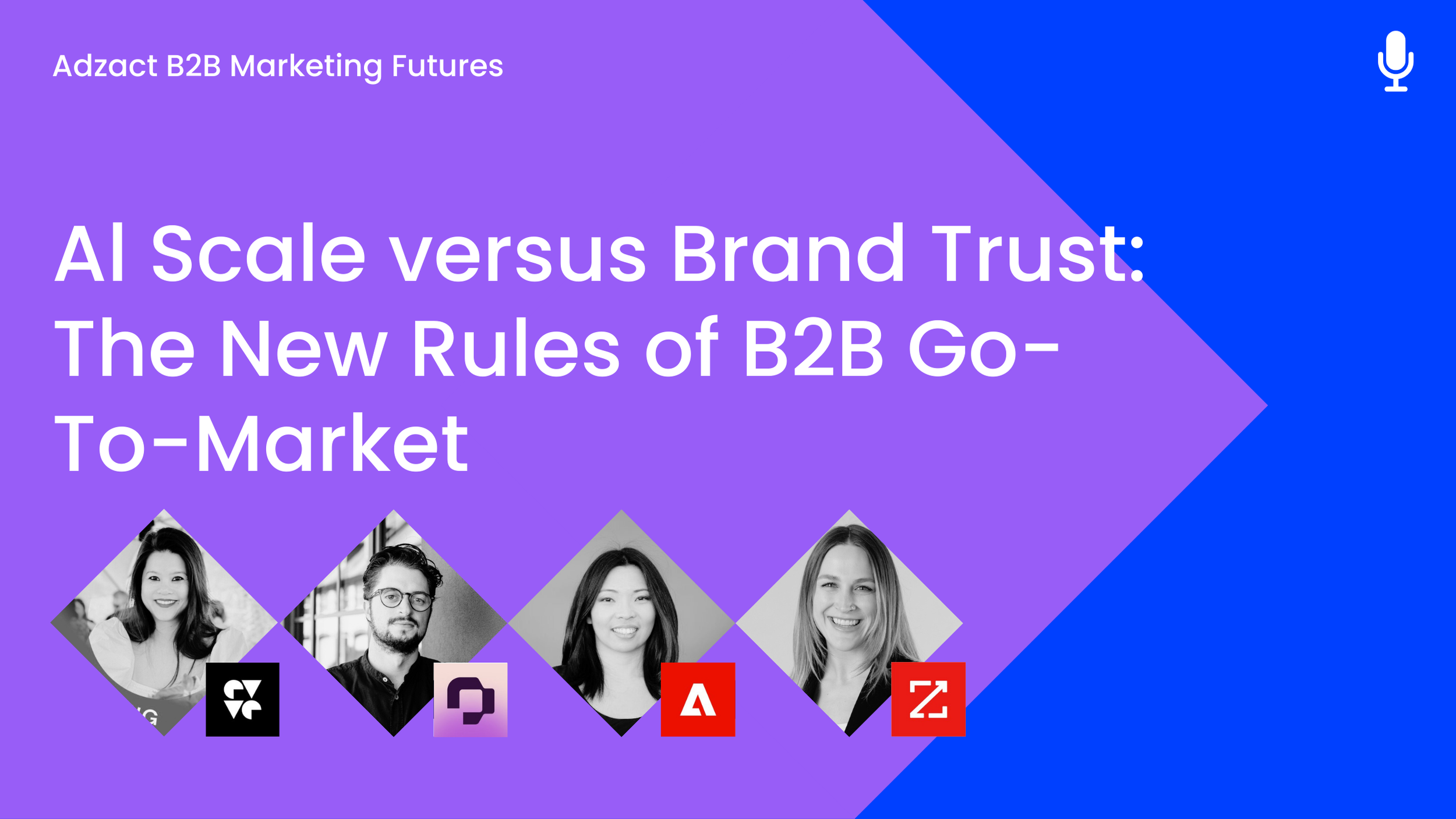
B2B go-to-market is entering a new phase as AI reshapes how teams plan, execute, and scale growth, but the real challenge isn’t access to tools, it’s how they’re used.
From automation and personalisation to brand, trust, and differentiation, AI is forcing B2B leaders to rethink what effective GTM actually looks like in practice.
In this episode of B2B Marketing Futures, senior go-to-market leaders come together to unpack how AI is changing GTM strategy today and where it risks creating sameness rather than advantage.
Guests
Laura Fu, Head of Revenue Operations & Strategy at DevRev
Alex Venus, Head of Growth Marketing at Personio
Millie Beetham, VP of Go-To-Market Strategy at ZoomInfo
Jessica Kao, Director, B2B GTM Transformation Advisor at Adobe
Transcript
Joaquin Dominguez (00:00)
Welcome to another episode of B2B Marketing Futures, the podcast for B2B marketers sponsored by AdSact Today's conversation is about B2B go-to-market in the AI era Over the last 12 to 18 months, AI has moved from something experimental to something that is actively reshaping how GTM teams operate From outbound and lifecycle marketing to rev-ops, content, personalization
AI is now embedded across the entire motion. So that creates a real tension from marketing and revenue leaders. On one hand, execution is faster and cheaper than ever, and the other differentiation is becoming harder. So if everyone has access to the same tools, what actually sets strong DTM teams apart? So to explore that, I'm joined by four leaders.
who bring very different perspectives across SaaS, enterprise, DevOps, and GTM transformation. And before we dive in, I'll ask each of you to briefly introduce yourselves, your role, and what your GTM focus looks like today. maybe Laura, would you like to start?
Laura Fu (01:10)
Hello, thank you. Thanks for having me, Joaquin. ⁓ So I'm Laura. I work at DevRev. DevRev is an AI native company that combines all your structured and unstructured data so that you can run both LLM agents on it and execute on workflows. And I am responsible for the go-to-market architecture and engineering of the organization. I also take care of the SDR function, which is going to be relevant in today's discussion.
Joaquin Dominguez (01:32)
yeah thank you so much welcome Alex welcome
Alex Venus (01:35)
Cool, thanks for having me. Yes, I'm Alex. I'm Alex Vinness. I'm based in London. I'm in Munich today and I work for Personio, leading their demand generation team. Personio are HR SaaS company, so we automate everything from recruiting to payroll and absence management and everything else in between. And yeah, everything inbound from awareness to pipeline is what I obsess about basically.
Joaquin Dominguez (01:56)
Thank you so much for joining us, Milly, welcome!
Millie Beetham (01:59)
Yeah, hi everyone. Great to be here today. My name is Millie Bitham. I lead good market innovation and strategy at Zoom Info. Zoom Info is the B2B go to market intelligence platform. We're really closing that execution gap for ⁓ all teams across go to market sales, marketing and ops. My focus is really on building these sort of scalable systems for revenue generation and leveraging really unique data to be able to do that.
It's a fun time to be in that space given all the ⁓ innovation around AI. Really excited for the discussion today.
Joaquin Dominguez (02:32)
awesome thank you so much and Jessica welcome
Jessica Kao (02:35)
Hi, I'm Jessica. I'm the director of B2B Go-To-Market Transformational Advisory at Adobe. And I spent about 10, 15 years being in marketing operations, driving technology to enable the next innovation and advancement in marketing to support the revenue funnel, ⁓ marketing and revenue and marketing and sales together. And now I've joined Adobe to be able to
bring the thought leadership and the best practices and the future looking state to all of marketing. And I focus on B2B and it's a great time. Like Millie said, it's a great time to be in what we do. And Adobe is building the tools, the AI, the agents, and the tools that help enable the things that we do every day in marketing and sales.
Joaquin Dominguez (03:23)
That's great. Thank you. Thank you so much, Jessica. And thank you all for those great introductions. Let's start with what's actually changing on the ground because AI has changed and has been part of GTM conversation for a while now. But over the last year or so, it's moved from theory to actually execution. And I love to understand what's generally made a difference versus what's been more hype.
than help.
Alex Venus (03:51)
I think this space is moving so fast. And I think there's always been throughout the career, like, you what's the future of work? I think this is probably the first wave I've certainly seen in my career that's kind of moving week by week. I would certainly say within the last six to nine months, I've certainly seen the ability for marketing teams to increase their frequency. And what do I mean by that? I mean, quickly. think everyone in
In marketing and demand gen has so many different competing priorities now. think thankfully most people understand that they need to get that balance right between demand creation, demand capture, investing more in brand, maybe then they were doing a performance marketing historically. And so we've got a lot of stakeholders, a lot of things we need to do. Day to day to day, I would say that's the main area that we've, we're investing a lot into AI is
areas around efficiency improvements. So we use a tool called Langdoc internally and that gives us a secure access to all of the leading open language models. And we use this across every area of the business. We have almost like a gamification of this internally in the company where we see the adoption of that by different functions. And our overall mission at Personio beyond what it is for our customers and our revenue goals is to be an AI powered GTM market.
an AI powered GTM team. And I think we've made a lot of progress doing that. We now use, think everyone in the organization uses AI in pretty much every aspect of the work that they do. And I think it's really just getting that balance right now between increasing your frequency, efficiency, and giving you headspace to really operate on some of those, particularly the brand piece. At the same time, not, yeah, like.
taking that away from having like unique positioning and the fundamentals of marketing. So we do it now in creative analysis. think account hygiene has been exponentially tackled through AI, particularly on the PPC side. think it's a perfect use case for a lot of that. And really a lot of the tasks that were quite difficult for marketers is getting close enough to the customer and digging into qualitative data. So we have set up agents for gone calls. We've got really structured closed lost analysis now.
I see the work that we're doing on audience segmentation. know, when, marketing teams got access to these huge pools of data, it presented a lot of opportunities for us. But I think when you don't have that data structured, you know, like performance marketing is a function I own for example. And when you, you try to build this creative testing model and you have thousands of different ads live across several different platforms, and then you use to work out what's working on an individual ad level. You're talking about.
things that can't scale right when you've got a team of three, four, five, six people. So it's trying to find that ability now to have that competitive edge and particularly in digital marketing and structuring previously unstructured data. And I think that's what's worked really well for us is, is, is deploying in areas around data analysis, data structuring. Um, and obviously, you know, all of the well spoken about use cases within the day to day admin that isn't really the sexy stuff that marketers talk about, but creating a campaign brief.
Um, know, struct struct structuring, um, some of your MBRs, these things take days sometimes to produce and they're coming at the expense of what I classify as real marketing work. And I think that's what we've able to do. You know, creating an MBR used to take five days now pretty much takes two hours without, uh, cutting down on the quality. We're now able to produce creative analysis across all of our ad platforms. And these, these aren't things that I would be able to ask of my executives before, because I knew if they did that.
they would have to have huge trade-offs that were just unjustifiable.
Jessica Kao (07:23)
I think with AI has come so many great things, but I also think it's caused a lot of chaos, right? Which is we are, you know, the pressures from everywhere, right? To be more efficient, to use AI, to adopt AI. And to your point, the technology is changing so fast, you know, but it's, you you kind of get this immediate short-term, like, yes, we can make things more efficient, but it's not sustainable in terms of after that immediate short-term, then what happens? But I think also,
It's the chaos of like, if we throw everything at the wall, know, spaghetti at the wall, we can do things with AI. But where I see kind of, especially in larger transformations, it's like the strategy. Strategy is still important. AI needs to be helping with good. It can amplify good things. If you put it on bad data, bad processes, bad, it's not going to fix everything. So I think there's a lot of expectation setting because I do get into, you know, a spectrum of conversations where
Some people think AI is just magic. AI will just do it for me. There's still that very much human strategy element, and what you feed, will amplify good. And if you feed bad things, it'll amplify bad. And I think what we're seeing is the first wave of, hey, AI isn't really helping in some cases. I'm like, well, did you have a strategy? Did you think it through? And it's this idea of we need to slow down to move fast. Can we take a pod and like,
What is the strategy and rework all the strategy? And Alex, you talked on like, kind of rethinking some of the processes. Like we are, the processes that we have are assumptions on the old way of working. And so it's almost like giving ourselves permission to like reevaluate and blow up our processes and like, what assumption was made because, to create that process? And what assumption doesn't exist anymore?
because of AI, right? Like a great example is, when we do ABM, when we do targeting, what do we do? We sit around a room, we sit around a virtual table between sales and marketing. We have to choose the top 10 accounts, the top 100 accounts, top 50 accounts. We've all been there. Why? Because to focus on more than 50 or more than 100 in a very bespoke way is very time and resource intensive. But is that really true now with AI, right? So it's an example of what are the assumptions that we've made in the past 20 years of our career that we are like,
wait a minute, know, and I, you know, what things that we can change with AI and that's in every single day. Like I was using one of our tools and you know, I didn't know how to enter it in a ticket. And what's the first thing I did? I slacked it, you know, I slacked my colleague. I didn't even think to be like, maybe I should ask the AI agent in the tool how to do something, right? It's these, you know, the assumptions that we did. And I'm like, I was like, I'm just going to see if I can answer my question. And it did. And not only did it answer my question, it actually asked me like,
Would you like me to do it for you? You know, so it's really changing behavior on so many fronts that I'm sure we're going to get into change management.
Millie Beetham (10:07)
No.
Alex Venus (10:08)
I think ABM
such a good take on that one as well. Cause you just see, I don't know if anyone's been like looking at their inbox recently, recently, but I'm seeing so many people who are clearly kind of creating like these AI orchestrations, particularly through things like clay. But again, even when you're creating like the channel synergies and you can, you know, get this harmony, harmony between inbound and outbound, you're still just shoveling generic, generic, unpersonalised offers. Right. So it's like you've created maybe this well thought out engine, but when the fuel is still just.
unpersonalised guff, it's like what are we really achieving here? It's just table stakes at the end of it, right? So I think yeah, ABM is a classic one where as always, people over engineer the engine and don't focus enough on the offers and the fundamentals.
Millie Beetham (10:48)
It's really interesting. There's two things I want to talk about in terms of like the change. Like what I've seen that is really, really fascinating too is that you sort of had for a long time, we all spent as leaders trying to define the strategy at the top or in sort of a centralized way and then disseminate that down. What giving AI tools, whether they're like homegrown, we have an incredible homegrown internal Zoom info chat tool that
There's hundreds of different tools attached to it. It connects into basically our entire knowledge base across our organization. It's super powerful every single day. What that creates though is this like bottoms up approach of like every single individual can sort of run their day to day, their business in the way that they want because they have all the answers to things at their fingertips. They don't need to, Jessica, to your point, like they don't need to slack somebody else to get an answer to something. They don't need to, you know, book a meeting to sort of.
talk about the context of what's going on at some account, like they know all of that information because it's being fed from all the players that they would normally reach out to to get that understanding. And so what I've seen across a number of like customers that I work with, but also like internally and in conversations, you know, with other good market leaders, there's this sort of flip that's happened of like, instead of strategy coming top down, there's a lot of sort of letting a thousand flowers bloom and figuring out the right way to do things coming from the bottom and then sort of like floating up.
I think that's incredibly powerful for small companies. I think that gets incredibly noisy and potentially problematic at large enterprise companies. So depending on where you are, there's sort of like good and bad to that and sort of navigating through how do you sort of enable or allow for both to be most successful, I think is an interesting like shift in sort of how we're like thinking about our go-to-market motion every day.
And the other thing I want to call out is like, we always talk about how AI, like what has AI changed over the last like 12, 18 months or whatnot from the perspective of generative AI. But I think what's really fascinating from my perspective is I've seen also the democratization of like AI ML. So like on the ML side, like now so many leaders, organizations, et cetera, are pursuing data science initiatives from the perspective of.
I want to build a propensity score. I want to build a behavioral score, et cetera, and get really thoughtful about how they're doing, you know, prioritization across their TAM, across their serviceable addressable market, for example, and being able to do that, not because the technology didn't exist, like that absolutely has been around forever. It's that the access to be able to do that or the contextualization of that score, right?
why was it scored 100 versus 75 or whatnot, comes from being able to take that data and then can use the generative functionality on top of that to make sense, to understand the context behind that scoring, et cetera. So it's like you're able to access and use that in your go-to-market motions.
across marketing, right across all digital marketing channels across, you know, ABM teams, field marketing, using that sort of prioritization and scoring models in new ways, but having different contexts on how that score is useful to them, depending on their channel, depending on sort of what engagement model, right, they're, they're in charge of.
Alex Venus (14:07)
Yeah. Another thing I'll say as well as people making big organisational changes, potentially prematurely, like we don't need copywriters anymore. We don't need creative directors. We don't need designers. And I think that's, that will be something that will come back to bite people. Cause I think, you know, if, the competitive advantage right now is implementing AI to simplify some admin and take care of someone like this, the basic life cycle tasks, then very quickly, the competitive advantage will be going against the grain with this tide of AI. for me,
know, pound for pound investing in design, investing in creative direction, investing in world-class copywriters is always going to be a smart investment for marketing teams, particularly if you're in a saturated category, which unfortunately I do live in, ⁓ in the HR tech space. So I think for, for executives, there's already the expectation that you can potentially go leaner than you want to, or you can dial down creative skills or, or you could just get a
say like a rev ops engineer to suddenly take care of all your life cycle marketing. think it's, you know, who knows what's going to happen or the development of these AI models. But I think it feels reactive and potentially premature to be making huge calls on what skillsets are redundant before I think some of these things have truly materialized.
Millie Beetham (15:17)
Alex, I agree with that more. like, so it must be incremental, right? Like this idea that you just strip the entire function out. Well, who's the builder? Who's the ideas person? If you take that person out of the conversation, you just have a builder and that builder might not have that context at Jessica's point, the strategy to be able to actually design that system effectively.
Laura Fu (15:17)
Yeah.
I think kind of lucky, you know, joining an AI native company about 18 months ago, we already were AI native. One of our products is actually a CRM product and we do a lot of rev ops workflows and stuff like that. So in terms of like go to market, I would say that I started in an AI native.
workflow already from the beginning. And so I'd say that like for me, less, it's less around like what has changed in the last 18 months than what I was doing before. And what AI has given me is much more efficiency in terms of how we actually make decisions because the data is available to us and it's so quick. And Alex said that, you he said, MBR is a very easy to create, right? And
The other thing too around execution is that while AI has made it a lot easier for us to make decisions, I think what everybody's saying here is that AI can only move at the speed of human transformation. So even if the AI can do amazing things,
And it can do all these amazing workflows and it can generate new content and all of those things. Like to just what Jessica said, if we didn't have a thought process or we weren't thoughtful about like what was strategy was, what like are we changing the processes? And the people are not willing to change at that speed. That's probably where I see.
⁓ probably the biggest obstacles that the technology maybe is ahead of where we are in terms of change management.
Jessica Kao (17:06)
It's always the humans. It's always the humans, right? People process the technology and now I'm on the fourth leg. For me, it's like change management is constant. And I think there's a big shift, right? Because we usually think about, we're going to go through this transformation. There's a beginning, there's an end. like, ⁓ as a company, we're going to go through this three-year transformation. Well, I think right now, because of the speed of the change of technology, transformation is constant. not only you going to do a phase, and we've gone through this here at Adobe as well.
Laura Fu (17:12)
Hmm.
Jessica Kao (17:31)
Like for example, our content team or our content transformation, we went through a transformation 18 months ago or two years ago to redo all of our processes. And we drink our own champagne and use our own products for content, content AI production, all of those things. But then we're also starting another, a next phase of transformation because the technology has moved again. So I think it's this idea of, this idea of like, people like humans that need to let go of when we change, change is not a failure.
But part of change management is like acknowledging and grieving for, you know, acknowledging the death of the old ways of doing things so that we can move on to the new ways, right? The five stages of grief of like, okay, we are all now sitting here and we will now like give a obituary to the way our old processes are and to let go, to try this new way. And this new way may be only on the shelf for 12 months, but that's not failure.
It's this idea of failing forward. And as a yoga teacher, I actually teach the same principles to my MOPs and marketing operations team of letting go and moving forward. Because we do, right? How many humans do you know are like, but this is the way that I've always done things, and they just don't want to let go. But how do we help them let go and move forward? And like you said, Laura, we can only move so fast as the humans will go. And change management needs to be built in into our day-to-day lives, I think, and go to market. And Alex, to your point about like,
new, what are new functions that need to be created? Transformation offices, AI transformation offices, change management offices, know, learning and development for technology, you know. So I'm a big proponent of like the marketing technology team or some centralized team within the organization that's responsible for learning and development, right? Because it's no longer, let me send this launch email, we put this new tool in, have at it. Like that doesn't work anymore.
Laura Fu (19:13)
I love how you framed that Jessica, transformation projects do not have a starting and date anymore. It's an ongoing transformation. Like if we want to stay current, transformation is something that's just on.
Millie Beetham (19:23)
also think, Jessica, what you just sort of alluded to is like, and back to Alex's point on sort of like omitting a whole function is going too far too quickly, right? All of a sudden you don't have the person who's designing the systems. But I do think what you're alluding to is you can either, there might be new functions to create to support some of that, or even go a bit step further to say, well, what if the organizational structure is not serving you?
right, the current organizational structure. So it's not, let me omit content marketing as a function, but how does content marketing and my advertising team, my demand gen function all sort of restructure a bit to support what is now new in terms of the workflows that we've built. It might be moving the pieces on the board a bit. I'm seeing that.
slowly happen, definitely at like these larger organizations that we work with. It's more reorientation of the function or functions, right, within a department versus the omission. And I think people need to remember that that's a worthy exercise right now, right? That's a really worthy exercise.
Jessica Kao (20:35)
I was going
to you an example of how we've done it internally. And I think there's a couple of themes. One, AI has enabled context, context of your go-to-market to be able to use the data. If you think about the way that all of our marketing team, many of our marketing teams are organized, whether it's a small company or an enterprise, you have channel owners. have, hey, I have an email team. I have a paid media team.
I have a web team, right? They all sit happily, they're responsible for their things, they have their individual metrics. But a customer, a buyer doesn't think like that, right? We tend to ship our marketing org structure, right? And think about the experience that they are. So now AI is able to bring and loop all of the data in together. The thing is internally, our teams are still separated like this. And so...
The idea is the idea of your go-to-market is a journey. You're trying to create a journey or experience for your customers. As a customer, do you care if the message came from an email or a web or an ad? You don't care at all. That is your engagement with a brand. And so wouldn't it make sense now to think about having
you know, a journey manager in your go-to-market team that strings and is at a horizontal layer that is purely focused on what is the journey. We've been trying to do, but we've always, right, we've been trying to do this for a long time, but the technology really wasn't there to enable that. But with this new wave of technology and AI and the opportunity that we're already blowing up all of our processes, our org structure, our way of thinking, we could have always done that before, but no one's ever going to take that risk. Why break what's working? Well,
The current way of working isn't going to be working anymore. You can't just run the ads the same way you've run the last five years. It's not going to work. Your ROI is diminishing because also buyers are changing the way their behavior is changing. So we've added in our marketing organization a horizontal layer of journey managers that own an audience, that take the whole journey, that work with channel managers and marketing technology in order to bring that to life.
put our whole way of thinking on its head. And we've gone through that transformation in the last 18 months, 24 months. Because also, customer, us all, we're so used to now, we want to interact with data like ChatGPT or like LLM. And so I think where the future is going to be going and changing is that the way that our consumers and our buyers want to interact with us is going to be conversational. It's conversation. It doesn't matter what surface, it doesn't matter where.
in real life, but they want to have conversations, whether it's a real person or whether it's an LM-like experience.
Millie Beetham (23:03)
Jessica, you're obviously in my small zeitgeist group, because I've had that exact conversation about the reorientation of the organization within marketing with just about every forward thinking CMO I've talked with in the last six months, every single one. And I think honestly, that's a super tactical thing. Like if you're on a marketing team, leading a marketing team right now, like you can take exactly that sentiment.
and start to look at your organization and go, okay, what are these like journeys I'm trying to build? And how am I thinking about my organizational structure? What people do every day as supporting driving those end to end versus maybe the previous way of thinking about it function by function, channel by channel, et cetera. It's amazing. I really do think that's like a really worthy exercise for people right now. It's like something very tactical that you can do. Obviously it has big implications. It's not a one and done conversation, but.
I think it's a very worthy objective to have on your set of priorities for the next six months.
Laura Fu (24:03)
Going back to what we talked about earlier, and Jessica said that, and you mentioned that our marketing organizations are very structured and we ship that experience to our customers. And then we talked about how we're gonna go into become a conversational type of organization. Just thinking about that already makes me nervous because we're generally not good at having conversations, right?
conversations, I think right now, even between teams, a lot of what happens as in the breakdown of silos is that we just aren't able to express what we really need from each other. And when you think about conversing with the AI, you actually have to be quite explicit about what it is you want. And if that history doesn't exist already of how people collaborate, then the AI is going to do the same. So going back to amplifying bad habits, that's what it's going to do. Similarly, if we're not good at
managing our conversations internally to present one brand to the customer, the customer is going to get the same disjointed experience. So I love that we're moving to conversations. That's the natural way that we talk about it, but we're still not good at it.
Alex Venus (25:09)
It's picking the use case as well. we have AI is not a strategy. And I think my big advice to anyone would be focus on the problems that you're trying to solve for. And those problems were the same problems that we have had for a long time. And generally focusing on the customer experience is like the shining light that kind of guides you through this stuff to kind of bring it back to that. You know, we've implemented qualified on our website. I think it's a really interesting technology and it has that conversational element to it.
Jessica Kao (25:10)
you
Alex Venus (25:37)
So now you can, you everyone knows about AISDRs and having real time conversations. And I think you can, you know, give people, certainly in the discovery phase of your buyer's journey, visibility of the product, or you can answer some of the basic qualification questions. And I think maybe there's a use case to a degree of an AI replacing a salesperson, but also in instances here, we're doing it where maybe the problem was that the sales process.
wasn't great in the first place, right? So the qualification process is kind of enterprise lead life cycle process that everyone has in big companies, but sometimes that same life cycle is put in SMB companies for some reason. Like we're solving a user experience that was always terrible and we're optimizing a terrible user experience versus going, hang on a second, we can maybe do this with a human.
but have a really good customer experience and index on the customer experience. So I think Jessica maybe made this point earlier on, we're optimizing old playbooks rather than taking a step back and going, how do we deliver an incredible customer experience when someone gets to know us and they're window shopping and they want to engage with us? AI 100 % can play a role. It's operating in hours that we're not even working. So we have hundreds of meetings booked.
a week and people are genuinely having conversations with us on Sundays at like 11am. I'm like, what are you doing, bro? But it's fine if they want to do that. But I think this idea that credibility and trust and specialisms and marketing knowledge that salespeople have is going to go away and people want to want to buy a mid ticket or a large ticket SaaS through an AI for me, it's just crazy. I don't think that's how humans have ever bought things or well, ever buy things because these are
fundamental things that are ingrained in our psychology that we need that trust, need that credibility, authenticity cuts for it. So it's not that AI is good or bad or isn't adding value, but it's going, okay, in B2B marketing in particular, we've had really, really horrible inbound lead funnels for a long time that have been built for far larger companies than, and, you know, have built on this kind of qualification that was all about improving lead quality at the expense of a good customer experience. And I think at times we,
we need to just take a step back and go, hang on a second, like, maybe this is the inflection point. We go, how do people buy our product? And is that the right way? And could we actually be having a process that has AI optimization, but AI isn't the sole answer for that optimization.
Laura Fu (28:06)
one of the key customer experience challenges that I like to weigh is in the past, we were solving for 80 % of the use cases, the most common ones. For example, on your lead list, the process was to build for the enterprise sale. And AI can do that qualification review, but still solving for 80 % of those.
of those cases. So what is worse? Now with Gen.ai, the AI can actually solve for 100 % because it can understand your intent, but it may not be accurate for the customer. So it may cause frustration on the customer side, or on the other hand, you can solve for 80 % of the use cases and still make it frustrating for the customer because they're not that ideal customer. So I think that's sort of the balance that we are weighing here.
Like, are we giving the customer a great 80 % use case or are we giving them a great 100 % but it's not accurate? So that's something I think about.
Millie Beetham (29:06)
You know, it's, it's interesting. This, this part of the conversation where you guys are going with this makes me always think about like the real difference between B2B and B2C marketing. Like B2B marketers are always chasing creating that like B2C experience, right? Like we've always been chasing that of like, okay, like that in B2C, right? Like you as a consumer, tell the company what you're looking for. And it's, it's, it's first party data coming from that consumer.
right? Saying this, are the things I'm really interested in. You don't have that in B2B, right? Like that person is not going to go out and like, hey, these are my preferences, but why not? So to your point, Jessica, it's like they are, but it was extremely hard to capture that. It was extremely hard to do that at that level of scale, especially as people, right? As professionals move around, right? Like your preferences as a consumer.
Jessica Kao (29:43)
Why not? Why not?
Millie Beetham (30:03)
Like me, I'm shopping online, right? Sort of shift over time, but like I'm still kind of me. However, my preferences relative to the company that I work for shift all the time. So what did that create? Well, account-based marketing. And now I hate the term account-based marketing because everything in marketing today is account-based. But I do think we have the opportunity to actually do account-based marketing today. Like row by row, you have a journey specific
to all of the top, hopefully prioritized set of your ICP, right? Like every single one of those journeys in theory could be created because you have this efficiency with AI. think what we should be 100%, right? Like actually creating the account-based marketing experience for Personia where across every single engagement channel, right? Every single...
Alex Venus (30:43)
Yeah, persona would stop being like on a PowerPoint presentation and start be living and breathing things right 100 %
Millie Beetham (30:59)
persona that you target at that company is getting right that sort of swarm of your brand. That's actually doable. I really think that the only thing that was keeping us from doing that previously was people power. Like it was the ability to have enough human resources. Now what we're running into is like, how do you make sense of the data around that? And then that becomes sort of the next resource conversation. But it's not that the data is not there.
The data is there. And so if you can figure out how to put that into your systems and build that, think we have a really exciting opportunity to like truly reach.
Jessica Kao (31:32)
Well, then
you can talk to your data. Think about the kind of what the AI, our behavior, we want to essentially in natural language talk to things that we couldn't really talk to. How many times have you gotten an e-book? It's a 45 page e-book. Just summarize it for me. You just want to talk to it. Now AI allows you to do that. With data and data sets, what is our?
I used to run the marketing analytics team. So my whole team built the data model and then built dashboards, right? You submit a ticket, you want to report. It takes a bazillion years to do because it was hard, you know, to produce this report. And they're like, well, okay, but I will have the next question. And you go through this cycle. Don't you just want to talk to your data? Right. And thinking about how the future of our engagements of how we interact with information, right, Alex, going back to your point of like, because I used to also own BDR operations in my past life. Right. So.
When people had questions and they were so bespoke, we needed to put a human, aka a BDR. We were trying to insert ourselves in a way, right? The hand raisers. We think you want to talk to humans because we think you have a question and we point you to a BDR. Well, what is the assumption that we're making that they can't find the information on their own? Because right now we throw them onto the website. Think about all the things that we do from a marketing perspective. We drive them to the website, we drop them off, we're like...
Good luck. I hope you find what you're looking for. And we lock things down like, we will send you to this webinar and we will not distract you until you register for this webinar. But if you don't want to register for your webinar, then I don't know what to do with you. But now, if we're having a conversation through an LLM-like experience, that's what they're trying to solve for the customer experience. They're trying to answer a question. They're one bespoke, unique question that is different from the next person that's different from.
a different persona and a different company with a different context. If we can do that with AI, then why are we sending them to a human and why are we trying to AI-ify a human when all we need to do is just answer the question, what is the problem that we're trying to solve?
Joaquin Dominguez (33:31)
Yeah, and well, I have been really enjoying the conversation. And I think that the concept that everything that we have been discussing today is about the brand, It's about like a brand is not a logo, it's the result of innovation, it's the result of human relationships. And good brands, at the end of the day, are the ones that have good customers or that have
centricity that understand the purpose of the business, that the branding is the outcome of the company's total actions, the reputation, the value it delivers. If we are talking with customers in a natural way because we have processes in place internally, then how we communicate with the external world is just a consequence in my opinion.
And at the end of the day, we need to provide value, right? And a brand must provide that value and utility. yeah, I'm curious, how do you see that connection between everything that happens internally, how good brands can transmit that to the rest of the world, and how good brands are leveraging AI in this context?
Alex Venus (34:43)
think it's like, I mean, everything that we're talking about, I think sometimes the AI conversation creates this kind of simplification of how people buy. It's always, you know, connect pain point to X persona, insert solution, copy away you go. I've, I've definitely bought technologies before. think everyone buys everything for a combination of, you know, the, emotional part of it and rational. You buy from people, you buy from
I think particularly in the next few years, think cyber and security will be a big focus for everyone. You don't just want to buy technology, you want to make sure that data is secure, particularly as we all lean into LLMs. But I've bought platforms before subconsciously and sometimes consciously because I really like the people that work there. And I like the branding that they do and the full leadership builds authority and credibility for that brand through me. And there's emotional triggers as well as rational triggers. And I think sometimes that we...
We look at these new life cycles that we can build with AI and it, one, it lacks a creativity, but it also lacks a holistic look at how people shop today, which has always been for a combination of these, of these different areas. Like I said before, I think AI can provide a lot of value in discovery and discovery of basically from consideration through to speaking to an AI and then kind of getting some sort of demo. But
It can provide value there because I think that part of our buyer's journey, particularly in B2B, was always elongated, was always filled with friction, and it's just been a bit rubbish. And I think, you know, really the top of funnel layer, where brand is not really just top of funnel, it's everywhere. But then also within that deal cycle, I just think everything still needs to be a human connection and you need to have that, yeah, obviously rational points addressed, but you're not just going to get it through an email cadence and then suddenly buy, you know, like a...
200, 300 grand a year enterprise cloud solution. It's just nonsense. It's not going to happen. So you can, you can remove friction points of AI and you can build, I think, free the four dimensional personios, personas, personas, is great. But this, think the, the theory around this and the conversation around this really sometimes just focuses on the rational. And I don't think it focused on the emotional side, which obviously the role that brand plays in marketing overall.
Jessica Kao (36:53)
was going to say if a human is making a decision, right? I this is like standard psychology 101. Like when we make decisions, it's 95 % emotional, 5 % logic. We are humans. Unless we have said like, hey, we're going to pass on AI. We're going to them make the decision. We are still humans. And we are still selling to humans. And if humans make decisions, 95 % emotional, right? Because at the end of the day, when you've bought a tool,
and it's a million dollars, it's like, OK, well, I can't make the wrong decision because if I make the wrong decision, what's the risk of getting fired? Right. That's a very emotional decision. And AI isn't going to think like that. That's a very, very emotional decision. And so I think the brands, the brands that win, the brands that around trust is really around that governance, right? Governance and security. But it's almost like it goes back to
I think the companies that are going to win are the companies who remember how to be human and how to interact with humans. think personally, the companies that can give really amazing, creative, bespoke, in real life event and experiences, think, because we're going to swing to AI and I think we're going to swing back the other way because humans crave interaction.
humans crave in real life. And I think that the brands that can land that, the B2B brands that can land like amazing in-person experiences, because AI can't touch that. You can't take that physical interaction between people and the emotional connection. Just even with us, right? Here talking to each other about a topic, right? We're bonded differently. Humans, that's all emotion. We've said a lot of facts, right? But it's different when we share and
understand each other. That's a human element.
Laura Fu (38:39)
Yeah, I had a ⁓ conversation with a startup founder a little bit ago. And, you know, he said that one of the things that he was very conscious about when designing his website and product messaging was, was he said that, you know, Jenny, I can produce all of this content for you. And that is why today we see a lot of company messaging narratives sounding exactly the same. And that's true because.
Gen.ai cannot become creative, right? That is something that we still as humans possess the ability to do. And so what he did was he said, you know, we started on a whiteboard. He and his leadership team started on a whiteboard, drafted the product mission, and then put it into the system. I thought that was like very smart of, you know, helping him preserve his brand. So it sounds different and it really is.
⁓ and you know, back to oversimplifying Alex, think that's, that's one of the challenges, which is you, you don't want the AI to oversimplify for you so that you can no longer be different. The other thing I'd say kind of going back to conversations and humans is, ⁓ you know, I work a lot with the SDRs and a lot of them are very young and, a lot of them are using AI to help them. you know, with their messaging, what they should say and build scripts and stuff like that. And the same problem that this, you know,
startup founder ⁓ experience or sort of realizes is happening to with the SDRs where they're getting scripts that make them sound like it sounds great, it looks great, it looks very polished, right? But sometimes it makes them sound like they're not really different from anybody else.
Millie Beetham (40:07)
Hmm. I want to there's like a nuance Alex and some of what you said that I that I want to pick up on which is I actually did a webinar quite some time ago now where we were talking about the concept of brand Jen. So like the idea I think you said something about well brand is at the top of funnel but actually it's like throughout the whole funnel. I think that's such a
critical note and like something that is again like such a like tactical takeaway from this conversation which is like How can you actually make sure that you're thinking about brand as it shows up? Throughout your funnel like it is not just a I created a bunch of brand awareness and now that awareness has turned into leads, right? They sort of top of funnel. I'm like maybe not even marketing qualified leads yet and There's something to that
which then sort of, I think connects Jessica into what you're saying, which is you need to be creating these brand experiences throughout your funnel, right? And those, that truly is brand, right? Demand generation, if you will. And I think the important, to your point, like that's because if we nail all of those other journeys, all of those other flows across our different engagement channels, if we nail...
the account-based marketing in its truest form, what else are you doing that makes you, Laura, to your point, different? Like what else makes you look different? And Jessica, those are those in-person experiences. That's the experiential. That's again, where B2B has to like learn from B2C, which is how do you show up in the world with the people who are buying your products? Whether they're buying from you face to face probably doesn't matter as much as they,
They need to know you, they need to see you, et cetera. And you need to make and create experiences for them to be able to do that and learn your brand. Again, this is like one of my like, I swear that because B2C is trying to connect with that consumer on that personal level, human empathy, that personal connection, et cetera, is something that's sort of ingrained into B2C marketing. Well, in B2B, we think of it so much as like, well, I'm interacting with
company. therefore I take the empathy or some of that personal out. But at the end of the day, right, I've now been in on the sales side of our organization at Zoom Info for the last couple of years. And I can tell you that those big deals still get done because we shook somebody's hand, took them out for dinner, understood what they like to order for lunch, right, because we created that report in a number of scenarios. Now, all of the other things have to be happening. For sure, you've still got to do all of the swarm everywhere else. It's not that you can do one without the other.
But the importance of that and thinking about it not as a top of funnel exercise or something that happens sort of separate from the rest of how you're thinking about like creating demand in the market, that sort of becomes part of your cohesive strategy throughout and beyond the sale. right? Once you've gotten that sale, which again, you know, some of us marketers really, I think, think about, you know, pre-sales versus post-sales, but it's throughout as well. Yeah.
Joaquin Dominguez (43:08)
Of course.
And what skills do you think are becoming more important in this context? I think we all agree that building a brand is even more important than before and building that human connection and building trust and having the right culture inside to be able to do these amazing things is also super important. But what are the skills when you are trying to, when you're hiring like...
What's your advice to the people listening? What are the skills that should build?
Laura Fu (43:37)
I'm hiring for two things.
I'm hiring for two things. The first one is the ability to build relationships and EQ. That's the first thing. And the second one is discernment, which is around being able to sense check or fact check whatever you are looking, what narrative somebody is giving you, what narrative the AI is giving you. But those are the two things that I'm asking for right now.
Millie Beetham (44:02)
That's so interesting. I feel like Laura, in addition to some of those, I'm looking for people who truly are hardworking. Like I've watched people literally all of a sudden just not work, right? Like their day is like four hours long instead of eight hours. Well, what are you doing with the rest of that time? Do you have a side hustle? Are you active in your community? Are you...
Laura Fu (44:09)
Mm.
Millie Beetham (44:25)
on and on and on. Like, how are you filling your time? Are you showing up as somebody that doesn't just do the bare minimum, right? And are you showcasing that sort of beyond maybe the core sort of professional role that you're being hired to do? I can't say enough about how, well now my job is, I can do it in four versus eight. It's like that mindset is not something that you want to be bringing necessarily into your culture as sort of this like weird byproduct.
of efficiency that's been gained over the last 12 months.
Jessica Kao (44:53)
mean, curiosity, right? All of these things that we're talking about are the elements of being human, right? It's like, we want to emphasize the human aspect of it, the curiosity aspect of it, the go-getter kind of attitude.
Millie Beetham (45:07)
I think really tactically though, like I also, hire for multidisciplinary backgrounds these days. So obviously like that's a little hard. You talk to somebody who's straight out of college and they're like, well, how the heck have I done marketing, sales and ops, right? I haven't been in the workplace, but I do think it's something that you can look for, you know, few years into career, you can ⁓ coach or, you know, manage too, which is.
you don't have to stay in your lane or you shouldn't necessarily stay in your lane anymore. Go out and get a job in marketing. Go then move into an operations role. Go and try your hand at sales and be able to come back with sort of a multidisciplinary view of how systems are interoperable, how data works for different people, right? How you, you know, deploy, you know, successful campaigns using this channel versus that channel. I found that those sort of like,
Jack of all trades folks are much better at thinking about the systems design that you need to be a true sort of incredible growth marketer today.
Alex Venus (46:05)
Yeah, I think I agree so much with everyone's points. For me, it's all like a soft skill, but it's practical for me would be kind of initiative. I think more than ever now, and there's so much novelty in a lot of the AI stuff that's coming out that it's so easy to just not critically think anymore and not be bringing new ideas to the table. my God, I can create a landing page in Lovable in 10 seconds. Doesn't mean you should do it. You like you need to be thinking and...
I think that the real, if I look at the high performers in my team, the people that really move the needle are the people that aren't just playing, playing a game that's already been played or copying something that they've seen on a LinkedIn post. You've seen this a lot in like CRO over the years. Okay, I know how CRO works. You just reduce the form fields. No, it's more about motivation and building that up in your end user and understanding them. So I think the thing I really index on now is...
the ability to be adaptable in an industry that's changing a lot. At the same time, have someone who's naturally curious, who's got that initiative, wants to be innovative. You hear a lot about creating that sort of culture in your organization, in the marketing in particular, where failing's okay. But I think now more than ever, people kind of have that anxiety about failing. It's like, you really have to take bold bets right now. It's never been noisier. Everyone's playing the same game, rinsing the same inbound tactics.
from like 10, 15 years, you have to be doing things differently. And doing things differently doesn't mean growth hacking some novel sort of tactic. It probably still means, you know, getting to know your customers better and doing the fundamentals with more intention and just understanding positioning. I think I was going about positioning that that's the thing for me. some own a point of view and just hold onto that so, so much because that is going to be.
what is going to hold you to the floor when there's this sandstorm of noise and email cadences that's going to hit everyone over the next sort of few months. Own your point of view and take bigger creative risks, be bolder and just look for creative curious minds. That's always the thing I'm looking out for. People with strong creative direction, people who are happy having a role for two years and it's probably going to be completely different in four years and it doesn't stress them out because they're happy to grow and develop with that.
They're the things I always look for when I'm hiring and when I want to develop people in the team.
Joaquin Dominguez (48:21)
Well, thank you all for this great and thoughtful discussion. It's been great having you on the podcast and I'm sure this will give listeners a much more grounded view on what AI actually means for B2B marketing. And yeah, thank you again. Thank you so much for joining us.