
Why Alignment Needs an Operating Model
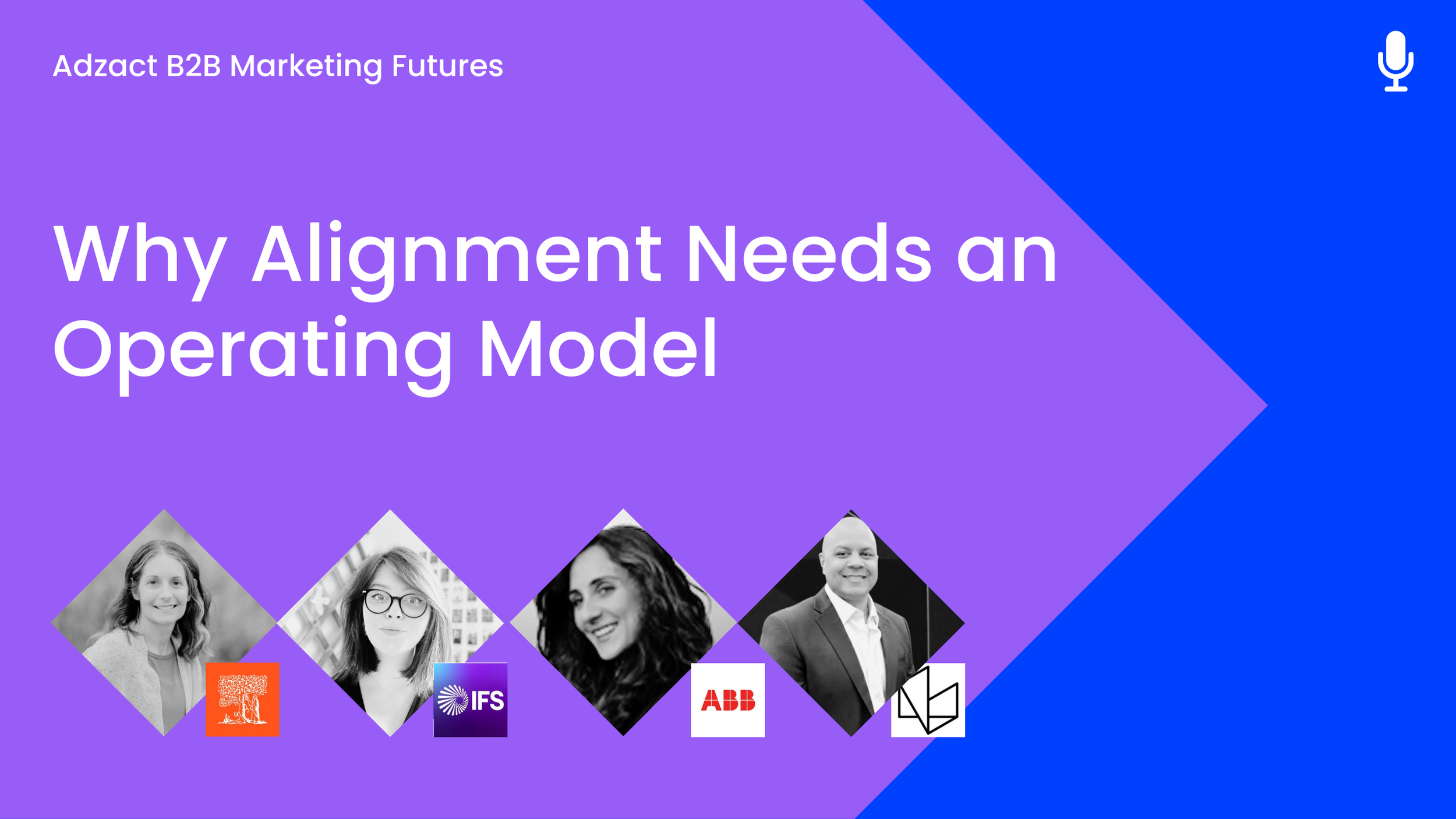
Sales and marketing alignment remains one of the most talked-about goals in B2B, and one of the hardest to achieve in practice. From lead definitions and data quality to attribution, incentives, and ownership, misalignment continues to slow growth and create friction across go-to-market teams.
In this episode, senior marketing leaders come together to explore where sales and marketing alignment breaks down today, and what practical frameworks, rituals, and operating models actually help teams work as one.
This episode delivers a candid, practitioner-led discussion on building alignment that drives commercial impact, including shared KPIs, ABM operating models, sales-informed messaging, leadership-backed processes, and how to demonstrate marketing’s influence across long and complex buying cycles.
Guests
Elise Cleary, Digital Marketing Manager at Elsevier
Lisa Andreeva, Account-Based Marketing Manager at IFS
Lorenza Fedele, Global Digital Marketing Manager, Robotics at ABB
Phillip Lewis, Senior Marketing Leader, Americas at Hexagon Manufacturing Intelligence
Transcript
Joaquin Dominguez (00:00)
Welcome to another episode of B2B Marketing Futures, the podcast for B2B marketers sponsored by AdSact Today's conversation is one of our favorite topics and is one of the most debated challenges in B2B organizations, sales and marketing alignment Despite better tools, more data and increasingly sophisticated go-to-market strategies, many teams still struggle to align on fundamentals like what a good lead look like
which accounts really matter, how success should be measured and where ownership sits across long buying cycles in global and enterprise organizations those challenges only multiply what's interesting is that alignment is rarely just tooling problem it's often structural, cultural and tied to incentives operating models and leadership priorities so the question becomes
what actually works in practice and where do even well-intentioned teams continue to break down to explore that I'm joined by four marketing leaders who bring very different perspectives across industries, regions and go-to-market models and I would love to hear short introductions on yourself so Lorenza, would you like to start? I give a sentence on yourself
Lorenza (01:17)
Yes, thank you Joachim and it's good to be here. Thanks for having me. I'm Lorenza Fidine and I am Global Digital Marketing Manager at ABB Robotics.
Joaquin Dominguez (01:26)
Awesome, welcome Lisa, welcome.
Lisa Andreeva (01:28)
Thank you very much. My name is Lisa and I'm the Account Based Marketing Manager at IFS.
Joaquin Dominguez (01:33)
Welcome Alice
Elise Cleary (01:34)
Thank you for having me. I am a digital marketing manager at Elsevier.
Joaquin Dominguez (01:39)
Awesome, I'm Phil, welcome.
Phillip Lewis (Hexagon) (01:42)
Hi, thank you again for having me. I am the Senior Marketing Leader for America's region of Hexagon Manufacturing Intelligence.
Joaquin Dominguez (01:49)
Amazing. Well, thank you all for those great introductions Let's start with the reality on the ground alignment is something most organizations talk about but far fewer feel they are truly truly cracked Where do you see the biggest breakdowns in sales and marketing alignment today?
Lisa Andreeva (02:08)
I've been doing regional marketing and currently I'm running account-based marketing. And I think one of the key frictions have been shared meanings and actually agreeing on definitions and what matters in reality. When marketing starts moving away from lead generation or pipeline creation and looks into conversion.
and helping sales drive the pipeline somewhere where they need to, and actually segment and focus on the accounts that matter. Some of the walls break. But ⁓ in my past life, when I was looking after MQLs, and I cared more about quantity rather than quality, there were a lot of frictions in terms of aligning on where marketing should actually spend the budgets and the time. But as soon as...
we collectively started agreeing on what matters, where we should go in collectively as one team instead of trying to separate into ⁓ functional rules necessarily and treating each project as a collaborative exercise that changed massively. Yeah,
Lorenza (03:13)
I agree with you. I also think shared lack of shared definition is key. And I think I'm not talking so much about marketing leads or sales leads or marketing qualified leads. I think companies are doing much and much better in defining those and agreeing with those, but more about readiness and intent. And I'm not sure if you have the same, but you can have a sales lead or sales qualified lead that is the right target.
It has decision making power or financial power, has a budget allocated and is prepared to commit to a purchase and knows exactly what they want. They're ready to put their hands up. But you can have a lead that has the same characteristic, but it's not sure which product, which solution works for them, not sure which companies to choose from because maybe they perceive the offering the same. And so they need more of a self nurturing. not knowing or not having an agreed definition on
Who owns that process, that sales nurturing? Is it marketing? Is it sales? Is it inside sales? Is it somebody else? I think that creates kind of like frictions and breakdown in the long term. I don't know if anybody else has seen this kind of trend.
Elise Cleary (04:22)
I agree with you both. I have also experienced this. think one of the points of friction I see often is understanding who the targets are. Is it a list of institutions, organizations? Because to set up that full marketing funnel, and I'm thinking from a digital marketing perspective, automation, building out the entire funnel across the user journey, if we know the target list,
of organizations and the individual pain points that can drastically change the marketing and the pieces of content serve. And that translates into perhaps budgets that could have been optimized in a more efficient way.
Phillip Lewis (Hexagon) (05:03)
Yeah, that all aligns well exactly with my positioning at Hexagon and what we experience from marketing. think, when I think in terms of our marketing here at Hexagon, know, we're in a manufacturing marketing industry, from our organization. And what I found ⁓ is that our marketing doesn't typically follow or, you know, align with the designed way of SaaS velocity.
in our world, we have physical products. have engineers and people that are out there aligning with consultative customers. And that's not very transactional at that point. So when we go out with our marketing interest or hand raisers doesn't technically mean readiness at all. So there's a lot of metrics of how do we align our,
messaging and our lead generation into readiness at some point in the map? And, ⁓ we see breakdowns all the time because, again, the marketing context around the manufacturing world doesn't sit at going fast with the messaging. it sits in our long buying cycles. So we have a challenge of trying to match. does Mark, how do we go to market? How do we
message the right audience and how do we tie those messages to all the multiple personas that we have within manufacturing. So there's a very big gap. Again, I've talked to Joakim about this before. Coming into marketing and driving in this manufacturing world, there's a lot of SaaS driven processes, but we haven't found really a tap into hardcore physical
reality marketing where manufacturing comes to play, where there's physical products, there's people talking and having consultation. So we have breakdowns inside that we try to optimize for speed where sales is optimized for consultation and long cycles. And that's where the balancing act comes in. We're trying to figure this out very quickly.
Joaquin Dominguez (07:00)
Well, that's a really helpful view of where things tend to go wrong Let's move from problems to practice In your experience, alignment doesn't improve just by goodwill so it usually requires a structure, rituals, operating models So please share with our audience what frameworks, processes, or rituals have generally helped you build better alignment between sales and marketing
Phillip Lewis (Hexagon) (07:26)
Yeah, I mean, I can continue off what I was bantering on from previous, right? You know, what we've done inside our organization because of this uniqueness of the manufacturing world and the folks that we market to and stuff is that we brought in the sales organization upstream, right? So we brought them in to help define persona definitions, to help deliver what the messaging to what are the customer pain points.
⁓ we sit in on maybe some closed loss deals with our sales teams to understand why were those sales lost. And we sit on that from a marketing standpoint, we sit in on conversations and discussions about closed won Why did this person decide to buy this product? Right? So we run this type of alignment across our, across our divisions within our organization, not just holding it into a marketing kind of queue where we're.
we're going to build out the marketing campaign and so on and then hand it off to sales. That hasn't been the case at all. So I think that's unlocked us to be able to have a two-way street between sales and marketing. it's grown. It's given us a lot more autonomy with sales to help them bring the deals faster. and also be more truthful in our marketing speak when we do go to market.
Lisa Andreeva (08:44)
can echo that. And given an account based marketer, obviously personalization and understanding individual accounts matters the most. That's the key priority. And it's less about talking to the account in terms of what we want to tell them and more about trying to understand what they want to hear and how we can help with their particular needs. And what I found the most effective is sitting down with the my marketing and sales counterparts and just
trying to peel off all of the layers and understand what actually matters. Where do we have our challenges as a company or as sales as individuals? What are the objectives of the campaign? Because obviously every campaign, given we're a sales driven organization is to close a deal. But there are also different types of goals within there. If we break it down step by step, it's building the right relationships, finding out the right people, hosting those meetings.
and driving the right type of communication. So through collaborative agreements on what matters and how we should approach it, what does sales do around this? What does marketing do? And how we can move towards the same goal in a clear, defined and accountable way and support each other. Because also it's, I think it's part of everybody's journey. Some things will work and some won't.
So being able to took a very fair and respectful look at things on what worked and sometimes more importantly, what didn't work and try to like, obviously not, it's not about blaming. It's about trying to understand the right ways of sorting out different issues and different accounts in different markets work very differently and we cover six different industries. So being agile and open to seeing
Well, the clear picture and collaborate with people with different sets of talents and priorities has been extremely helpful as part of our rituals.
Joaquin Dominguez (10:42)
And how often you have those meetings, if you are working across several industries that could become quite hard to manage, right? And you could be ending and yes.
Lisa Andreeva (10:52)
It is quite a lot.
Yeah, so my role in particular, I'm leading the center of excellence in terms of account based marketing. So I act as a consultant and advisor to most of my regional counterparts, and they involve me in some of the key priority projects. So it depends the real answer. Some of the projects I'm in most of the calls and having those conversations trying to align.
some of them are more ad hoc and just looking into different particular challenges and trying to advise in the best capacity. But yeah, sometimes it gets busy, but also I think those parts of my job are the most interesting and exciting because it's human based on top of all of the data that we get digitally, obviously on top of all of the research I feel in those conversations where
people with various talents sit down and actually think about human centric marketing or human centric sales. This is where the true difference shines. And yeah, this is why I feel like most importantly now in the world of AI, where pretty much everything can be complemented with artificial intelligence, those human connections actually mean the most.
Joaquin Dominguez (12:07)
Lisa, regarding your structure. You mentioned those ad hoc meetings. When did you decide to have an ad hoc meeting? Is it because things are not working or, I don't know. Tell me if you could share one example, that would be awesome.
Lisa Andreeva (12:24)
Yeah, of course. Most of the projects where I participate, I'm an advisor and supporter. So usually I'm being invited in those meetings during either certain cadences, or when the team thinks that they would appreciate an extra opinion in the projects that I run myself, if I have a feeling that I don't know enough to make a well informed professional decision in terms of how to approach the account. And that could be anything from tone of voice.
to the right phrase in some of the more complex industries like defense, for example, where very precise wording is very important. I initiate a conversation with some of the people who know the account the best and quite often at sales. It's the account managers that work with them quite often. And at least they can guide me to once again as a team.
And sometimes they also pick up some of my ideas and some of my phrasings to take those to their one-to-one meetings or calls or demos or other things so that we speak in unison.
Joaquin Dominguez (13:22)
That makes a lot of sense. Alice, you mentioned earlier that understanding who to target was key in sales and marketing alignment. Could you explore more that idea and give us an example of how that looks in reality and how it helps you and your team to align with sales?
Elise Cleary (13:44)
Yes, so understanding who the audience is and bringing in all the contacts that was already shared and the various perspectives is critical in the planning phase. And I would recommend having a planning phase, having a discovery. Before many times there could be really useful pieces of information and insight that are learned at the very end when you're trying to go to market. And it really limits the opportunity.
practical example of this is I serve global marketing teams primarily in the medical and nursing education space. And so if we have the insight from the sales team on who the targets are and we collaborate with our marketing counterparts, an understanding from the personas that are mapped out.
here are the challenges and here are the pain points and then helping connect that dot through advertising, through messaging. So here's how this product comes along and solves that challenge and knowing is the challenge relevant across all products? Is it relevant across all institutions? Is there a cohort of classes?
that it's relevant across an entire organization or just certain programs. So knowing those details can really help define before we go into channel strategies. On my end, I look at a lot of data and a lot of digital trends from what are the keywords and questions asked in both organic search engines and answer engines and starting.
from the get-go on knowing who that persona is, the audience, the challenges, the pain points, the successes, what we're hearing from the sales team, that will help drive the entire roadmap for that campaign. And when you think of a campaign and the life cycle, that could be months, it could be years, as well as retaining those clients once you are successful in ⁓ signing that contract.
Lorenza (15:53)
Yeah, I mean, I think it could really echo what everybody here has ⁓ said, it resonate very well. it's all about meetings, communications, building things together. But there is one lever that I've seen working really, really well, which is also shared ⁓ KPIs. And so especially when I worked in IT and tech consultancy, when you had a campaign or a project, you would have cross-functional teams. So sales and marketing, project manager.
or management or design, have rather had to be involved work together. And everybody was measured against the same KPI, so the same project outcomes, which in turns were linked to the personal KPIs of the individuals. And so also what that means is that when you have success that is shared, then collaboration and alignment is not optional anymore, right? And then
you repeat that kind of framework and with repetition you get a habit and then it becomes just a way of working and a way to align because you are working constantly together for that specific campaign or project. And so I think that as I've seen it works really, really well.
Phillip Lewis (Hexagon) (16:58)
Can I ask a question about that? Cause that's very interesting. Lorenza, how do you pick which KPIs are shared, right? Between the sales and marketing, is there a leadership involvement in that? Or is it really between the local marketing and sales folks for the region or whatnot?
Lorenza (17:13)
No, no, I mean,
it depends on the project or the campaign that you're doing, but there is agreement. And of course, depending on the different levels that you would have also leadership involved in defining those. But it could even be just simply, I'm just going to say something random now, but from marketing lead to sales lead conversion rate and sales lead to opportunities conversion rate, just to say common metrics. But those are shared, right? So there is an interest.
for everybody to really make sure that it works at the different levels and not simply, you know, my job is to generate marketing leads, my job is to just convert. It's a collaboration, you know. And so depending on the project or the campaigns that you would have, then you would agree on those, but those would be shared. it would be a project outcome,
Phillip Lewis (Hexagon) (17:57)
Yeah.
interesting. I love this stuff because it's just a crazy learning experience for my part too every time. when it comes to shared alignments, and Lorenzo, this is probably you or anybody else, right? When leadership looks at how marketing goes to market with a program or channels, do you have to also define what is demand gen? Because I find my leadership in sales might
totally think the mangins something completely different or you know I'm gonna have ABM, I'm gonna start ABM program, their totally mindset is different than that definition. So is that same similar experiences? I'm sure everybody has it on here.
Lorenza (18:35)
Yeah, to some extent. mean, we do a lot of, I'm going to say readiness programs or training, you know, trainings, for example, internal to kind of like speak the same language and, you know, as you say, get that kind of alignment in simple things as in, you know, what is the man gen or what is, you know, the man gen or marketing influence on sales outcome or, know, ABM, you know, what is it, you know.
Phillip Lewis (Hexagon) (18:38)
Yeah.
Lorenza (19:00)
You can have different types of ABM or levels of ABM, one to one, one to many, one to few. So trying to get the educational piece in. it's ⁓ definitely super, super important. And it takes time to build. We keep doing it. And hopefully, long term, will it be all on the same page.
Phillip Lewis (Hexagon) (19:20)
Thank you.
Lorenza (19:22)
Because what we also have is, I think at the base level, is kind of like also set the expectations right and make sure there's alignment, what's to be expected from marketing in terms of contribution to sales outcomes. So we work with our conversion rates and we have a conversion models and we work back
wards on it. So, know, again, if you have a marketing to sales lead conversion rate, and then from sales lead to opportunity, or account to opportunity, whatever that is, you know, and you work backwards, then you can really see what's the, you know, ideal marketing contribution to reach that sales outcome, you know, what would you need to achieve in an ideal world, but then you can plug in the budget that you may be have for that campaign or the project and then see realistically, what is the direct contribution that
that marketing campaign could have. And I think that kind of sets the basis for alignment in terms of expectation. So that's, at the base or starting point level for me. Philip, what do you think? Because we are kind of in a similar environment.
Phillip Lewis (Hexagon) (20:25)
Yeah.
Yeah, no, you're right. Absolutely. mean, this year is a little test in theory on my part. I could either have my job still at end of the year or not, but it's, what we're looking to do from our region is really, you know, our sales are long cycles. So attribution can easily break down at any point. And we all have KPIs, MGRs and MGOs, what have you.
But I'm really going to focus this year, and we're going to focus on, instead of what's converted, we're going to ask really what helped the old move forward and focus on influence. So we're really going to try to focus heavily on the influence direction. Are prospects more informed when sales talks to those prospects? Are conversations easier for sales?
We had a small example of this two years ago when we launched a product and we did a phenomenal job in our region to make noise well ahead of the launch. It's teasing, teasing, teasing, got to the launch, did a great launch. And then months after we just pounded the market with this product, right? And just talked about it. And all of our sales came to us and we're like, this is fantastic. I have my respectful customer that I've known for seven years asking me about
something from the product before I even got to them. Like their customers are coming up saying, Hey, I saw this, tell me more about it instead of the opposite. Right. So that model seemed to work really well. Well, then once, you know, marketing alignments start to change and our focuses have to be on other things, we found out that that fell off and people were like, Hey, how come this product's not being talked about anymore? Or there's so much noise in the market. Now it's not. So I'm going to focus on influence really.
much this year on understanding that, and help ask sales on what is working from our marketing standpoint. Are you getting the meetings? Are you seeing the messaging and hearing it from your customers? And then we're going to track that because at the end of the day, marketing doesn't own revenue, But we clearly, clearly, clearly influence revenue through our marketing processes and campaigns.
So I'm going to have a very big eye on marketing-influenced opportunities and track it heavily. It's one of the things that we haven't done deeply in our organization, but I think we have the tools now with AI and other tools in the background, in the backend, that we can now heavily monitor influence. And I'm going to use that as heavy as I can.
Elise Cleary (22:55)
So thanks for sharing that, Phillip. What comes to mind, there is a lot of research that LinkedIn campaign, through LinkedIn campaign manager and LinkedIn ads has shared on the impact of brand awareness campaigns. And you think brand awareness, getting the messaging out there of your current products or an existing products in the value.
And the question often that I'll get is, how does that convert to a lead? Well, there's a lot of evidence shown across a lot of platforms. When people already know about your product, brand awareness starts long before they decide to join that webinar, join that sales call. And it's all of the touch points. think it's an average of seven to 10 touch points before they go ahead and
convert, fill out the sales form. And so that attribution model is key as well. So I'm curious, Philip, when you consider influence, that, are those activities that your team is working on or are there third parties that also you've created partnerships to also scale your influence?
Phillip Lewis (Hexagon) (24:06)
Yeah, it's a good question. We so we do a lot of internal built campaigns that drive through different channels. And but then we also have a heavy alignment into the PR and media and paid media world. And what we're doing this year is we're we're developing a tracking solution for the third party outbound so that we can maintain a tracking, you know, KPI, let's say for those to see how often
did our message or this product or whatnot get mentioned in this publication? How often are we using paid media to help lift our voices up to the audiences that are correct for us, right? So from an affluent standpoint, it's not just looking at in our database, we use Salesforce, in our database, how many engagements did customer A or person A have?
Right. And, she seen that engagement tactic. It's that plus how often did this, person get, sit, sent a message on LinkedIn through LinkedIn paid or how, how, how often did we target this group of individuals and push content out there to these teams that are aligned to also our customer base as well. So it's, it's a heavy task that I'm trying to still.
navigate because again this year is really a focus on that. But at the end of the day I think influence is it's just a matter of ensuring that leadership is on board with it first of all and also that you know defining influence is a key KPI to say that's why our salespeople are having an easier job.
to talk to those customers or sell this product. I just can't live off of NGR at all because all the other stuff disappears. What about the 10 other touches that we promoted? You don't see that on an NGR. I mean, we see it out through the Influence KPI. So little bit different mindset going into this year, but like I said, we shall see. I've got a lot more to go.
Lisa Andreeva (26:12)
And I think the influence to pipeline and demand generation, not necessarily generating the demand, but nurturing it through the stages is one of the most complex things to make tangible and explain. My, my KPI, my annual KPI is marketing influence pipeline progression. And one of the key KPIs, ⁓ IFS for marketing is closed one deals. It's like helping sales close a proportion of the deals.
So for the last two years, it's been a journey to try to move from hearsay to actual data proven engagements. But this data is not always the numbers that we see on our reports. Sometimes this data is oral feedback from the account, which are the most priceless things when our sales rep would go into a meeting with an account and account would say,
Phillip Lewis (Hexagon) (26:40)
Mm-hmm.
Lisa Andreeva (27:07)
Hey, we saw this thing, it really resonates with us. And in the back of this message, could be three people working on this messaging just for them. And this is where we know, okay, we nailed it. This is going to the right way. yeah, quantifying and qualifying certain things. I think it goes back to our conversation about shared incentives and definitions, doesn't it? To agree on what we agree good looks like, what are...
sales objectives and marketing objectives, no matter how small and silly they are, and trying to also agree at the same time, how we're going to measure what good looks like. So that we could make an informed decision. Was that a job well done? Do you want to continue going this way? Or do we want to change something? Or do we want to just scrap it? Because once again, not everything works and it's okay. And the process of discovery is one of the most fascinating ones.
Phillip Lewis (Hexagon) (28:01)
Thank
Lorenza (28:01)
It's
very interesting what Lisa was saying, because we have a think of what success looks like. So it's exactly what you are saying. And measuring influence and direct contribution is also a key, two key kind of like KPIs if you want to put it down that way. So yeah, absolutely. Totally agree.
Lisa Andreeva (28:19)
And it brings us closer to sales, doesn't it? Because we start naturally speaking their language. We start naturally connecting to them in the places where they care about things the most. And our role becomes a bit clearer where we move from a position or like old fashioned position of like marketing as being a service to marketing being a part that actually helps move the needle. And this is where the relationships become very, very different and a lot more positive.
Phillip Lewis (Hexagon) (28:21)
Mm-hmm.
Yeah, that's spot on.
Elise Cleary (28:49)
continuing the direction we're going here, one thing that I think I've been thinking about a lot that has a huge impact on alignment is when we have that success story, when we have that win, when we have that insight, how to share that at scale. So and I'm thinking more internally, but also with external partners. So
routine dashboards, are they the same format? Do we all have alignment on the same metrics across the channel? And where this can make, I'll try to think of an example here, this can make a huge impact is a campaign that I worked on previously. We had alignment and the goals were clear. And through the six to nine months, we worked together on a
collaborative team, was really good collaboration, the overall goals continued to change. So at the end of the day, the reporting, we reported on a lot of different metrics, but really being able to define, you know, what were the friction points along the way and how did we define success in that? I think the takeaway could be.
the sales team had a different definition of success versus marketing versus digital marketing versus operations. So I think when you start the planning process and you have that internal and know what are the knowledge gaps right away, what are the areas of alignment and you have a routine agile process, Lisa, I liked how you had referenced that where you're iterating as you go and you throw out what doesn't work.
All of that also requires a high performance culture of being able to speak up, being able to share those insights, being able to raise your hand and say, hey, I thought we were going to achieve this goal with this AVM campaign. And it wasn't as successful. And do you have those conversations?
two weeks into the campaign and planning, or are we waiting maybe six months after a lot of effort has gone into something that could be redirected? So I'd say that's more of an internal approach and alignment that I find to be critical that drives the overall outcomes and just bringing in those knowledge shares and perspectives along the way.
Lisa Andreeva (31:13)
Yeah, and I think the reporting bit and analysis, it's more like execute, report, analyze, course correct, and then go again. So in terms of how we look, like most importantly, social media is obviously a huge part of it. One of the most complex things is like sometimes we target just one organization.
So the pool of people that are included in the campaign is minuscule by comparison to a lot other campaigns. So measuring becomes a bit harder also because benchmarks most likely don't exist. So we need to kind of correct the benchmarks or like adjust the benchmarks that exist in the industry for demand generation in general or to try to take the temperature on our own. Like how do we feel about this number?
Yes, it doesn't align with the industry benchmark, but what does it tell us? This is one of the key things is to be able to not only set the targets, but and report on them, but be able to give them a human face because sometimes lower engagement is not a red flag because we're actually engaging more of the right people instead of adding more people that will contribute to the numbers, but not necessarily to results. And in terms of cadences, we pilot
in particular social media campaigns for a month at first. And we measure them in terms of the first two weeks, and then we turn off certain creatives that don't, don't perform, and keep on going and adjusting the messaging, trying to analyze what people engage with and what they don't and why we can see certain patterns. But I see that with ABM, you can see proper results, like not tactical, but strategic based on the whole campaign.
within three to six months. So it's a very, very, very slow burner. So you do need those additional checkpoints within the journey of trying to understand how it's going. And this is where all of those agreements with sales with what do we want to measure? Maybe we have identified the buying committee and we know the people we want to engage. Can we track what they and their team engages with? Maybe, I don't know, a rogue person decided to thumbs up our ad on LinkedIn. Fantastic.
Like this gives us a lot of additional information to be able to measure the temperature. And sometimes the answer is we don't know. Sometimes the results are inconsistent. So it's continuous testing and discussions. And once again, conversation, conversation, conversation with sales, constant feedback loop of trying to collectively decide, okay, maybe it's not performing the way we wanted it to. Maybe it's performing just in a totally different fashion.
Maybe the messaging that the team engages with is not the ABM messaging, but a messaging of a different campaign that goes wider. Do we need to change the approach and what signals to read and how? And a lot of those are open questions that get answered on separate account calls because one size simply doesn't fit all.
Joaquin Dominguez (34:08)
mentioned a lot of interesting things, but I would love to continue on one about B2B marketers love big numbers. They love having or giving 1000 MQLs to sales. know, but on the other hand, I've heard a lot of salespeople saying, actually I prefer just one lid, but actually that is really, really warm.
Phillip Lewis (Hexagon) (34:10)
it.
you
Joaquin Dominguez (34:29)
And hopefully with all their buying committee aware of our solution and showing like very strong signals that they are ready to buy instead of having 1000 MQLs that are very maybe good fit, but not ready to buy. And yes, we need to be super aware that our counterpart sells. They want leads that are ready, not those that are good on paper. So yeah.
Phillip Lewis (Hexagon) (34:55)
Lisa's definition of defining the actual KPI. Like they're still in definition mode from a marketing standpoint. Nobody really knows how social is very, on an analytical level, knowing how social affects the sales direction. Right. And it's the same thing that we find too. We can go all day long and do these campaigns on social and have this big digital presence, but there's certain pieces of it that you can't measure. Like the thumbs up. mean, it's,
So I kind of want to say like, can we, can we just sales and marketing align with a KPI called excitement? I mean, you know, when you get them, when you get sales and marketing and excited about one thing, you know, something's working and it's hard to put a number on that.
Elise Cleary (35:29)
Yeah.
Lisa Andreeva (35:31)
Yeah.
Yeah,
totally. But it's also redefining some KPIs if they're actually not what we're looking forward to. So we've defined something, we're going after this KPIs. think we also need to be humble enough as organizations, not just as individuals to be like, okay, we tried it out. Didn't work. Why didn't it work? How can we change it? So it's, it works better.
Joaquin Dominguez (35:56)
Definitely not easy. It's a mix of a lot of data, even self-reported attribution and signals that are qualitative, not always quantitative. And it's our role to measure them. And they are as important as those that you can measure in all your campaigns. Well.
Thank you so much for today's conversation we've covered a lot of ground from the root causes of misalignment to the practical frameworks that help teams work better together and the realities of supporting sales outcomes across complex global organizations Thank you all for such an open and thoughtful conversation and thank you for joining B2B Marketing Futures until next time, thank you so much