
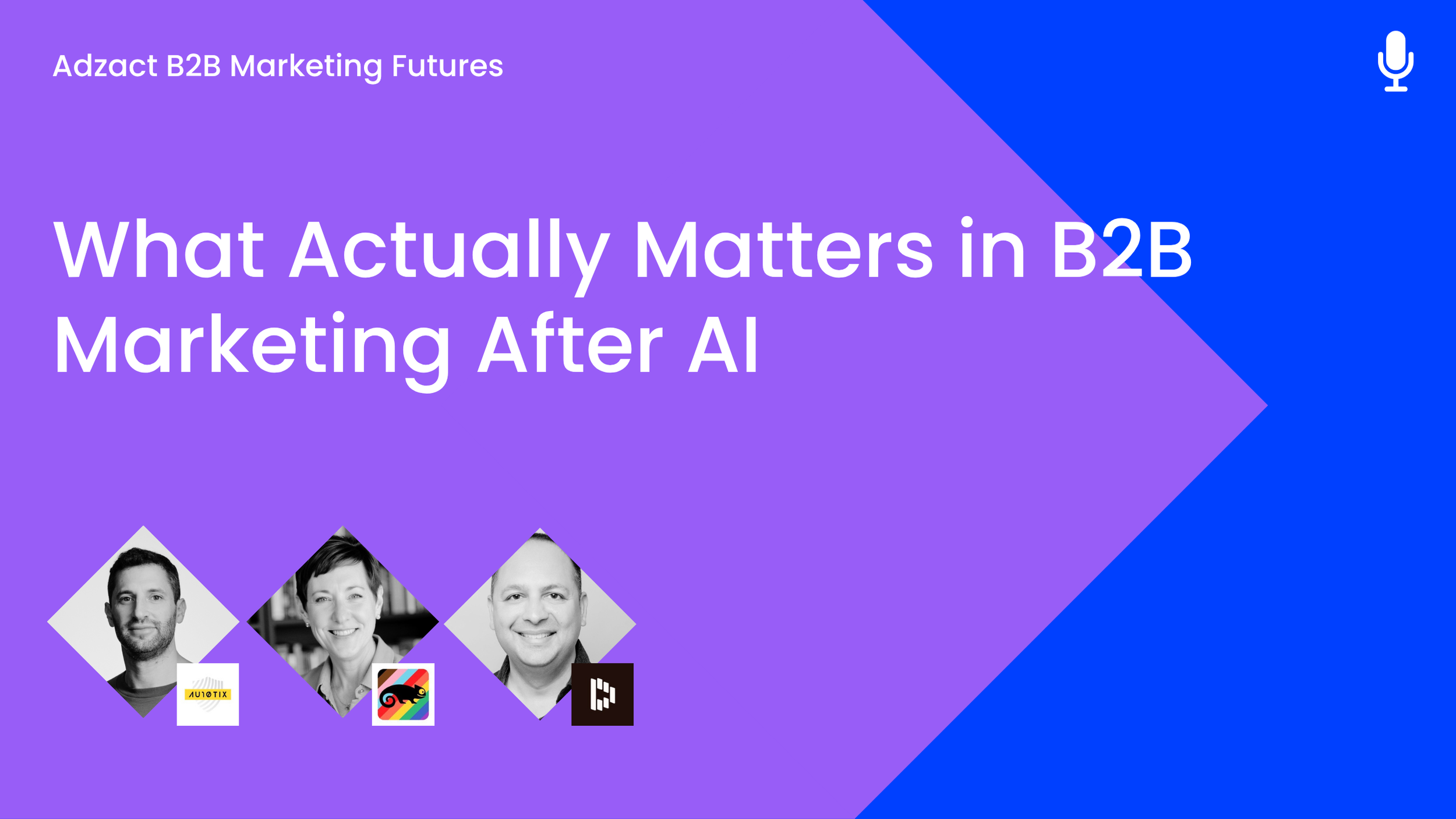
What Actually Matters in B2B Marketing After AI
If AI can now execute most marketing tasks, what stops everything from becoming commoditised?
We’ll open by challenging the idea that AI is just an efficiency gain, and explore what actually creates differentiation when everyone has access to the same tools.
Where does advantage come from now: data, strategy, brand, or distribution?
This question breaks down the possible sources of edge in an AI-first world, and whether one clearly dominates or if it’s the combination that matters.
Is targeting still a problem, or has it effectively been solved?
We’ll examine whether AI-driven signals and automation remove the need for traditional targeting approaches, and what replaces them if they do.
If everyone can generate content at scale, what makes marketing effective rather than just abundant?
This focuses on quality vs volume, how taste, narrative, and positioning evolve when content production is no longer the bottleneck.
What do high-performing marketing teams focus on when they’re no longer executing campaigns manually?
To close, we’ll explore how priorities shift, from running campaigns to designing systems, shaping strategy, and influencing product and market direction.
Guests
Dhiraj Kumar, Chief Marketing Officer at Dashlane
Margaret Dawson, Chief Marketing Officer at SUSE
Simcha Weil, Demand Generation Leader at AU10TIX
Transcript
Joaquin Dominguez (00:00)
welcome to another episode of B2B Marketing Futures, the podcast for B2 Marketers is sponsored by Sact.
Today we are asking a question that is becoming harder for every marketing leader to ignore. What actually matters in B2B marketing after AI? Because if AI makes execution faster, cheaper, and more widely available, then a lot of the things marketing teams used to compete on start to look less defensive. And like content production, personalization, outbound, campaign creation, reporting.
as a generation, these are all becoming easier to scale. But that's not necessarily mean marketing becomes easier. In fact, it may mean the opposite. If everyone can produce more, personalize more, automate more, then the real advantage shifts elsewhere. if it shifts to judgement, positioning, brand, customer understanding, trust, distribution, creativity, and
The ability to know which buyers and accounts actually matter. So today we are going to explore what becomes more valuable when execution is no longer the bottleneck. We'll discuss what AI commodity size, how B2B brands can break through the noise, why targeting is still such a hard problem, and what marketing teams should change now to stay effective over the next few years.
But before we get into the discussion, I would love to hear short sentence on yourselves. So Simba, maybe would you like to start? Welcome.
Simcha Weil (01:33)
Yes, yes, sir.
thank you. So yeah, so I'm Sim Kowau. I lead demand generation at a company called Authentics. they do identity verification for users, working with customers like PayPal, Booking, Coinbase to authenticate users, see that they're real users, not deepfake, onboarding deepfakes or tampered documents, especially today with deepfakes and AI all over. In the past, I've been head of marketing at a ad tech company called
called Prim is part of the McCann group. Happy to be here.
Joaquin Dominguez (02:06)
Welcome. Margaret, welcome.
Margaret Dawson (she/her/md) (02:08)
Thank you. Margaret Dawson, I'm the chief marketing officer at SUSE. we're an enterprise software company, specifically infrastructure software, and everything we do is on the open source development model. So kind of open infrastructure sovereignty and AI infrastructure as well.
Joaquin Dominguez (02:24)
Awesome. Welcome, Margaret. Dear Edge, welcome.
Dhiraj Kumar (02:28)
Well thank you. Thank you having me and excited to be here. Dirac Kumar, I'm the chief marketing officer of Dashlane, which is a global credential security, password security company. We both serve consumers as well as enterprises, and really protect people from credential threats which are getting worse as AI becomes
and this is an exciting conversation, I think, for all of us. AI is so central to the topic being discussed in the department.
good to be here.
Joaquin Dominguez (02:58)
Welcome
all. Thank you for those introductions. Let's begin with the the bigger strategic question, right? Because for a long time a lot of marketing advantage came through being available to execute well. Could you produce enough content? Could you launch campaigns quickly? Could you personalize at scale? Could you build workflows that competitors could not easily replicate? But AI is changing that.
It compresses execution time, it lowers the cost of production, and it gives more teams access to capabilities that used to require specialist resources. So the question becomes if execution is no longer the scarce thing, then what is? Is the advantage now in data, strategy, brand? I would love to hear what are your thoughts on this.
Dhiraj Kumar (03:46)
as marketers, we all are driven to compete, to stand out. I think that's our job. and I think you're absolutely right. I think, you pose the question if I can automate everything, if I can produce content at scale, where is the edge? And part of at least for myself, I've been thinking a bunch about
it's a transformative moment. It changes how we do marketing. How does it compare to other transformative moments that we've had, what we learned from it? And digital was one of them, right? If you go twenty years back, and when digital came, it dramatically changed our ability to target, to automate, to reach people, distribution, media execution, the speed at which and yet you look at the last 20 years and the big brains that were built.
Whether it's Salesforce or Google or Netflix, Spotify, it doesn't matter. A couple of things are true. Even as every brand could now compete in the in a scale media, there at the end there were very distinctive stories they were telling in the marketplace about who they are, what they offer, obviously the product itself. I think the second thing is their ability to react and respond and understand their customer.
That was great. and I think they took advantage and they knew how to use the modern channels effectively. So I think there are some parallels to what would be true even now, as transformative as this is, I think there will be a much greater focus, but you have to still be distinctive in terms of what you offer to the customer and the story you're telling.
You have to be great at the new channels that'll emerge and how to use them effectively to serve the brain story. And the speed is going to change. And how do you take advantage of the speed to react and respond to learn faster? I think those in my mind, I think those are the things that'll be true. And the question, how do you build for that?
Margaret Dawson (she/her/md) (05:30)
Yeah, I can add to that. I I think you're right. There's foundational elements that don't change. And I think sometimes we love to think that any new transformative technology or movement, like, we just want to pivot or knee-jerk, but the same things are true that having that clear positioning and messaging, having a differentiated point of view and how you communicate that, I think.
continuing to be creative, having humor and boldness, in your stories and in your brand, still make a difference. In fact, even more so. I think there is something very, human about the way we use humor or that engagement that continues to give an edge. It has to be authentic. and you can actually tell when AI is trying to be funny. and it doesn't always work very well.
I think the edge that AI gives us, and Dirige kind of spoke to this, is the speed of which we can gain intelligence on our competitors, on our customers, on our prospects, and then how we use that data to very quickly inform the campaigns and how we're going to market and how agile we can become to have that human engagement. But I I really, I'm a true believer.
in the story and in the message. And I think that you don't give that over. You inform and train AI, how to use that and your voice, but you don't hand it over to them.
Simcha Weil (06:50)
Yeah, I totally agree. I mean the fundamentals are the fundamentals. I do have to say it's much harder. I mean it's much harder because
Margaret Dawson (she/her/md) (06:57)
Yeah.
Simcha Weil (06:58)
yeah, we feel it all over. I'm talking to other marketing leaders. It's just hard today.
Margaret Dawson (she/her/md) (07:03)
Yeah.
Simcha Weil (07:04)
It's really hard. It's much faster, which which is great. Okay, we have these tools, we can move fast.
Also, your competitors, also our competitors are moving fast. There's so much content out there and amazing content, right? Because AI could give you the wow effect. And then it feels like the customers are losing it. It's much more effective anything we do. And so I think it's forcing us, so it's like a blessing and a curse. It's forcing us to stop a second. Okay.
especially in B2B, to stop a second and think, okay, what is really effective? What message will resonate? what really is our story? Who are we really? What really differentiates us and it forces us to get to the fundamentals? Where in other times you could just, flow, do what everyone's doing. And if you have a good ad, people will see it today. Nobody's gonna see it. Just to get a really good ad, you have to get a really good message. You have to have a very clear
and to the point message. so it's a blessing. So it's so hard that it's a blessing because it's forcing us to be much better and much more strategic. Yeah.
Margaret Dawson (she/her/md) (08:05)
I hope so. I hope that it means that there'll
be no marketing fluff. It's funny because I always train my my AI, agent, I'll always say, Can
Simcha Weil (08:12)
Yeah.
Margaret Dawson (she/her/md) (08:13)
you just read this and get rid of any fluff? And it's like, thank you. So maybe we'll have
Simcha Weil (08:17)
Mm-hmm. Yeah, yeah.
Margaret Dawson (she/her/md) (08:18)
to be even more clear.
Simcha Weil (08:19)
Yeah, hopefully.
Joaquin Dominguez (08:20)
Yeah,
Margaret Dawson (she/her/md) (08:21)
So
Joaquin Dominguez (08:21)
exactly because when every team has access to the same tools, to the same models, and the ability to generate campaigns, emails, ads, landing pages, research and accounts as you were mentioning, Margaret. like so things become inevitably commodity sized, right? Are less differentiated. We are already seeing this with automated outbound
A lot feels more personalized on the surface, but less human in practice, right? So and I think the same thing happens with thought leadership, with ad creative, with many different things that you feel AI behind things. So I'd love to explore where you think AI generally reduces differentiation and where human judgment is still matters most.
Margaret Dawson (she/her/md) (09:09)
I think we just spoke to part of it, which is the danger of depending too much on AI, especially with content, is it's only going to be as good as what it can learn. And if everyone's using the same pool of knowledge, so to speak, right, we're gonna be less differentiated. And you see it already. I don't know if I'm I'm assuming everyone goes to trade shows and for whatever market category you're in. I mean, there's sometimes you'll be at a conference and literally the sea of booths.
look and feel and sound so similar no matter what the category is. So, it goes back to that wasn't AI's fault, right? That's our own, but somehow we're all getting watered down in our differentiation. So I I think in this era, you're right. what AI can commoditize is optimization of content.
workflows, tasks, like we should just give that all to AI and focus more time on creativity, on strategy, on boldness, on, what is gonna engage with a human. and really being clear on where I I AI can shine and where we need that doubling down of humans. And I'll just give one example. We recently worked with a what I would call,
old-fashioned advertising agency to do a real live ad using actors, but it's very tongue-in-cheek. It's very, humor first. It's taking a pain point of customers, which in our case I mentioned we were open source. So this is, customers sometimes hate the black box, the proprietary technology where they can't see inside the black box. And
We built an ad where literally a human was inside a black box like he was trapped by the vendor. And so we're just gonna be rolling this out. hopefully it'll be out before this podcast is. But sometimes things like that become really important because it's so different. People are like, wait, this is an AI. This is like humans, and they're being just ridiculously funny about a pain that I have, but hopefully it'll stop them, right? To think about something because it's different.
Simcha Weil (11:08)
right.
Dhiraj Kumar (11:09)
it's about standing out. Right. It's about
Margaret Dawson (she/her/md) (11:11)
Right.
Dhiraj Kumar (11:12)
kind of making people pay attention.
Simcha Weil (11:14)
I think just like you said with the trade shows, it's always a race to the bottom, right? in any very competitive market, everyone's gonna do and copy. And now with AI it just became 10x, right? Much faster. what happened last year is so irrelevant already. we moved so much forward we have to stop and think, it's I think it's even a little different than B to C.
Because B2C, you have millions and millions of customers, so why not get out of a thousand different ads and whatever works, works, right? And B2B, when you're trying to get to very specific people, you gotta stop and think. You gotta be much more effective. Do less and do smarter, be more effective. Focus your budgets, your energy on the things that'll make a difference. that's what I feel. You can't just, all right, do everything. No.
Joaquin Dominguez (12:00)
I agree with you, Simha, but the challenge then is how you do that precision targeting and messaging with creativity. Because for years B2B has been really focused on that, on talking specifically to decision maker, to the pain point. But we forgot about the important thing that we are talking to humans and you need to do it creatively and
It doesn't matter if you are a B2B brand or a B2C brand, you're just a brand for a consumer and you are competing for attention points. And B2B brands have invested a lot on creativity for years, right? So they have that advantage, I believe, on this. And the question is how B2B brands can start thinking more creative creatively and and putting like those campaigns out there that
will be different, right? At the end of the day, I don't know.
Margaret Dawson (she/her/md) (12:53)
No, I think
you've got to be bold. I think I I call it poke the pig or poke the snake or poke something. Like you've got to have that kind of differentiated point of view. And it takes courage. And I think that's something that marketers have not always had to have. It was good enough to just tell your story. But I think the human side is how do we push ourselves to be bold, to be courageous, to be different.
and still relevant to our customers, and then use AI to take that content and take that creativity and deliver it to the person in the channel, in the format, in the moment that they're interested in it. And that to me is the combination is that use the humans and our empathy and creativity and soul to come up with these, new ideas and engagement. But then AI is the one that's gonna help us reach the people.
based on, what they're looking for at the time they're looking for it in the channel they're looking for it. And that's what we couldn't do well ourselves. And AI thrives in that.
Joaquin Dominguez (13:55)
Yeah,
and Margaret,
Dhiraj Kumar (13:55)
Mm.
Joaquin Dominguez (13:56)
during our briefing call, we had a conversation about how many companies still struggle to answer the basic question of who are we? Right? And
Margaret Dawson (she/her/md) (14:03)
Right.
Joaquin Dominguez (14:04)
if you can't answer that simple question, then how can you become memorable and how can you think creatively?
Margaret Dawson (she/her/md) (14:10)
Yeah, AA's not gonna help you if you can't if you don't have that down. Doris,
what were you gonna say?
Dhiraj Kumar (14:15)
Yeah, I was so you asked the question about how's AI helping you how the role of AI is in the a marketing organization shaping and I would say we're all experimenting with it. And more recently, I would say in our teams that kind of two different use cases are emerging broadly.
One is what I would call automation and the other thing is I call augmentation. Automation we all know, can we automate a whole bunch of things here whether it's campaigns, the media targeting, the analyses.
But more recently, we are seeing, and we're using Claude effectively in Gemini, where we're not using it for automation, but to go back and forth. Margaret talked about, well, how do you build a story? And so we have built a system where we can actually process tons of customer calls.
Margaret Dawson (she/her/md) (15:02)
Mm-hmm.
Dhiraj Kumar (15:02)
But rather than saying, give me the thing, we're asking them, we give a lot of context about the business.
We're kind of pushing, we're playing some ideas, we're developing new positioning to get to that distinctiveness. But rather than saying, hey, listen, can I automate all the gong calls and get insights? We're saying get the gong calls and now go back and forth. Here's a point of view on positioning. Does that make sense? It comes with something which is okay, but makes us think a different way. And so I think that's in a way I I had sort of been
Developing a new way of thinking about AI, which is not as much a technology or a tool. Imagine if somebody said, Hey, listen, you can have tomorrow bunch of experts, creative experts, branding experts. they're not experts particularly in a business, but they're branding experts, creative experts, the strategy experts, media experts that are sitting next to you. And you have them available. What are you gonna do with it?
And I think the power of that sort of expertise and intelligence is in sort of the dialogue, is the strategy development with them. So I would say that's an interesting change we are seeing, which will allow us to use AI in a different way, not as an automation tool, which certainly is a big use case, but as more of an augmentation.
Simcha Weil (16:14)
yeah, It's a superpower that we have. So it can't do it for us, right? It can't do the strategy of the company and be the smart marketers we want to be. But it gives us, yeah, it augments us and makes us much stronger. but yeah, I think the the basics of really stopping and thinking, it just amazing how important it is more and more these days. You have to stop, yeah, and think.
Joaquin Dominguez (16:36)
Yeah.
And and since during our briefing call you mentioned authentic's that the campaign We love fraud. It
great to hear that story because I think i it exemplifies very well that creative work that feels human, distinctive and hard to replicate through AI alone.
Simcha Weil (16:55)
Exactly. So we're in a market where it's very competitive. So there's a lot of companies today that will authenticate users, right? It's not
cutting edge, all right. It's not cutting edge technology. There's a lot of competitors, and everyone's talking the same way, right? You're scared someone's gonna, fraud is gonna come in, they're gonna steal from you. There's a dude with a hoodie, and he's on his computer,
Margaret Dawson (she/her/md) (17:17)
Yeah.
Simcha Weil (17:19)
and then that these are all the images, and everyone's just saying how many different features they have. You can do it in four seconds. We have a competition about how many countries do we have the IDs from. So we wrote 195, just like the US
Our competitors wrote there's 220 countries
someone wrote 250 because each state in the United States it's just getting absurd. so we ran with AI and we tried to think of all kinds of strategic, but it's not there. And we took a creative consultant, one of the leaders
In McCad, he used to be chief creative, and we asked him for ideas. He had ideas that AI won't give. So one of those ideas were really creative, like that most people will take a pill, but we're the vaccine. And I'm like, no, no, stop that. No.
Margaret Dawson (she/her/md) (18:03)
Ha ha ha
Simcha Weil (18:05)
Like this creative people. This is creative people. But his other idea was, listen, we just love fraud. We have this thing.
kind of weird, but we love to watch, shows. We look at people, big fraudsters, and we admire them. And we decided to go to the biggest event of the year, Money 2020 in Vegas, where we we spent like almost a half a million dollars on the biggest booth.
And we did a hall of fame to the biggest fraudsters in history.
Okay.
Margaret Dawson (she/her/md) (18:31)
I love it.
Simcha Weil (18:33)
And and we talked about how we admire them. And now this is, this is an audience that come to say, how do you fight for? And we just we love fraud and we admire them. And this had so many amazing conversations. the first night I didn't sleep, just worried what's gonna be because I pushed this whole thing forward.
and it was just amazing. People came over, people sent their assistance. I want to get that hat. I love fraud. I love fraud too. And it was a whole thing. It was like a movement. And that's something, at least today, AI, AI isn't there, right? To give you the out of the box. And that led us to all kinds of different iterations on the campaign where employees in the company, you know, talk about how much they love fraud and how they caught fraudsters in their eyes. They're like, wow.
and it's a thing and people connect, people laugh. And when the ops started coming in and people said you said something about loving fraud, or some people answer and say, Listen, I don't love fraud at all, but let's meet tomorrow. It's
Margaret Dawson (she/her/md) (19:25)
Ha ha.
Simcha Weil (19:26)
a conversation. I love it. There's a sentence I took from the email where you said, Hey, you want to meet at an event SDR that I manage? And she answered, Listen, I don't love fraud. When are you available tomorrow? and it's just perfect. That's that's the thing, right? AI doesn't give you
Margaret Dawson (she/her/md) (19:39)
But I love that.
Dhiraj Kumar (19:39)
November
Sion started it.
Margaret Dawson (she/her/md) (19:40)
And it's live. I mean, I I think every marketer has experienced this. it was a little bit post-COVID as well. And AI somehow has done this. All of a sudden, live events are more successful than ever. Like, and I think some of it is we're all seeing the impact on, website traffic. And although I will say
AI is helping us there as well. But there's something about live events. And so if you can allow people to enjoy themselves and get educated and try to solve some of their problems, at these events, it's just a win-win. But it's almost like this craving people are showing up at these events. I'm like, this is insane. Like I don't remember this.
ever before, other than maybe, the nineties at C Bit or some of these old shows we used to go to in IT, So it's fascinating to watch.
Dhiraj Kumar (20:24)
It goes back to
Margaret you were saying earlier about some fundamentals remain true. And
Margaret Dawson (she/her/md) (20:28)
Right.
Dhiraj Kumar (20:29)
I think when you're trying to make decisions on major B to B products or spending, to be able to engage, you ask questions, to have interaction with fellow peers and with the vendor you're interacting. I mean that remains that was true twenty years ago, that remains ten years ago, remains true. I think what's i would be interesting
I just had a meeting with a vendor, AI vendor who was pitching a product that just takes that event and the pre and the post management event and automate it through AI. So it's kind of these interesting things are emerging where I think the fundamentals still remain the true and what'll change slightly is how you execute those fundamentals.
in a new way. And that's what happened with digital. And that's gonna happen here too. so I think that's kind of some of the interesting things that'll emerge over the next couple of years.
Margaret Dawson (she/her/md) (21:18)
Absolutely.
Joaquin Dominguez (21:19)
Absolutely. And I think this brings us neatly to targeting because B2B is different from B to C, right? Because we have the advantage that we know the companies that you need to target and the people working for these companies, then everything after that is way easier. You just need to be creative. You just need to be I know it's it's easier said than done, but
targeting is meant to be much easier with AIs because we can analyze more data, we can understand more accounts, map buying committees, identify patterns, but in practice, B2B targeting is still incredibly hard. Knowing who to target is not just about having more data, it's about knowing which accounts are actually a good fit, which personas
Margaret Dawson (she/her/md) (22:06)
Mm-hmm.
Joaquin Dominguez (22:07)
matter, what problem they are trying to solve.
I would love to hear how are you thinking about targeting and how AI is helping with with with that.
Simcha Weil (22:16)
This is one thing I could say, only good things about AI.
it helped me, I focus a lot on that, so that really, really helps me. Okay. I do things with cloud code that would take me three days, I do it in 20 minutes, like like that. It's amazing. we also use, I don't know if we should say tools, but let's say recording conversations across the whole company, the whole sales team, and then we use AI to summarize all the data there, and then what are the five most important things that come up?
It's that's amazing. And then you could find or who are the titles? Put them into blogs. Who are the titles that are most effective, that have the highest conversion rates? Amazing things. They they used to have to run data now. It's like five minutes to ask that question. It's like what are the best converting titles in the last year? yeah, and and there they could be complex workflows with working with different sourcing tools, enrichment. There are so many.
And each one has their own things. so it could get complex, but today with AI you could do amazing things. I see it. Yeah. Targeting is still not easy, but it's much better for me.
Margaret Dawson (she/her/md) (23:20)
Yeah. I think you still have to know your personas and your buying groups and what makes a company relevant to your business. Like I don't think that goes away, but I agree that the use of AI and then intelligence to focus on the right accounts based on intent. Like I think intent data has just changed the game. when you start to be able to see
the opportunities or just where that account is in different market categories and in the process, which people are involved with that. so it it's still that combination of AI and human engagement, but I mean our ability to quickly understand, who
is at a certain stage or which personas are engaging the most or I love your questions, like just being able to ask in natural language, like, which campaigns are converting the most and where do I put more money? that took hours and hours to to analyze. And I still think that's the opportunity. I still think that hasn't quite
gotten there yet where, literally like the aggregation of all those data sources, because AI would have to be able to get into all of your tools. I think it'll be there in the next six months. and I can't wait to be able to say like, show me the top five investments and where I should put money the next six months. like I would love someone to take away time on that. so we can focus on other things, but
Dhiraj Kumar (24:36)
question which gonna I think it would be interesting over the next three years. We certainly there is a huge opportunity in improving turreting. With targeting and B2B complex. The question is in two or three years, as everybody can run a tool and do the turreting. If you're in your category and I'm in my category and trying to compete with the other players in our category and everybody can do it, the same insights through turreting.
it's the same question we are posing for every part of that can be done easily for everybody. Where's the edge? And I think the part of I go back to a little bit what you were saying earlier, Margaret that the intent it's a continuum, targeting is a continuum. And I think we will get into more deeper understanding of not just who's in the market, but before that.
who's thinking, who's dealing with problems, and that requires much more each brand coming with their own strategy and using AI to unpack a unique advantage. I think that's where the game is gonna get played in targeting over next few years once we get through the phase of getting the base level intent squared away pretty fast.
Margaret Dawson (she/her/md) (25:43)
I mean, the reality is the targeting is almost reversed, right? Because there's tons of data that shows now that your buyer has either found you or not found you, from very, early in the process. And by the time they reach out to you, they're already 70% down the way, right? So your
Simcha Weil (25:59)
Okay.
Margaret Dawson (she/her/md) (25:59)
ability to target your customer versus your customers targeting you, it's become a different game.
Simcha Weil (26:03)
Exactly.
Margaret Dawson (she/her/md) (26:06)
Like you almost have to get in front of everybody, right? And then hope that the people that you want.
Dhiraj Kumar (26:09)
Which goes back to invest
Margaret Dawson (she/her/md) (26:12)
back to that, yeah.
Dhiraj Kumar (26:11)
in Brain, right? that's a big question going on
is the investment portfolio. I mean you still have to do the foundations of ABM campaign, but maybe the investment in Band become far more important in the world we're moving into.
Margaret Dawson (she/her/md) (26:25)
If they cannot find you, I mean it's become so no we were already in so much noise pre-AI, right?
Dhiraj Kumar (26:32)
Yeah. Yeah.
Margaret Dawson (she/her/md) (26:33)
You add AI in the fact that they don't even have to come to your website now. I mean, at least before the noise, you could pray they found your website or pray they found something, but now they don't even have to go there. That content's being delivered to them. So how you show up and how you get included and
How you still sound human, but you've gotta, make sure the bots find you. I mean, that's the complexity now, right? And I think you're right. I think it goes back to content is king, brand to demand, you know, it's like I it it feels like back to the future sometimes, you know, even though the channel is different.
Simcha Weil (27:04)
Yeah. And and one thing that goes into here, I think, is really connecting with the other departments in the company. I'm just working so much more with product and with sales. and because all this data on what customers like and what bothers them, at the end of the day, I mean, if you can't get to them in a good way and they're getting to you, you have to have a product that feels good, that looks good. You have to answer really their pains. They have to like you.
Like if you don't have a good product and if your sales don't know, exactly how to communicate, then the marketing won't work. You have to work much more holistically today. You just to think what the person, what the client, what the customer feels, needs. And if you really serve him well and you look good and you tell in a compelling way across the company, in your product and in your sales, then you're gonna be effective. It's not
I don't know if today could work where you have a very cool marketing out there and that's if people are gonna buy you. You're gonna have to work together, at least in my case with product and sales, that it's gonna be a holistic picture where people like you. Yeah.
Margaret Dawson (she/her/md) (28:08)
Yeah.
But I think this
Dhiraj Kumar (28:08)
Little
Margaret Dawson (she/her/md) (28:09)
leads into you're probably gonna go there, Jokin. It's like you're bringing up the point of integrated programs, integrated campaigns, integrated go-to-market. And I think you're right that you said something earlier somehow that I think is really important, which is focus. And I think it's focused on fewer things, and all the levers have to move against that focus, right? And that's how you break through
Simcha Weil (28:30)
Exactly.
Margaret Dawson (she/her/md) (28:30)
the noise. So
I am a true believer in integrated campaigns and like three or four things. You can't be known for 20 things. Hopefully it's two. But then your entire company, everything that's, going outbound and inbound has to be aligned to that focus. And, because that's the only way you'll break through.
Joaquin Dominguez (28:47)
What skills become more important to align the organization to that focus? How should marketing sales teams and and product work together?
Margaret Dawson (she/her/md) (28:57)
I mean, this is gonna sound funny, but I have found program and project management and related tools to be life-saving because the thing that is always missing to get that full integration is visibility and coordination because everybody's doing a million things, right? We've never been lacking action, so to speak, or activity, whether it's the right things, I don't know, but having that visibility to say, okay, wait, next quarter, all of this is already happening.
How do we make this make sense together? Or maybe we shouldn't do these 20 things and just do these 10 things. And look, all of these are aligned to security. Let's just do focus on security for the next quarter or whatever it is, right? But things like Asana or Trello, Ajira, whatever your flavor is, and how they're
incorporating AI capability to help you. Honestly, it's become critical to our job. And then the data is the other piece I'll put in there. It's just how the analytics, and how we use the data. It sounds funny though, right? It's like what's
Dhiraj Kumar (29:55)
Yeah.
Margaret Dawson (she/her/md) (29:55)
critical to marketing? Project management and data.
Joaquin Dominguez (29:58)
Go going
Dhiraj Kumar (29:59)
Yeah.
Joaquin Dominguez (29:59)
going
to b basics, yeah.
Margaret Dawson (she/her/md) (30:00)
Right.
Dhiraj Kumar (30:01)
Well, I think that's the theme. I was gonna build upon what Margaret said. I think they're kind of there are two kind of areas emerging, at least on my team and one is all roles become far more strategic. And what that means is they become far more the core fundamentals of marketing. So if you're in the product marketing arena, you about how do you position the product.
How do you position the company if you are in the growth arena? It's about how do you stimulate domain. And I think a lot of the operational piece will get out. So you have to start getting some people who can be strategic and really love that and can actually up level themselves and be able to think because it's not as much the operational activity as you said. It's more about thinking. so that's kind of one part. The other part that's about skills is is
adaptability is becoming far more and you're seeing some people
Margaret Dawson (she/her/md) (30:50)
Yeah.
Dhiraj Kumar (30:50)
comfortable with it, some not, we're gonna go through a lot of change. Workflows will change, job nature will change. And I think it goes also when you're trying to develop programs, what you gotta be very quick and understanding feedback coming in or insights coming in, be able to use that. And if you're used to like, hey, I gotta run this campaign, I gotta run this channel, and I'm just about how I execute this well.
versus now thinking I have to process a lot of information, maybe talk to the eye and think about a different strategy. And doing that adaptability and change, even how you operate, I mean that adaptability is I'm finding some people really good at it, some very uncomfortable. And those are things emerging to be great skills. And it goes back to a little bit more fundamental skills. that
Margaret Dawson (she/her/md) (31:37)
I spot on. Yeah,
change management. I
Simcha Weil (31:39)
Yeah.
Margaret Dawson (she/her/md) (31:40)
was just talking to my leadership team about this. It's like this has become, such a superpower.
Honestly, and and I don't think we're great at it. I I'll say that to myself. Like I thought because I love change, I thrive on it. I think that's typical of people that have been entrepreneurs or kind of become leaders, but you you just assume everyone feels like you. It's like, ooh, look at that, let's go, let's drive this. And wow, they're like you look behind you and everybody's still on the other side of the pond, right? And so I think we really have to be aware of
how we bring people on this journey. But the problem is, and you've all said this, the speed of which we have to change has become so great. But I'm worried, like, is there, how we hire for that. And if you only hire for people that are super agile and fast, are you missing, talent that are the processors and the thinkers, which are always, I always need those near me. And so I think this is a huge issue that we've got to address and really
tackle and I don't have the answers yet. I'm like I'm trying to figure it out myself, honestly.
Simcha Weil (32:38)
Yeah, I think it also depends on the job. So I have the blessing. Let's say I also lead a team of SDRs. And there, I like at the beginning, I was like, okay, maybe learn to use more AI. And then I said, wait, this is the kind of persona. So I took told my operations team to make sure that they don't do anything technical with SDRs. I just want them talking to people. And I just listened to a call with my SDR where and there's a story also about AI.
We have a flow that has hyper personalized emails. There's just genius. We have I'll show you an N8N, this automation, it's beautiful. So many different AI models just to give the perfect email to people. And so there's the flow. And I listen to the call and I hear the SDR talking to someone, and she's Yeah.
I'll tell you the truth. I'm actually researching identity verification companies right now. So but I'm in a meeting now. Can we talk later? Could send me an email. And he said, listen, sure. how do I mean you're probably not gonna see the email. So I'll tell you what, I'm gonna send you in the title Purple Mountain. Okay, so you'll remember. And she laughed and she said, Okay. And and this is one of the biggest target accounts that we're targeting. And she answered and they have the call set. And I looked
Margaret Dawson (she/her/md) (33:51)
Well.
Simcha Weil (33:52)
at the flow.
And I saw that first of all she said she's searching for companies, so she's right in the market. But we sent her two amazing emails and she opened them and she didn't answer them. Right? Because that's what happens with AI. She has a million hyper-personalized emails. But when a guy comes and he gives his his personal human touch, now she remembered him and she set the call.
And and I think that you need to find the right person for the job to be done. Right. We need some strategic thinkers that will stop and not fall into the tools because the these tools could be addictive, right? You could play with Claude all day, at least me.
I just build things, do things, do like they do, a new tool. We need some people to stop and think and and really understand the common sense and the strategy. I mean, what do our customers want? Just to common sense, taste, things that
AI doesn't have. And
Margaret Dawson (she/her/md) (34:41)
Yeah.
Simcha Weil (34:42)
but on the other hand, there's some roles, like selling or talking to people. You just need someone who knows how to talk to people and it's fun to talk to. Yeah.
Margaret Dawson (she/her/md) (34:49)
I think that's so
funny. I was just telling the story the other day. I was at a tech conference and one of our best AEs was there. And I was like, okay, so give me like the net of this company. How are they using our technology? What's their architecture? blah, blah, blah. What are their top three priorities? And he's like, I'm not technical. I don't know. Like, you'll have to go ask the SA. And I was like, What? and then the CTO.
Of this company comes down the hallway and he's like, Jeremy. And they're hugging and I'm just like, okay, everyone loves this guy, and he knows nothing.
Simcha Weil (35:17)
Exactly, exactly.
Margaret Dawson (she/her/md) (35:19)
Like he couldn't answer like really basic questions and it doesn't matter. So I think what you just said is both incredible but also correct, And I think we forget that it all goes back to like humans just wanna like other humans.
And then the technology will come.
Simcha Weil (35:35)
Yeah. Perfect.
Dhiraj Kumar (35:36)
Yeah.
Joaquin Dominguez (35:36)
Well,
that feels like a great place to wrap up. We've covered how AI is changing execution, what's still creates real advantage and why brand judgment and targeting and and customer understanding matter more than ever. Thank you, Margaret, Diret and Simha for sharing your views today. And thank you to everyone listening to B2B Marketing Futures. We'll see you in the next episode.
Dhiraj Kumar (36:03)
Thank you.
Simcha Weil (36:03)
Awesome.
welcome to another episode of B2B Marketing Futures, the podcast for B2 Marketers is sponsored by Sact.
Today we are asking a question that is becoming harder for every marketing leader to ignore. What actually matters in B2B marketing after AI? Because if AI makes execution faster, cheaper, and more widely available, then a lot of the things marketing teams used to compete on start to look less defensive. And like content production, personalization, outbound, campaign creation, reporting.
as a generation, these are all becoming easier to scale. But that's not necessarily mean marketing becomes easier. In fact, it may mean the opposite. If everyone can produce more, personalize more, automate more, then the real advantage shifts elsewhere. if it shifts to judgement, positioning, brand, customer understanding, trust, distribution, creativity, and
The ability to know which buyers and accounts actually matter. So today we are going to explore what becomes more valuable when execution is no longer the bottleneck. We'll discuss what AI commodity size, how B2B brands can break through the noise, why targeting is still such a hard problem, and what marketing teams should change now to stay effective over the next few years.
But before we get into the discussion, I would love to hear short sentence on yourselves. So Simba, maybe would you like to start? Welcome.
Simcha Weil (01:33)
Yes, yes, sir.
thank you. So yeah, so I'm Sim Kowau. I lead demand generation at a company called Authentics. they do identity verification for users, working with customers like PayPal, Booking, Coinbase to authenticate users, see that they're real users, not deepfake, onboarding deepfakes or tampered documents, especially today with deepfakes and AI all over. In the past, I've been head of marketing at a ad tech company called
called Prim is part of the McCann group. Happy to be here.
Joaquin Dominguez (02:06)
Welcome. Margaret, welcome.
Margaret Dawson (she/her/md) (02:08)
Thank you. Margaret Dawson, I'm the chief marketing officer at SUSE. we're an enterprise software company, specifically infrastructure software, and everything we do is on the open source development model. So kind of open infrastructure sovereignty and AI infrastructure as well.
Joaquin Dominguez (02:24)
Awesome. Welcome, Margaret. Dear Edge, welcome.
Dhiraj Kumar (02:28)
Well thank you. Thank you having me and excited to be here. Dirac Kumar, I'm the chief marketing officer of Dashlane, which is a global credential security, password security company. We both serve consumers as well as enterprises, and really protect people from credential threats which are getting worse as AI becomes
and this is an exciting conversation, I think, for all of us. AI is so central to the topic being discussed in the department.
good to be here.
Joaquin Dominguez (02:58)
Welcome
all. Thank you for those introductions. Let's begin with the the bigger strategic question, right? Because for a long time a lot of marketing advantage came through being available to execute well. Could you produce enough content? Could you launch campaigns quickly? Could you personalize at scale? Could you build workflows that competitors could not easily replicate? But AI is changing that.
It compresses execution time, it lowers the cost of production, and it gives more teams access to capabilities that used to require specialist resources. So the question becomes if execution is no longer the scarce thing, then what is? Is the advantage now in data, strategy, brand? I would love to hear what are your thoughts on this.
Dhiraj Kumar (03:46)
as marketers, we all are driven to compete, to stand out. I think that's our job. and I think you're absolutely right. I think, you pose the question if I can automate everything, if I can produce content at scale, where is the edge? And part of at least for myself, I've been thinking a bunch about
it's a transformative moment. It changes how we do marketing. How does it compare to other transformative moments that we've had, what we learned from it? And digital was one of them, right? If you go twenty years back, and when digital came, it dramatically changed our ability to target, to automate, to reach people, distribution, media execution, the speed at which and yet you look at the last 20 years and the big brains that were built.
Whether it's Salesforce or Google or Netflix, Spotify, it doesn't matter. A couple of things are true. Even as every brand could now compete in the in a scale media, there at the end there were very distinctive stories they were telling in the marketplace about who they are, what they offer, obviously the product itself. I think the second thing is their ability to react and respond and understand their customer.
That was great. and I think they took advantage and they knew how to use the modern channels effectively. So I think there are some parallels to what would be true even now, as transformative as this is, I think there will be a much greater focus, but you have to still be distinctive in terms of what you offer to the customer and the story you're telling.
You have to be great at the new channels that'll emerge and how to use them effectively to serve the brain story. And the speed is going to change. And how do you take advantage of the speed to react and respond to learn faster? I think those in my mind, I think those are the things that'll be true. And the question, how do you build for that?
Margaret Dawson (she/her/md) (05:30)
Yeah, I can add to that. I I think you're right. There's foundational elements that don't change. And I think sometimes we love to think that any new transformative technology or movement, like, we just want to pivot or knee-jerk, but the same things are true that having that clear positioning and messaging, having a differentiated point of view and how you communicate that, I think.
continuing to be creative, having humor and boldness, in your stories and in your brand, still make a difference. In fact, even more so. I think there is something very, human about the way we use humor or that engagement that continues to give an edge. It has to be authentic. and you can actually tell when AI is trying to be funny. and it doesn't always work very well.
I think the edge that AI gives us, and Dirige kind of spoke to this, is the speed of which we can gain intelligence on our competitors, on our customers, on our prospects, and then how we use that data to very quickly inform the campaigns and how we're going to market and how agile we can become to have that human engagement. But I I really, I'm a true believer.
in the story and in the message. And I think that you don't give that over. You inform and train AI, how to use that and your voice, but you don't hand it over to them.
Simcha Weil (06:50)
Yeah, I totally agree. I mean the fundamentals are the fundamentals. I do have to say it's much harder. I mean it's much harder because
Margaret Dawson (she/her/md) (06:57)
Yeah.
Simcha Weil (06:58)
yeah, we feel it all over. I'm talking to other marketing leaders. It's just hard today.
Margaret Dawson (she/her/md) (07:03)
Yeah.
Simcha Weil (07:04)
It's really hard. It's much faster, which which is great. Okay, we have these tools, we can move fast.
Also, your competitors, also our competitors are moving fast. There's so much content out there and amazing content, right? Because AI could give you the wow effect. And then it feels like the customers are losing it. It's much more effective anything we do. And so I think it's forcing us, so it's like a blessing and a curse. It's forcing us to stop a second. Okay.
especially in B2B, to stop a second and think, okay, what is really effective? What message will resonate? what really is our story? Who are we really? What really differentiates us and it forces us to get to the fundamentals? Where in other times you could just, flow, do what everyone's doing. And if you have a good ad, people will see it today. Nobody's gonna see it. Just to get a really good ad, you have to get a really good message. You have to have a very clear
and to the point message. so it's a blessing. So it's so hard that it's a blessing because it's forcing us to be much better and much more strategic. Yeah.
Margaret Dawson (she/her/md) (08:05)
I hope so. I hope that it means that there'll
be no marketing fluff. It's funny because I always train my my AI, agent, I'll always say, Can
Simcha Weil (08:12)
Yeah.
Margaret Dawson (she/her/md) (08:13)
you just read this and get rid of any fluff? And it's like, thank you. So maybe we'll have
Simcha Weil (08:17)
Mm-hmm. Yeah, yeah.
Margaret Dawson (she/her/md) (08:18)
to be even more clear.
Simcha Weil (08:19)
Yeah, hopefully.
Joaquin Dominguez (08:20)
Yeah,
Margaret Dawson (she/her/md) (08:21)
So
Joaquin Dominguez (08:21)
exactly because when every team has access to the same tools, to the same models, and the ability to generate campaigns, emails, ads, landing pages, research and accounts as you were mentioning, Margaret. like so things become inevitably commodity sized, right? Are less differentiated. We are already seeing this with automated outbound
A lot feels more personalized on the surface, but less human in practice, right? So and I think the same thing happens with thought leadership, with ad creative, with many different things that you feel AI behind things. So I'd love to explore where you think AI generally reduces differentiation and where human judgment is still matters most.
Margaret Dawson (she/her/md) (09:09)
I think we just spoke to part of it, which is the danger of depending too much on AI, especially with content, is it's only going to be as good as what it can learn. And if everyone's using the same pool of knowledge, so to speak, right, we're gonna be less differentiated. And you see it already. I don't know if I'm I'm assuming everyone goes to trade shows and for whatever market category you're in. I mean, there's sometimes you'll be at a conference and literally the sea of booths.
look and feel and sound so similar no matter what the category is. So, it goes back to that wasn't AI's fault, right? That's our own, but somehow we're all getting watered down in our differentiation. So I I think in this era, you're right. what AI can commoditize is optimization of content.
workflows, tasks, like we should just give that all to AI and focus more time on creativity, on strategy, on boldness, on, what is gonna engage with a human. and really being clear on where I I AI can shine and where we need that doubling down of humans. And I'll just give one example. We recently worked with a what I would call,
old-fashioned advertising agency to do a real live ad using actors, but it's very tongue-in-cheek. It's very, humor first. It's taking a pain point of customers, which in our case I mentioned we were open source. So this is, customers sometimes hate the black box, the proprietary technology where they can't see inside the black box. And
We built an ad where literally a human was inside a black box like he was trapped by the vendor. And so we're just gonna be rolling this out. hopefully it'll be out before this podcast is. But sometimes things like that become really important because it's so different. People are like, wait, this is an AI. This is like humans, and they're being just ridiculously funny about a pain that I have, but hopefully it'll stop them, right? To think about something because it's different.
Simcha Weil (11:08)
right.
Dhiraj Kumar (11:09)
it's about standing out. Right. It's about
Margaret Dawson (she/her/md) (11:11)
Right.
Dhiraj Kumar (11:12)
kind of making people pay attention.
Simcha Weil (11:14)
I think just like you said with the trade shows, it's always a race to the bottom, right? in any very competitive market, everyone's gonna do and copy. And now with AI it just became 10x, right? Much faster. what happened last year is so irrelevant already. we moved so much forward we have to stop and think, it's I think it's even a little different than B to C.
Because B2C, you have millions and millions of customers, so why not get out of a thousand different ads and whatever works, works, right? And B2B, when you're trying to get to very specific people, you gotta stop and think. You gotta be much more effective. Do less and do smarter, be more effective. Focus your budgets, your energy on the things that'll make a difference. that's what I feel. You can't just, all right, do everything. No.
Joaquin Dominguez (12:00)
I agree with you, Simha, but the challenge then is how you do that precision targeting and messaging with creativity. Because for years B2B has been really focused on that, on talking specifically to decision maker, to the pain point. But we forgot about the important thing that we are talking to humans and you need to do it creatively and
It doesn't matter if you are a B2B brand or a B2C brand, you're just a brand for a consumer and you are competing for attention points. And B2B brands have invested a lot on creativity for years, right? So they have that advantage, I believe, on this. And the question is how B2B brands can start thinking more creative creatively and and putting like those campaigns out there that
will be different, right? At the end of the day, I don't know.
Margaret Dawson (she/her/md) (12:53)
No, I think
you've got to be bold. I think I I call it poke the pig or poke the snake or poke something. Like you've got to have that kind of differentiated point of view. And it takes courage. And I think that's something that marketers have not always had to have. It was good enough to just tell your story. But I think the human side is how do we push ourselves to be bold, to be courageous, to be different.
and still relevant to our customers, and then use AI to take that content and take that creativity and deliver it to the person in the channel, in the format, in the moment that they're interested in it. And that to me is the combination is that use the humans and our empathy and creativity and soul to come up with these, new ideas and engagement. But then AI is the one that's gonna help us reach the people.
based on, what they're looking for at the time they're looking for it in the channel they're looking for it. And that's what we couldn't do well ourselves. And AI thrives in that.
Joaquin Dominguez (13:55)
Yeah,
and Margaret,
Dhiraj Kumar (13:55)
Mm.
Joaquin Dominguez (13:56)
during our briefing call, we had a conversation about how many companies still struggle to answer the basic question of who are we? Right? And
Margaret Dawson (she/her/md) (14:03)
Right.
Joaquin Dominguez (14:04)
if you can't answer that simple question, then how can you become memorable and how can you think creatively?
Margaret Dawson (she/her/md) (14:10)
Yeah, AA's not gonna help you if you can't if you don't have that down. Doris,
what were you gonna say?
Dhiraj Kumar (14:15)
Yeah, I was so you asked the question about how's AI helping you how the role of AI is in the a marketing organization shaping and I would say we're all experimenting with it. And more recently, I would say in our teams that kind of two different use cases are emerging broadly.
One is what I would call automation and the other thing is I call augmentation. Automation we all know, can we automate a whole bunch of things here whether it's campaigns, the media targeting, the analyses.
But more recently, we are seeing, and we're using Claude effectively in Gemini, where we're not using it for automation, but to go back and forth. Margaret talked about, well, how do you build a story? And so we have built a system where we can actually process tons of customer calls.
Margaret Dawson (she/her/md) (15:02)
Mm-hmm.
Dhiraj Kumar (15:02)
But rather than saying, give me the thing, we're asking them, we give a lot of context about the business.
We're kind of pushing, we're playing some ideas, we're developing new positioning to get to that distinctiveness. But rather than saying, hey, listen, can I automate all the gong calls and get insights? We're saying get the gong calls and now go back and forth. Here's a point of view on positioning. Does that make sense? It comes with something which is okay, but makes us think a different way. And so I think that's in a way I I had sort of been
Developing a new way of thinking about AI, which is not as much a technology or a tool. Imagine if somebody said, Hey, listen, you can have tomorrow bunch of experts, creative experts, branding experts. they're not experts particularly in a business, but they're branding experts, creative experts, the strategy experts, media experts that are sitting next to you. And you have them available. What are you gonna do with it?
And I think the power of that sort of expertise and intelligence is in sort of the dialogue, is the strategy development with them. So I would say that's an interesting change we are seeing, which will allow us to use AI in a different way, not as an automation tool, which certainly is a big use case, but as more of an augmentation.
Simcha Weil (16:14)
yeah, It's a superpower that we have. So it can't do it for us, right? It can't do the strategy of the company and be the smart marketers we want to be. But it gives us, yeah, it augments us and makes us much stronger. but yeah, I think the the basics of really stopping and thinking, it just amazing how important it is more and more these days. You have to stop, yeah, and think.
Joaquin Dominguez (16:36)
Yeah.
And and since during our briefing call you mentioned authentic's that the campaign We love fraud. It
great to hear that story because I think i it exemplifies very well that creative work that feels human, distinctive and hard to replicate through AI alone.
Simcha Weil (16:55)
Exactly. So we're in a market where it's very competitive. So there's a lot of companies today that will authenticate users, right? It's not
cutting edge, all right. It's not cutting edge technology. There's a lot of competitors, and everyone's talking the same way, right? You're scared someone's gonna, fraud is gonna come in, they're gonna steal from you. There's a dude with a hoodie, and he's on his computer,
Margaret Dawson (she/her/md) (17:17)
Yeah.
Simcha Weil (17:19)
and then that these are all the images, and everyone's just saying how many different features they have. You can do it in four seconds. We have a competition about how many countries do we have the IDs from. So we wrote 195, just like the US
Our competitors wrote there's 220 countries
someone wrote 250 because each state in the United States it's just getting absurd. so we ran with AI and we tried to think of all kinds of strategic, but it's not there. And we took a creative consultant, one of the leaders
In McCad, he used to be chief creative, and we asked him for ideas. He had ideas that AI won't give. So one of those ideas were really creative, like that most people will take a pill, but we're the vaccine. And I'm like, no, no, stop that. No.
Margaret Dawson (she/her/md) (18:03)
Ha ha ha
Simcha Weil (18:05)
Like this creative people. This is creative people. But his other idea was, listen, we just love fraud. We have this thing.
kind of weird, but we love to watch, shows. We look at people, big fraudsters, and we admire them. And we decided to go to the biggest event of the year, Money 2020 in Vegas, where we we spent like almost a half a million dollars on the biggest booth.
And we did a hall of fame to the biggest fraudsters in history.
Okay.
Margaret Dawson (she/her/md) (18:31)
I love it.
Simcha Weil (18:33)
And and we talked about how we admire them. And now this is, this is an audience that come to say, how do you fight for? And we just we love fraud and we admire them. And this had so many amazing conversations. the first night I didn't sleep, just worried what's gonna be because I pushed this whole thing forward.
and it was just amazing. People came over, people sent their assistance. I want to get that hat. I love fraud. I love fraud too. And it was a whole thing. It was like a movement. And that's something, at least today, AI, AI isn't there, right? To give you the out of the box. And that led us to all kinds of different iterations on the campaign where employees in the company, you know, talk about how much they love fraud and how they caught fraudsters in their eyes. They're like, wow.
and it's a thing and people connect, people laugh. And when the ops started coming in and people said you said something about loving fraud, or some people answer and say, Listen, I don't love fraud at all, but let's meet tomorrow. It's
Margaret Dawson (she/her/md) (19:25)
Ha ha.
Simcha Weil (19:26)
a conversation. I love it. There's a sentence I took from the email where you said, Hey, you want to meet at an event SDR that I manage? And she answered, Listen, I don't love fraud. When are you available tomorrow? and it's just perfect. That's that's the thing, right? AI doesn't give you
Margaret Dawson (she/her/md) (19:39)
But I love that.
Dhiraj Kumar (19:39)
November
Sion started it.
Margaret Dawson (she/her/md) (19:40)
And it's live. I mean, I I think every marketer has experienced this. it was a little bit post-COVID as well. And AI somehow has done this. All of a sudden, live events are more successful than ever. Like, and I think some of it is we're all seeing the impact on, website traffic. And although I will say
AI is helping us there as well. But there's something about live events. And so if you can allow people to enjoy themselves and get educated and try to solve some of their problems, at these events, it's just a win-win. But it's almost like this craving people are showing up at these events. I'm like, this is insane. Like I don't remember this.
ever before, other than maybe, the nineties at C Bit or some of these old shows we used to go to in IT, So it's fascinating to watch.
Dhiraj Kumar (20:24)
It goes back to
Margaret you were saying earlier about some fundamentals remain true. And
Margaret Dawson (she/her/md) (20:28)
Right.
Dhiraj Kumar (20:29)
I think when you're trying to make decisions on major B to B products or spending, to be able to engage, you ask questions, to have interaction with fellow peers and with the vendor you're interacting. I mean that remains that was true twenty years ago, that remains ten years ago, remains true. I think what's i would be interesting
I just had a meeting with a vendor, AI vendor who was pitching a product that just takes that event and the pre and the post management event and automate it through AI. So it's kind of these interesting things are emerging where I think the fundamentals still remain the true and what'll change slightly is how you execute those fundamentals.
in a new way. And that's what happened with digital. And that's gonna happen here too. so I think that's kind of some of the interesting things that'll emerge over the next couple of years.
Margaret Dawson (she/her/md) (21:18)
Absolutely.
Joaquin Dominguez (21:19)
Absolutely. And I think this brings us neatly to targeting because B2B is different from B to C, right? Because we have the advantage that we know the companies that you need to target and the people working for these companies, then everything after that is way easier. You just need to be creative. You just need to be I know it's it's easier said than done, but
targeting is meant to be much easier with AIs because we can analyze more data, we can understand more accounts, map buying committees, identify patterns, but in practice, B2B targeting is still incredibly hard. Knowing who to target is not just about having more data, it's about knowing which accounts are actually a good fit, which personas
Margaret Dawson (she/her/md) (22:06)
Mm-hmm.
Joaquin Dominguez (22:07)
matter, what problem they are trying to solve.
I would love to hear how are you thinking about targeting and how AI is helping with with with that.
Simcha Weil (22:16)
This is one thing I could say, only good things about AI.
it helped me, I focus a lot on that, so that really, really helps me. Okay. I do things with cloud code that would take me three days, I do it in 20 minutes, like like that. It's amazing. we also use, I don't know if we should say tools, but let's say recording conversations across the whole company, the whole sales team, and then we use AI to summarize all the data there, and then what are the five most important things that come up?
It's that's amazing. And then you could find or who are the titles? Put them into blogs. Who are the titles that are most effective, that have the highest conversion rates? Amazing things. They they used to have to run data now. It's like five minutes to ask that question. It's like what are the best converting titles in the last year? yeah, and and there they could be complex workflows with working with different sourcing tools, enrichment. There are so many.
And each one has their own things. so it could get complex, but today with AI you could do amazing things. I see it. Yeah. Targeting is still not easy, but it's much better for me.
Margaret Dawson (she/her/md) (23:20)
Yeah. I think you still have to know your personas and your buying groups and what makes a company relevant to your business. Like I don't think that goes away, but I agree that the use of AI and then intelligence to focus on the right accounts based on intent. Like I think intent data has just changed the game. when you start to be able to see
the opportunities or just where that account is in different market categories and in the process, which people are involved with that. so it it's still that combination of AI and human engagement, but I mean our ability to quickly understand, who
is at a certain stage or which personas are engaging the most or I love your questions, like just being able to ask in natural language, like, which campaigns are converting the most and where do I put more money? that took hours and hours to to analyze. And I still think that's the opportunity. I still think that hasn't quite
gotten there yet where, literally like the aggregation of all those data sources, because AI would have to be able to get into all of your tools. I think it'll be there in the next six months. and I can't wait to be able to say like, show me the top five investments and where I should put money the next six months. like I would love someone to take away time on that. so we can focus on other things, but
Dhiraj Kumar (24:36)
question which gonna I think it would be interesting over the next three years. We certainly there is a huge opportunity in improving turreting. With targeting and B2B complex. The question is in two or three years, as everybody can run a tool and do the turreting. If you're in your category and I'm in my category and trying to compete with the other players in our category and everybody can do it, the same insights through turreting.
it's the same question we are posing for every part of that can be done easily for everybody. Where's the edge? And I think the part of I go back to a little bit what you were saying earlier, Margaret that the intent it's a continuum, targeting is a continuum. And I think we will get into more deeper understanding of not just who's in the market, but before that.
who's thinking, who's dealing with problems, and that requires much more each brand coming with their own strategy and using AI to unpack a unique advantage. I think that's where the game is gonna get played in targeting over next few years once we get through the phase of getting the base level intent squared away pretty fast.
Margaret Dawson (she/her/md) (25:43)
I mean, the reality is the targeting is almost reversed, right? Because there's tons of data that shows now that your buyer has either found you or not found you, from very, early in the process. And by the time they reach out to you, they're already 70% down the way, right? So your
Simcha Weil (25:59)
Okay.
Margaret Dawson (she/her/md) (25:59)
ability to target your customer versus your customers targeting you, it's become a different game.
Simcha Weil (26:03)
Exactly.
Margaret Dawson (she/her/md) (26:06)
Like you almost have to get in front of everybody, right? And then hope that the people that you want.
Dhiraj Kumar (26:09)
Which goes back to invest
Margaret Dawson (she/her/md) (26:12)
back to that, yeah.
Dhiraj Kumar (26:11)
in Brain, right? that's a big question going on
is the investment portfolio. I mean you still have to do the foundations of ABM campaign, but maybe the investment in Band become far more important in the world we're moving into.
Margaret Dawson (she/her/md) (26:25)
If they cannot find you, I mean it's become so no we were already in so much noise pre-AI, right?
Dhiraj Kumar (26:32)
Yeah. Yeah.
Margaret Dawson (she/her/md) (26:33)
You add AI in the fact that they don't even have to come to your website now. I mean, at least before the noise, you could pray they found your website or pray they found something, but now they don't even have to go there. That content's being delivered to them. So how you show up and how you get included and
How you still sound human, but you've gotta, make sure the bots find you. I mean, that's the complexity now, right? And I think you're right. I think it goes back to content is king, brand to demand, you know, it's like I it it feels like back to the future sometimes, you know, even though the channel is different.
Simcha Weil (27:04)
Yeah. And and one thing that goes into here, I think, is really connecting with the other departments in the company. I'm just working so much more with product and with sales. and because all this data on what customers like and what bothers them, at the end of the day, I mean, if you can't get to them in a good way and they're getting to you, you have to have a product that feels good, that looks good. You have to answer really their pains. They have to like you.
Like if you don't have a good product and if your sales don't know, exactly how to communicate, then the marketing won't work. You have to work much more holistically today. You just to think what the person, what the client, what the customer feels, needs. And if you really serve him well and you look good and you tell in a compelling way across the company, in your product and in your sales, then you're gonna be effective. It's not
I don't know if today could work where you have a very cool marketing out there and that's if people are gonna buy you. You're gonna have to work together, at least in my case with product and sales, that it's gonna be a holistic picture where people like you. Yeah.
Margaret Dawson (she/her/md) (28:08)
Yeah.
But I think this
Dhiraj Kumar (28:08)
Little
Margaret Dawson (she/her/md) (28:09)
leads into you're probably gonna go there, Jokin. It's like you're bringing up the point of integrated programs, integrated campaigns, integrated go-to-market. And I think you're right that you said something earlier somehow that I think is really important, which is focus. And I think it's focused on fewer things, and all the levers have to move against that focus, right? And that's how you break through
Simcha Weil (28:30)
Exactly.
Margaret Dawson (she/her/md) (28:30)
the noise. So
I am a true believer in integrated campaigns and like three or four things. You can't be known for 20 things. Hopefully it's two. But then your entire company, everything that's, going outbound and inbound has to be aligned to that focus. And, because that's the only way you'll break through.
Joaquin Dominguez (28:47)
What skills become more important to align the organization to that focus? How should marketing sales teams and and product work together?
Margaret Dawson (she/her/md) (28:57)
I mean, this is gonna sound funny, but I have found program and project management and related tools to be life-saving because the thing that is always missing to get that full integration is visibility and coordination because everybody's doing a million things, right? We've never been lacking action, so to speak, or activity, whether it's the right things, I don't know, but having that visibility to say, okay, wait, next quarter, all of this is already happening.
How do we make this make sense together? Or maybe we shouldn't do these 20 things and just do these 10 things. And look, all of these are aligned to security. Let's just do focus on security for the next quarter or whatever it is, right? But things like Asana or Trello, Ajira, whatever your flavor is, and how they're
incorporating AI capability to help you. Honestly, it's become critical to our job. And then the data is the other piece I'll put in there. It's just how the analytics, and how we use the data. It sounds funny though, right? It's like what's
Dhiraj Kumar (29:55)
Yeah.
Margaret Dawson (she/her/md) (29:55)
critical to marketing? Project management and data.
Joaquin Dominguez (29:58)
Go going
Dhiraj Kumar (29:59)
Yeah.
Joaquin Dominguez (29:59)
going
to b basics, yeah.
Margaret Dawson (she/her/md) (30:00)
Right.
Dhiraj Kumar (30:01)
Well, I think that's the theme. I was gonna build upon what Margaret said. I think they're kind of there are two kind of areas emerging, at least on my team and one is all roles become far more strategic. And what that means is they become far more the core fundamentals of marketing. So if you're in the product marketing arena, you about how do you position the product.
How do you position the company if you are in the growth arena? It's about how do you stimulate domain. And I think a lot of the operational piece will get out. So you have to start getting some people who can be strategic and really love that and can actually up level themselves and be able to think because it's not as much the operational activity as you said. It's more about thinking. so that's kind of one part. The other part that's about skills is is
adaptability is becoming far more and you're seeing some people
Margaret Dawson (she/her/md) (30:50)
Yeah.
Dhiraj Kumar (30:50)
comfortable with it, some not, we're gonna go through a lot of change. Workflows will change, job nature will change. And I think it goes also when you're trying to develop programs, what you gotta be very quick and understanding feedback coming in or insights coming in, be able to use that. And if you're used to like, hey, I gotta run this campaign, I gotta run this channel, and I'm just about how I execute this well.
versus now thinking I have to process a lot of information, maybe talk to the eye and think about a different strategy. And doing that adaptability and change, even how you operate, I mean that adaptability is I'm finding some people really good at it, some very uncomfortable. And those are things emerging to be great skills. And it goes back to a little bit more fundamental skills. that
Margaret Dawson (she/her/md) (31:37)
I spot on. Yeah,
change management. I
Simcha Weil (31:39)
Yeah.
Margaret Dawson (she/her/md) (31:40)
was just talking to my leadership team about this. It's like this has become, such a superpower.
Honestly, and and I don't think we're great at it. I I'll say that to myself. Like I thought because I love change, I thrive on it. I think that's typical of people that have been entrepreneurs or kind of become leaders, but you you just assume everyone feels like you. It's like, ooh, look at that, let's go, let's drive this. And wow, they're like you look behind you and everybody's still on the other side of the pond, right? And so I think we really have to be aware of
how we bring people on this journey. But the problem is, and you've all said this, the speed of which we have to change has become so great. But I'm worried, like, is there, how we hire for that. And if you only hire for people that are super agile and fast, are you missing, talent that are the processors and the thinkers, which are always, I always need those near me. And so I think this is a huge issue that we've got to address and really
tackle and I don't have the answers yet. I'm like I'm trying to figure it out myself, honestly.
Simcha Weil (32:38)
Yeah, I think it also depends on the job. So I have the blessing. Let's say I also lead a team of SDRs. And there, I like at the beginning, I was like, okay, maybe learn to use more AI. And then I said, wait, this is the kind of persona. So I took told my operations team to make sure that they don't do anything technical with SDRs. I just want them talking to people. And I just listened to a call with my SDR where and there's a story also about AI.
We have a flow that has hyper personalized emails. There's just genius. We have I'll show you an N8N, this automation, it's beautiful. So many different AI models just to give the perfect email to people. And so there's the flow. And I listen to the call and I hear the SDR talking to someone, and she's Yeah.
I'll tell you the truth. I'm actually researching identity verification companies right now. So but I'm in a meeting now. Can we talk later? Could send me an email. And he said, listen, sure. how do I mean you're probably not gonna see the email. So I'll tell you what, I'm gonna send you in the title Purple Mountain. Okay, so you'll remember. And she laughed and she said, Okay. And and this is one of the biggest target accounts that we're targeting. And she answered and they have the call set. And I looked
Margaret Dawson (she/her/md) (33:51)
Well.
Simcha Weil (33:52)
at the flow.
And I saw that first of all she said she's searching for companies, so she's right in the market. But we sent her two amazing emails and she opened them and she didn't answer them. Right? Because that's what happens with AI. She has a million hyper-personalized emails. But when a guy comes and he gives his his personal human touch, now she remembered him and she set the call.
And and I think that you need to find the right person for the job to be done. Right. We need some strategic thinkers that will stop and not fall into the tools because the these tools could be addictive, right? You could play with Claude all day, at least me.
I just build things, do things, do like they do, a new tool. We need some people to stop and think and and really understand the common sense and the strategy. I mean, what do our customers want? Just to common sense, taste, things that
AI doesn't have. And
Margaret Dawson (she/her/md) (34:41)
Yeah.
Simcha Weil (34:42)
but on the other hand, there's some roles, like selling or talking to people. You just need someone who knows how to talk to people and it's fun to talk to. Yeah.
Margaret Dawson (she/her/md) (34:49)
I think that's so
funny. I was just telling the story the other day. I was at a tech conference and one of our best AEs was there. And I was like, okay, so give me like the net of this company. How are they using our technology? What's their architecture? blah, blah, blah. What are their top three priorities? And he's like, I'm not technical. I don't know. Like, you'll have to go ask the SA. And I was like, What? and then the CTO.
Of this company comes down the hallway and he's like, Jeremy. And they're hugging and I'm just like, okay, everyone loves this guy, and he knows nothing.
Simcha Weil (35:17)
Exactly, exactly.
Margaret Dawson (she/her/md) (35:19)
Like he couldn't answer like really basic questions and it doesn't matter. So I think what you just said is both incredible but also correct, And I think we forget that it all goes back to like humans just wanna like other humans.
And then the technology will come.
Simcha Weil (35:35)
Yeah. Perfect.
Dhiraj Kumar (35:36)
Yeah.
Joaquin Dominguez (35:36)
Well,
that feels like a great place to wrap up. We've covered how AI is changing execution, what's still creates real advantage and why brand judgment and targeting and and customer understanding matter more than ever. Thank you, Margaret, Diret and Simha for sharing your views today. And thank you to everyone listening to B2B Marketing Futures. We'll see you in the next episode.
Dhiraj Kumar (36:03)
Thank you.
Simcha Weil (36:03)
Awesome.