
Is Brand The Last Thing Left?
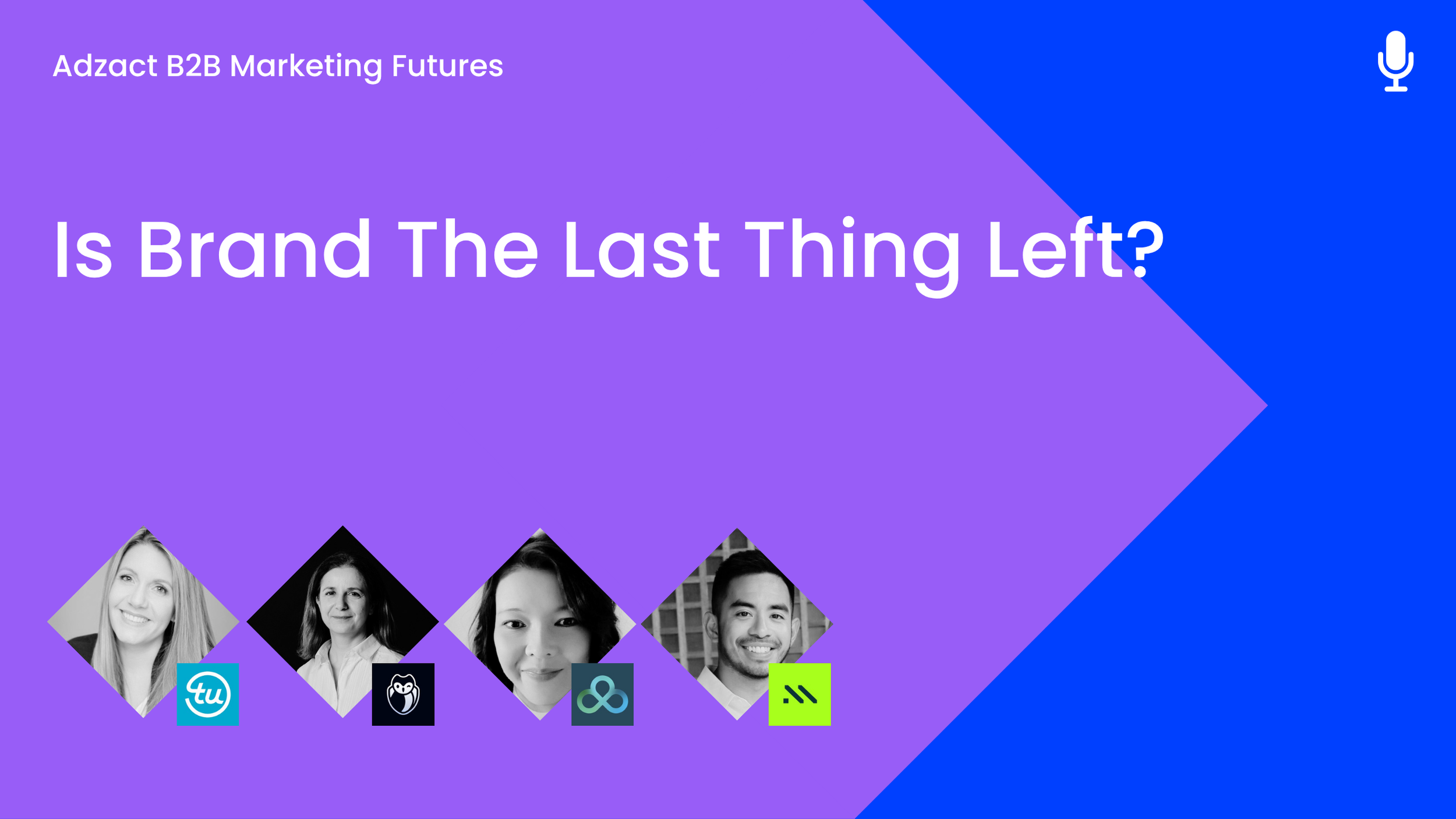
AI now makes it possible to speak directly to every account with 100% personalised pain points. This shift is forcing a fundamental rethink of how we build pipeline and what role brands should play.
We’ll explore:
Are traditional digital ads still relevant in an AI-first world?
Is the art and creativity of advertising under threat, or about to be redefined?
How can hyper-personalisation make marketing more powerful, not less?
Do we need to rethink GTM from the ground up, and if so, how?
Guests
• Allyson Dietz, Marketing Strategy Lead at TransUnion
• Carole Winqwist, Chief Marketing Officer at GitGuardian
• Lauren Luen, Independent B2B GTM Consultant (formerly VP, Growth Strategy & Operations Transformation at EDB)
• Yvo Cortez, Growth Marketing Manager at Middesk
Transcript
Joaquin Dominguez (00:00)
Welcome to another episode of B2B Marketing Futures. Today we are diving into a big and increasing urgent question for modern marketing teams. Is brand the last thing left? As AI continues to automate execution, personalize at scale, and commoditize many of the traditional advantages that marketers relied on, we are entering a world where everyone has access to the same tools, same channels,
and the same capabilities so what actually differentiates companies now? is it still performance, is it data, or is brand becoming the final lever that truly sets business apart? in this episode we'll explore how brand is evolving in the AI driven landscape how organizations are balancing automation with identity and what it really takes to stand out
But before we jump in, I'd love for each of our guests to introduce themselves and share a bit about their background and current focus. So maybe Alison, would you like to start and give a sentence on yourself?
Allyson Dietz (01:07)
I'm Alison Dietz. I lead marketing strategy for TransUnion's marketing solutions business, which essentially means I work with a myriad of teams across things like events and paid media and product marketing. And ultimately, we pull together a plan that helps us to grow our business. So we're focused on growth and B2B marketing. But a little bit about marketing solutions at TransUnion, we
We help our clients understand who their consumers are, how to reach them effectively, and how to measure whether or not their marketing is working. So I get to market to marketers, which is a fun place to be, given the fact that I am squarely in that audience as well.
Joaquin Dominguez (01:47)
really interesting thing thank you so much Alison, Carol, welcome
Carole Winqwist (01:52)
Thank you. I'm Carol Linkvist. I'm the CMO of GitGuardian. GitGuardian is a cybersecurity scale-up. I've been with the company five years and built the company from being 30 people to more than 150 now. So the brand as it is today and all the marketing we've done with the team building this brand across the years has been a great experience.
And in cybersecurity, one important element of a brand is trust. So we can discuss this during the conversation, how you build trust with your audience.
Joaquin Dominguez (02:27)
100 % welcome. Thank you so much. Ivo, welcome.
Yvo Cortez (02:32)
My name is Ivo Cortez. lead growth marketing at MidDesk and I've been in demand gen for about eight years now from different industries and a little bit about MidDesk. So MidDesk is a business intelligence platform. We help banks, fintechs and platforms answer one fundamental question. Can I trust this business? So think about KYB business verification as a background check for businesses that you'll be working with. And trust is everything in this space.
Joaquin Dominguez (02:57)
everything. Well, thank you. Thank you. Great introductions. Lauren.
Lauren Luen (03:02)
Yes, hi, thank you. Thanks so much for having me. My name is Lauren Lewin, folks. I'm a growth strategy and operations consultant helping executive teams turn AI from this buzzword into business outcomes.
Joaquin Dominguez (03:14)
Awesome. Well, great introduction. So thank you. Thank you all. Let's start with the big picture, OK? Because we are seeing a world where AI is making personalization, targeting, and execution increasingly accessible to everyone, right? So in that context, do you think brand is becoming the only true differentiator? And more importantly, what actually is brand in this new environment? Is it?
perception, trust, experience, consistency, something else entirely.
Carole Winqwist (03:46)
GitGuardian has always been edgy in terms of what we are able to activate in terms of personalization. For example, we have our own intent model that we built from scratch some years ago and it was really powerful. But as you say, we see more and more people...
having access through AI to commoditize capacity of personalization. So the question we have asked ourselves late last year was, how do we differentiate? How are we now?
getting the attention. We build the trust already with our audience in our market. think we are seen as a trusted advisor when it comes to cybersecurity and we signed these large accounts. So trust is there, but how do we go and differentiate when for the attention span of our audience? And I think one thing that we determined in there is that human experience is something we have to double down on.
Human to human relationships through events is one thing, but also through white-gloving service across the board. you target large account, this is critical. So we are not shifting, but we are doubling the investment into the tactics that involve human relationship.
to uplift the, on the experience you were mentioning, what is it we want to build is basically as we are a premium solution, we are considered, you know, complex capacity and large accounts. want to build the image that goes with it and the experience that goes with it during our events and during our sales and CSM interactions.
Joaquin Dominguez (05:26)
really interesting topics that you mentioned and we can cover in a second the importance of having a positive experience and perception and building trust as many of you have mentioned. What about the rest?
Yvo Cortez (05:39)
I think when in a world of AI, enabled infinite personalization, automation, think brand isn't just becoming the differentiator. It always has been. Like that brand is always something that, you know, you have to start it early and really establish it before going to market. And I think what AI has done is really removed some of the excuses in my opinion. Like for example, you can't really hide behind a slow competitor anymore. You can't win on just speed alone, right? Like how can you make that personalized touch?
at mid desk, actually, we just went through a full rebrand recently, like a new site relaunch, everything, which was a massive work, on all fronts, but you know, the insight that drove it wasn't just, we need a new look, right? Like we need to stand for something. So like, how do we reframe that? So for example, we land on a tagline of like behind every great, behind every great yes, because what we do isn't just business verification or KYB at mid desk. You know, it actually enables like our products enables.
the decisions that let good businesses grow. So how do we change from like, okay, this is what we can resolve versus like, this is what we can launchpad for everybody else that we really would work with. So I think brand has always been there, but more like how does AI influence the speed of it? And also the quality that you can really bring because everyone has access to same tools all about how you use it.
Allyson Dietz (06:55)
It's really interesting to hear what you said. I saw your rebrand, Eva. It looks really great. So I'm glad you mentioned it, because I thought it looked really amazing. But I think hearing what you said, Carol, about the human touch and the one-to-one, events is such a big part of how we show up in B2B. It's a key component, a key channel that we leverage for exactly that reason that you described, Carol, which is we have to have these
interpersonal relationships that helps to drive a lot of growth, particularly with known customers. We find that that really works well for us with people that know us. So brand is actually one of those components that helps to enable success both in paid media as well as in events for us because it helps lay that foundation so that we show up more effectively in all of our channels. You one of the things that you haven't touched on either, one of you necessarily is the fact that yes, AI is here. Yes, AI is the shiny new object.
But the reality is, is you can't really take advantage of those AI capabilities unless you have your data house in order, unless you have your data interconnected and you have that singular view of who your customer is and can better understand who that customer is. Otherwise, you're duplicating your efforts and you're not necessarily taking full advantage of the AI capabilities. So, you we talk a lot about that internally. We've been on a long journey. I call it a marathon, not a sprint. For those of you maybe who are thinking internationally that what we really mean by that is that
It takes time, it takes patience, and it takes a lot of effort to get that data house in order. And we've been, I would say that journey is still ongoing, but it is something that we also coach our clients around, is being able to better understand who that consumer is, who that customer is, and being able to connect the dots across your data ecosystem really helps you to take full advantage of AI capabilities.
Lauren Luen (08:39)
Alison, 110 % agree with that. I'd say the last two years of my life has been getting data houses in order and laying that foundation for AI to be impactful. But if we look at about, we have so much more available to us now, we can do so much more once that data is cleaner than it used to be, it's never gonna be perfect. But it's what can we do with the branding now? I think there's so much more potential with branding to make it personalized and reach the right people, right place, right time.
We've always done that, but I'd say it's probably about 70 % of the way there. Messaging will be right, but I'll be reaching the right people at the right time with the right personalization, that right nuance. Now we can really almost get to that 90%, 95%. So it's really, really exciting now once we have that foundation laid to say, brand's not the only differentiator and AI can do so much more for it, we have homework to do before we can actually jump to saying, oh, let's put AI on.
Allyson Dietz (09:37)
I love that. We have homework to do. I 100 % agree.
Lauren Luen (09:38)
Yeah.
With marketing, my take has always been efficiency before efficacy. was probably one of the first functions within the organization to really be impacted by AI. you put the cart before the horse, and you've got to take those baby steps and build slowly and progressively.
Yvo Cortez (09:57)
And also just to add onto that really quick, Like just how marketing has shifted the past few years in a way, this line is floating around everywhere, more with less. But then again,
Lauren Luen (10:06)
Thank
Yvo Cortez (10:07)
like when you think about do more, especially with AI, it's like, like you guys all mentioned, we have to do our homework now because with more capabilities, we really got to have that focus and using AI to kind of really hone in and like, are the right initiatives that we really need to do that we can scale and do everything else with?
automation, personalization, but having that true north to begin with, because I feel like not everyone's always thinking about, or not having full alignment across the board.
Joaquin Dominguez (10:33)
Yeah, believe like consumers, the only thing that they own in their head is the brand. Like they don't care about procurement or like how you are doing things inside, right? They only care about the brand. And if the brand is how you use human, how your employees communicate with the external world, I think then you need to put a lot of effort in that.
in all the other processes as well. And many times we forget that the brand is the sum of all the parts in a business. And I would love to hear how have you seen brand evolving in your organization over the past few years? Have you seen a shift from performance-led marketing towards something more holistic? And how does brand show up today in your strategy to say, I don't know, two to three years ago?
Allyson Dietz (11:32)
can go first. sounds like everyone has sort of perspective on this, but TransUnion, we've been historically known as a credit bureau. So for those of who are familiar with us, most people know us as a credit bureau, but we offer a lot of different capabilities under that umbrella of TransUnion. And in particular, my focus is on the marketing solution space, as I said. So if you think about a company like TransUnion where it's in the financial services space, it's a credit bureau,
Words like brand awareness as a KPI is not seen as taken very seriously because it doesn't talk about things like performance and sales growth and revenue growth. So talking about brand, can be a little bit taboo within our organization and has been. So we've had to go on a long journey to help understand the fact that, help our leadership understand that brand can be really the infrastructure that enables growth.
So we don't really focus on it just being about awareness, but more so how that awareness ultimately drives and signals leadership in the category, and therefore also then helps us to drive the growth that we're expecting. So if we've repositioned TransUnion beyond that credit bureau space, we've really been focusing on things like building trust and familiarity across all of our capabilities.
so that we show up in a way that our audience thinks of us and considers us when they're making decisions about investing in marketing solutions, as well as things like fraud solutions and other capabilities that we have under our umbrella. But it really means that we've had to think about what paid, owned, and earned channels that we're really investing in to help signal that leadership, help to signal that presence, and really focusing on the fact that brand helps us to then ultimately drive more
lead gen and then ultimately revenue growth and showing how that funnel kind of pulls, how we pull brand and grow through that funnel. That really helps us to signal internally that brand is a key component of our success.
Carole Winqwist (13:22)
to double down on what Alison says, I think I come from maybe a bit of a different world than, than being in a small company at the beginning. And then we're scale up. Brand has usually been over. I mean, it's an oversight for many companies that have a strong product. think, okay, my product is enough, right? I don't need to build a brand. And it's a mistake that a lot of startup do that. They don't invest from day one on the brand.
And it's fine until they need it, right? Until they go big enough to, basically have to defend the brand and have competitors who are stronger and have invested in the brand. So my take on this is always when I advise some of the CEO of startups is always have faith. And because for me, brand investment is kind of a...
Faith. It's difficult to prove your brand's impact. We're not, mean, in small company, you're not going to run, you know, measurement of brand awareness. It's too expensive and we're not in a B2C world where we do, you know, like,
panels and stuff like that. don't, we have proxies to measure the brand power. But one thing that is sure is that if you don't invest in brands, you pay it at some point. And also it's a long run, right? It's what Alison was telling. It's such a long run investment and you have, the proof is coming years after years because people, your inbound will grow steadily because people will
refer yourself and be proud to refer to their peers. And in the P2E world, it's critical, but you don't measure it with one item. You measure it from different little, I would say, signs. And having, you know...
convincing the decision makers, the CEO of your company that brand is really an important investment. Day one is critical, I think, for all company growing fast so they don't realize too late that they under invest.
Yvo Cortez (15:20)
Yeah. And if I may just chime in as well, kind of following up to everything that Alison and Carol mentioned. know, like thinking of brand of like, not just a nice to have, but it's just clever. And also kind of thinking about all the other touch points of brand, right? So it's not always about, Hey, we have a new brand. This is it. We're launching it upfront for everybody, but more like what is that identity that we really stand for? So as Alison mentioned, when we show up to events at Middesk, we had a huge kind of like presence at Money 2020 last year, for example, and really making that impact of
Not just saying, Hey, here's a booth and experience and talk to us about our products and solutions, but here's kind of a lifestyle. Here's kind of introducing a new way to think about, Hey, trust is something that you build with your prospects, customers and your clients, but also trust is something that kind of creates because we create that environment to be welcoming. So by showing, for example, like our booth last year was some couches, some merch on there, really just showing like where our hubs are and just really showing that impact of who our identity is.
You know, when I first joined MidDesk, we're kind of leading, we had a pretty clear product market fit, value propositions, and really honing in on the different capabilities that our products kind of provide, like all the sources of data, real time updates, et cetera. But then we kind of shifted to like, not just what our platform does, but here's kind of what's possible when you trust a business identity. So kind of pushing onto this idea, not just the capabilities, but also like who we really are. And I think if you get ahead of that, like everybody else mentioned,
we kind of get to own that narrative and kind of our identity of who we are, who we're perceived as versus if you kind of establish a brand too late because you have a strong product, then at that point, you don't really have control like what the perception is and who they think you are. So by having that agency from early on can really just establish and make it stronger. And as Alison mentioned, it's a long-term investment, right? So you bet we better make it right the first time or else it'll be harder to shift anything down the line once the market has kind of established who you are.
versus you as television to yourself.
Joaquin Dominguez (17:16)
let's shift into one of the biggest tensions marketers are dealing with right now which is personalization at scale because with AI you can do personalization at scale and versus brand consistency
Because
with the ability to create and distribute content at massive scale, how do you ensure that your brand remains coherent, distinctive, meaningful? Where do you draw the line between automation and human control?
Carole Winqwist (17:46)
That's a tough one, yeah. I mean, for me, personalization doesn't mean that you transform yourself to please the person, I mean the audience. It's not that. For me, personalization is how you talk about what the person is interested in, but through your own brand prism, right? So you're not...
Acting, you're not an actor that change roles each time you talk to a different person. You're the same person, but you just talk to the topics that interest people. if I take our audience, for example, we have three types of personas. We talk to AppSec leaders, to IAM identity leaders, and to development CTOs.
For those three, we are still the same brand, are still the same value proposition in terms of the high level value proposition. What we will do is use the right words, use the right pain points or the I would say, agenda of these people, but always with the same positioning and messaging at the top.
So I think it's not for me, hyper personalization should not be endangered, putting in danger the consistency of the brand. If you do it correctly, of course, if you transform your, your, your messaging and positioning each time you talk to a different persona, then you make a blurry and nobody knows who you are in the end. So that's not what I would recommend.
Joaquin Dominguez (19:20)
Isn't the same problem of doubling down on humans and the experience, Carol, that you mentioned at the beginning, right? Because if you really rely on your people and if you don't train your people, then the process is something that is a gamble and you only rely on charisma and only rely on things that you can't manage. However, if you truly invest on your people, then of course you can get results that are more predictable.
I believe with
Allyson Dietz (19:49)
Thank you.
Joaquin Dominguez (19:49)
AI it's a similar thing, don't you think?
Lauren Luen (19:52)
I much agree. think Carol hit it when she said personalization is a sub-segment of branding. Branding typically, it should draw the boundary around the tone, the mission, the values, the value prop. And then personalization is, not every single facet of your branding will be relevant for each buyer. So just hit on those facets that really will get their top pain points, whatever it may be.
company and brands tone but maybe it's you know shifting to language that's a little bit more technical, less technical, whatever the role may be. branding is that overarching guideline or boundary and then the personalization is giving you that leeway to play within that boundary to make your messaging and make you more relatable to your audience.
Allyson Dietz (20:40)
So our current campaign is this campaign we've called Bring Clarity to Chaos. So in the marketing ecosystem, you probably feel this as marketers yourselves, there's a lot of chaos, AI and data fragmentation and a lot of things we've actually been talking about already, building brand and managing performance, all those things. So our current campaign for marketing solutions at TransUnion is really this idea of being able to bring clarity to chaos.
I mentioned that because at the top of the funnel, we're still messaging around that. And I think I mentioned that already, which is we're spending a lot to signal leadership to our potential customers and to the buying center. Because we know from some data LinkedIn's published in the past that 81 % of companies choose the brand that they know when they're making B2B decisions.
you don't want to get fired from making the wrong choice. So we're really spending a lot to try and drive that trust and that relationship and that confidence at the top of the funnel. Where we start to personalize is at the bottom of the funnel. So still keeping that campaign of bring clarity to chaos. But to your point, Carol, if we're talking to somebody who is a data persona or an analytics persona or a marketing or someone who's in charge of media spend, we might tweak what we're saying or what case studies or what content is showing up at the bottom of the funnel.
in order to personalize for their needs. But at the top of the funnel, it all kind of runs through that Clarity to Chaos sort of messaging so that it's from top to bottom, a similar story that you're hearing from the brand.
Carole Winqwist (22:05)
But back to your Jera, back
Allyson Dietz (22:05)
And we're seeing
Carole Winqwist (22:07)
to your point on human thing.
I think it's really important for a company to keep their DNA. mean, their values and their culture. And that's why we pay a lot of attention when we hire people that they fit within the DNA and the mindset because yes, they are representative of the company outside. when they interact with people, are, I'm always telling the new people when they come up, I'm saying it's so long to build a brand. It's so fast.
to destroy it. So please, please, please, as an individual guardian, you need to make sure you protect the brand and you build the brand and you respect the brand each time you use, for example, basic thing, each time you use a presentation deck, even internally, use a template. Don't invent. not, you're not, you know, you're not a designer. You're not good at this. I'm not good at this. have designers, they built beautiful slides. Use it. You know, that's basic things, but just showing that.
we need to respect the brand as an entity. for me, it's an asset that it's the crown jewels of the company, right? We need to build it and we need to make it grow and be proud of it because that's part of how we are envisioned from the outside, what the experience is working with us, right?
Everyone in the company should build it and should cherish it, basically.
Yvo Cortez (23:33)
Yeah. And also I just, love how everyone kind of touched on like really upskilling our internal like talent and also like within people within the organization. And that's actually something that we're doing really well at Middesk in my opinion is because for example, like we're using Claude skills, like really a big time all over the place, but we actually create specific skills, for example, external brand voices and really taking a lot of our positioning, how we present ourselves. So the second we go externally, everyone is equipped.
with the same exact framework. So by having that consistency, we really get to protect, like what Carol mentioned, really protect that brand. Because I really look at brand as kind of the identity, and personalization is that relevance. So it's kind of what Alison was touching on, depending who you're talking to, the core stays the same, but approach might be different towards the bottom of the funnel, because that's where it really matters most. We really capture their attention. And also when it comes to kind of thinking about all these different signals of personalization is that when we kind of
try to prove the impact of brand, as many say, like there's a lot of different metrics you can look at, right? There's so many different things that people can use to analyze. But when we look at kind of a multi like multimedia, modeling of just seeing like, where do these different touch points? Hey, we might be just launching a brand new product or feature, but the way we come out to market with that is like saying, Hey, look at all these use cases for specific industries and whatnot. But if we see a particular prospect or customer really engaging with that.
that sense of signal is like, hey, let's reach out to them and just have that conversation. Let's just ask, what are their pain points? Like, how can we shift and really further evolve what we have to really tailor for what they need while also still thinking of things at scale, but that's more like the personalization level. Everything is still within the guardrails of the brand. So staying consistent and keeping that identity really true.
Carole Winqwist (25:19)
I was just thinking what Eva was saying. I didn't think about that, but now you say it. realize it's totally true. Maybe AI is going to help us having a more consistent brand because of all the usage of these agents that will be skilled within the tone, within the right ways and everything. Even maybe.
Are we going to, yes, we're going to be more consistent. And at some points I wonder, are we going to be able to evolve the brands because we are going to be following such a, you know, established framework. Will it let the evolve coming? So maybe that's another angle that will eat, you know, the opposite of rich, right? It will go.
Will it be able to evolve still because of these guardrails? That's also a good question, I think.
Lauren Luen (26:09)
I think Carol, if anything, AI will force branding to evolve. Because I love that you have Claude skills for your branding. think being able to develop the Claude skill for your brand forces teams to sit down and ask some of those very nuanced questions about the brand. Traditionally, there are multiple facets to the brand. But a lot of times, it's kind of close enough.
you know, interpreted it. We'll nail one thing, you know, 80 % of the way, but that doesn't work for AI. We have to put it in black and white. You know, it's this, not this. It's that, not that. So I think it will force us to have these conversations to work out every minor detail. Some don't need to be worked out, but to say it is exactly these three things, these four things. And I think it's going to open up the question to get that one level deeper, Carol, to say,
How do we need to evolve? Or do we need to slightly away from something that we were doing before? Do we need to double down somewhere? Do we need to take a new approach? I think there'll be some great conversations coming out of this just to iron out those details. So we can.
Allyson Dietz (27:19)
And that
actually makes me think it's even more important to have that feedback loop, Lauren. What you're describing makes me think that that's even more important to, you know, find the KPIs, find the ways to measure success. Otherwise, you'll be in a position where you're not aware whether or not it's time to change because you just, you've basically said it and forget it is what it sounds like the opportunity is right now with AI. But we have to make sure that we.
evolve to Carol's point and then we have to find ways to evolve. And the only way to do that is if you have that feedback mechanism to ensure that you know it's time to evolve.
Yvo Cortez (27:55)
Yeah.
Lauren Luen (27:55)
Yeah, because traditionally
Carole Winqwist (27:55)
Mm.
Lauren Luen (27:56)
we've been pretty bad about it. There has to be an event that's triggering this evolution of is there a brand launch, a product launch, something's happening in the market. Other than that, there isn't typically that continuous monitoring of things are going trending up, trending down with respect to all the brand indicators. So 100 % agree with
Yvo Cortez (28:18)
Yeah. And also I love that everyone kind of touched on at the end, they write like, need to keep training the AI models or whatever we're using, because to what Carol mentioned is like, yeah, that is a good point. Like in a way you can be cornered into stagnant, like by not being dormant and not growing. But I think that burden really falls on our organizations to see, are we happy with this? Or like, do we get new feedback and really feed it every time? And I think that also goes back to training everyone to organization is that, Hey, have a growing mindset. Like just because you had something.
pumped out on AEI doesn't mean it's good to go to ship. You know, and also kind of have that same exact mentality when it comes to just growing the narrative and growing the brand in general of like every time new things come up or new feedback or new insights of how customers are getting success or what's not working with them or what type of messaging has been landing or really talking to sales like, what's their outreach that they're looking with their sequences? What's working? What's landing? What isn't landing from the new branding? What are they using from new branding? What's being picked up by the market really just
having that open feedback and keep feeding that to everything that we're using because at the end of the day, if you don't grow and don't excel, you're going to be left behind. And once you're left behind, it's going to be hard to catch up because everyone's
Carole Winqwist (29:27)
Hmm.
Yvo Cortez (29:28)
so fast with all the tools we have.
Joaquin Dominguez (29:29)
Yeah, and I believe AI could augment good things. For example, you can send 100 emails before AI. If you could send 100 now with AI, you can send 1 million emails or thousands of them. If the emails are good, amazing, but if they are bad, you can really damage your brand reputation, right? So having those feedback loops, guardrails, whatever, like whatever good management you can have and good thing, as you mentioned, Lauren, as
Maybe AI is pushing us now to have good management in place. Otherwise, you can really damage your brand reputation.
Carole Winqwist (30:06)
Yeah,
and one thing I think we should never forget is the craft. it's not because we get automation that...
I mean, if I take the image of, you know, industrialization, this is not because we have the machines that we should produce crappy goods, right? And it, is what happened with industrialization. And I think in our world, that's not where we want to go. At least not me. I don't want to go there in commoditization of my, my, my tooling and my campaigns. want to use the automation to augment my craft and have something even or.
precise even more to the point rather than volume. So yes, it might help on volume for some industry, but in B2B enterprise, volume is never a good decision, I think.
Lauren Luen (31:03)
I agree, you AI use the AI to get that first draft to get you 80 % of the way, but then it has to be as that it's your craft. It's your experience. It's very nuanced in B2B. You need that experienced human being, the professional who's done this, who knows to say, you know, this minor tweak here, this is what's going to really make or break. I don't ever see that. think AI is
pushing us to really focus more on the value added tasks of very nuanced having that final review, making those edits. But let's make the tools work for us and let's make them do all the groundwork, churn out that first draft, happy to look at that and then move forward from there.
Yvo Cortez (31:46)
Exactly. Kind of like I'm thinking
Allyson Dietz (31:47)
Yeah.
Yvo Cortez (31:48)
of AI as a supplement or like an enhancement, not a replacement.
Lauren Luen (31:52)
Mm-hmm. And all the vent, yeah. 100%.
Allyson Dietz (31:54)
I think you have to have a clear strategy on how you want to use it. Because I think what you're describing, Carol, I couldn't agree more that just because you're saying more doesn't mean that that's better. know, we've our first investment has really been on the content front, for example, from an AI perspective, because it allows us to take a lot of those brand standards that we were talking about, our current narrative, so all the things that we've documented and build more context that has historically been a bandwidth limitation for us.
But just because you're saying more doesn't mean that you're getting better. So you have to really be clear as to what is it, where do you want to leverage the AI capabilities and how do you really mean something to your audience and have that sort of relationship that you were talking about earlier in terms of the human to human relationship. How do you ensure that people know that you exist, play in this space and you're the right choice for their needs? In order to do that effectively, you have to make sure that you're saying something meaningful and you're actually.
just because you send a million emails, you don't necessarily know that you're gonna get a million emails opened. It doesn't mean that you're necessarily gonna get more emails open. So you have to find a way to still have the craft and use the AI to help, as you said, an enabler, not a replacement for what you're trying to achieve.
Yvo Cortez (33:05)
Yeah. And also just to add onto that too, think Alison, you touched on it. It's just because you're doing something at scale doesn't mean it's what works. You know, let's take an example, like even SEO, like SEO shifting with AEO, GEO, everything you kind of mentioned. And, you know, a company can make with AI a thousand articles that hits on all the search keywords that you need. But then just because you get that traffic, organic traffic to your site, but it's not connected to your products and the intent, it doesn't matter.
Right? Like
Carole Winqwist (33:33)
Yeah.
Yvo Cortez (33:34)
for example, like I can have an article saying, Hey, this is what everybody in the financial industry needs. But then if it's not clearly tried to our brand, to our products, to our solutions, we're getting the traffic. We're getting that top of funnel metrics fluff, but then we're not getting the conversions down funnel because there's no quality there. It's all quantity. It's all massive scale, but we're not connecting the dots. We're not really creating a cohesive story or a journey for them to really like, even if they don't know about.
just even creating that awareness consideration, just really moving down the funnel. So, you know, I think AI can have that scale and the quantity, but the intent still comes from a human touch point. Like we're the ones kind of tasked with making sure, stitching the whole journey together, that we do have an angle for them. And even if they get to that conversion, we're still there to like prime them, nurture them, upsell, cross all, whatever it may be. But I think just because the audience doesn't
Carole Winqwist (34:23)
Yeah, we
Yvo Cortez (34:25)
know the answer.
Carole Winqwist (34:25)
still have to convert. I think I read this. This is like the classic statistics, but we still have to convince the 5 % that are in the decision process, right? The 95 % of the market, they're just not even looking around or, you know, they're there. Just you need to work with them on a different type of brand messaging than the 5 % that are ready to buy.
And our work is really to be able to address both audience, right? The one that are ready to buy, we need to be very precise, very everything. And then the 95%, the brand role is different, is we need to be top of minds for when they are in the 5%, they just contact you and it's an inbound, right? So.
It's always trying to invest short term, 5%, long term, the 95%. And what do you put in place with your campaigns and your messaging that address both categories of the market? And it's not easy, but it's not new. it's always been the case. think it's just, have different, now we have different tools and different ways of addressing those two categories.
and probably the capacity to do it better, I think.
Allyson Dietz (35:43)
Mm-hmm.
Joaquin Dominguez (35:43)
Yeah, I think
Allyson Dietz (35:43)
Well said.
Joaquin Dominguez (35:44)
being focused is so important, right? It's so easy to get distracted with AI and trying to do more. And at the end of the day, we need to focus and learn from our current clients. I think that's the most important thing. I think there is the answer for everything. You need to listen to them, build your product around them, and then look and find your ICP and your total addressable market and...
100 % agree with you, Carol. There is 95 % of your total addressable market that are not even aware that you exist probably. So you need to build that round awareness to then focus on the ones who are ready to buy.
thank you all so much for this conversation. I think it's clear that while technology continues to evolve, the fundamentals of differentiation, trust, clarity are becoming even more important today. I think if there is one takeaway is that brand is no longer just something on top of marketing.
is the core of how companies compete and thank you again for joining our panel it was great having you and for all the ones listening we'll see you in the next episode of B2B Marketing Futures